Chicago Stories
The Daring Feat of the Auditorium Building
Clip: 10/16/2026 | 5m 2sVideo has Closed Captions
When the Auditorium Building opened in 1889, it was the tallest building in Chicago.
When the Auditorium Building opened in 1889, it was the tallest building in Chicago. Engineer Dankmar Adler and architect Louis Sullivan had one major challenge from the start: A 16-story building of this size would require lots of support.
Problems playing video? | Closed Captioning Feedback
Problems playing video? | Closed Captioning Feedback
Chicago Stories is a local public television program presented by WTTW
Lead support for CHICAGO STORIES is provided by The Negaunee Foundation. Major support is provided by the Abra Prentice Foundation, Inc. and the TAWANI Foundation.
Chicago Stories
The Daring Feat of the Auditorium Building
Clip: 10/16/2026 | 5m 2sVideo has Closed Captions
When the Auditorium Building opened in 1889, it was the tallest building in Chicago. Engineer Dankmar Adler and architect Louis Sullivan had one major challenge from the start: A 16-story building of this size would require lots of support.
Problems playing video? | Closed Captioning Feedback
Where to Watch Chicago Stories
Chicago Stories is available to stream on pbs.org and the PBS app.
Chicago Stories - New Season!
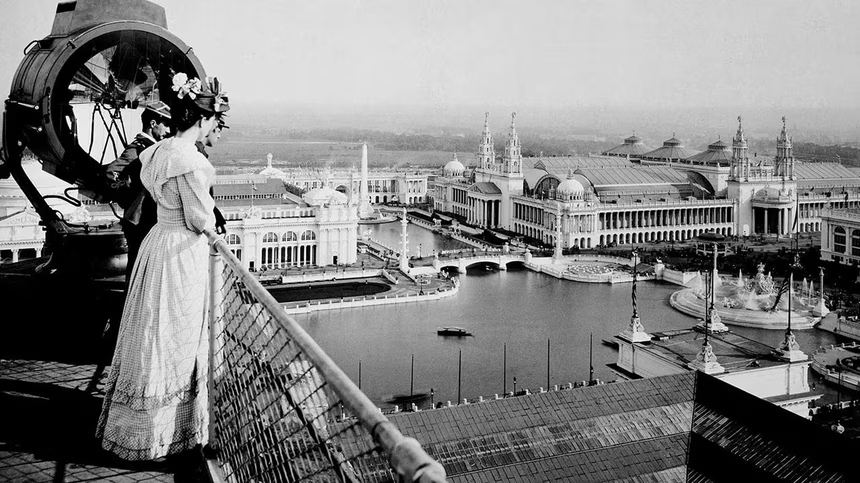
Season 6 includes: The World’s Fair of 1893, Toy Town, Skyscrapers, and Home of the Irish.Providing Support for PBS.org
Learn Moreabout PBS online sponsorship(gentle music) - [Narrator] In 1889, when the auditorium building first opened its doors, it was the largest building in the country.
- The auditorium was the great monument of Chicago, of this era.
- [Narrator] It was the dream of a young Chicago-born opera lover and philanthropist, Ferdinand Peck.
- He was the son of an old Chicago family, and he had these high ideals and ideas for the city.
- [Narrator] Peck believed a grand music hall could help heal the city in a time of violent labor struggles.
If he kept ticket prices low, the working class could sit next to the elite and find common ground in their shared appreciation of high art.
- There was this sort of cheeky article that was written for the New York Times saying, you know, what does Chicago need?
A beautiful theater like this for, you know, it is of wolves and bears out there.
- [Narrator] To support his opera house, Peck proposed something unheard of, a block-long multi-use complex that included a hotel and rentable office space.
But when Peck chose the upstart architectural firm of Adler & Sullivan for a project of this scale, eyebrows were raised.
(gentle music continues) - This relatively small and inexperienced firm, what had they built up to that time?
Loft buildings, small residences.
- [Narrator] German-born Dankmar Adler was a successful engineer and theater designer.
His much younger partner, Boston-born architect Louis Sullivan, however, was another matter.
Though he was considered a visionary, Sullivan could be temperamental and erratic.
- He really needed Adler, the engineering partner in the firm, to kind of balance him and to turn those ideas into practical realities.
- [Narrator] Adler's biggest challenge?
Chicago's bedrock sits so deep, 80 to 200 feet down, that digging to it was financially out of the question.
(gentle upbeat music) - Chicago is probably one of the worst places in the world to try to build a tall building.
We are on the shore of a very big lake, and for the last 10,000 years or so, the soil here has just gotten saturated.
- Engineers have a drive, thankfully, to make the most effective and efficient structure that you can, to hold up anything.
- They actually figured out a way that's almost like a raft floating on the ocean, to do it, and it actually worked.
- [Narrator] The innovative foundation was a concrete and steel slab that spread the building's enormous weight evenly, and sat just 14 feet down in Chicago's soft clay.
- And the raft foundation included a pyramid, and that essentially floated on that sea of mud.
Just imagine you're the contractor, you're building the auditorium building, and you have to account for the fact that it is going to sink a little bit.
And so you build it a certain level, two feet above the sidewalk, let's say, and then you're hoping that it's going to gently settle down to sidewalk level by the time it's done.
- [Narrator] Peck was obsessed with owning the tallest building in the country, and demanded a 17th story be added to the tower.
- Dankmar Adler told the client, "Your tower is going to sink into the ground."
They went ahead and built it.
- [Narrator] After three painstaking years of construction, Adler held his breath as the overloaded building finally settled, unevenly.
- You walk into their lobby and put a marble and, you know, kind of watch it roll as the building has started to settle.
- When you walk into the auditorium today, you walk down two or three steps instead of up.
(gentle inspirational music) - [Narrator] Despite these failings, the auditorium building put Chicago on the map as more than a place of stock markets and stockyards.
It was now a place of high culture.
- It was the building in Chicago that probably made New Yorkers jealous in a way that almost nothing else would have.
- [Narrator] It's crown jewel?
A dazzling 4,237 seat theater where Sullivan's talent for ornamentation inspired by nature was on full display.
- This wonderful space just opens up before you with the lights agleam.
The acoustics were perfection.
- Here we are just a decade after the great fire, and this wonder has appeared.
 New
New10 Unsung Heroes of the Chicago Skyline
Video has Closed Captions
Explore 10 skyscrapers that deserve more attention, from Art Deco gems to modern towers. (5m 37s)
 New
NewJeanne Gang’s Mark on the Chicago Skyline
Video has Closed Captions
Architect Jeanne Gang has added two distinctive buildings to the Chicago skyline. (5m 58s)
 New
NewJohn Moutoussamy and the Johnson Publishing Building
Video has Closed Captions
The Johnson Publishing building was the first high-rise in Chicago designed by a Black architect. (3m 4s)
 New
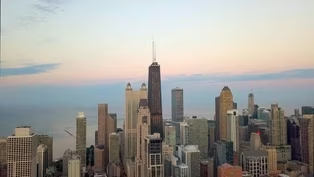
NewThe Rocky Rise of Hancock Tower
Video has Closed Captions
The John Hancock Center was one of the city’s most improbable success stories. (6m 36s)
 New
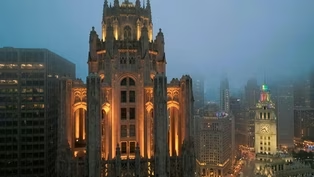
NewThe Wrigley Building and Tribune Tower
Video has Closed Captions
Across Michigan Avenue from one another are two Chicago icons. (4m 50s)
Providing Support for PBS.org
Learn Moreabout PBS online sponsorship










Support for PBS provided by:
Chicago Stories is a local public television program presented by WTTW
Lead support for CHICAGO STORIES is provided by The Negaunee Foundation. Major support is provided by the Abra Prentice Foundation, Inc. and the TAWANI Foundation.