Chicago Stories
John Moutoussamy and the Johnson Publishing Building
Clip: 10/16/2026 | 3m 4sVideo has Closed Captions
The Johnson Publishing building was the first high-rise in Chicago designed by a Black architect.
When the owner of the Johnson Publishing Company – the company behind Ebony and Jet magazines – set out to make his new headquarters, he hired John Moutoussamy. He would design the first high-rise in downtown Chicago created by a Black architect.
Problems playing video? | Closed Captioning Feedback
Problems playing video? | Closed Captioning Feedback
Chicago Stories is a local public television program presented by WTTW
Lead support for CHICAGO STORIES is provided by The Negaunee Foundation. Major support is provided by the Abra Prentice Foundation, Inc. and the TAWANI Foundation.
Chicago Stories
John Moutoussamy and the Johnson Publishing Building
Clip: 10/16/2026 | 3m 4sVideo has Closed Captions
When the owner of the Johnson Publishing Company – the company behind Ebony and Jet magazines – set out to make his new headquarters, he hired John Moutoussamy. He would design the first high-rise in downtown Chicago created by a Black architect.
Problems playing video? | Closed Captioning Feedback
Where to Watch Chicago Stories
Chicago Stories is available to stream on pbs.org and the PBS app.
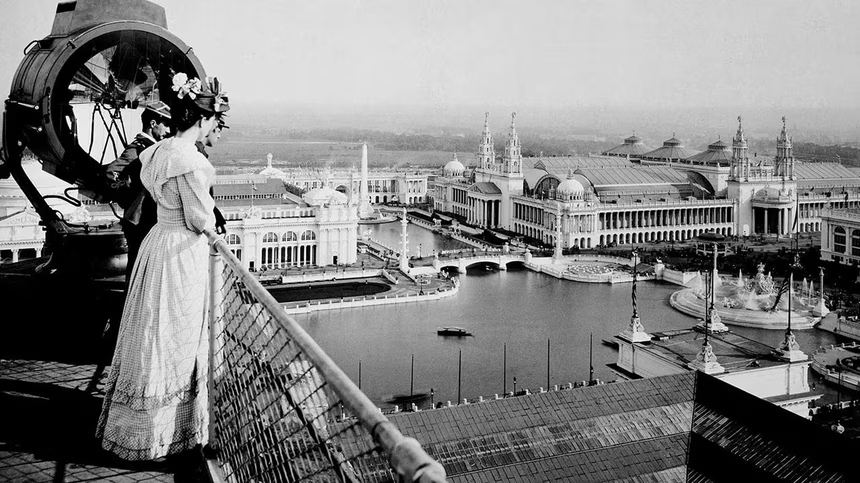
Chicago Stories - New Season!
Season 6 includes: The World’s Fair of 1893, Toy Town, Skyscrapers, and Home of the Irish.Providing Support for PBS.org
Learn Moreabout PBS online sponsorship- But another of Mies's students, John Moutoussamy, would challenge norms in a very different and more permanent way.
- The skyline is being shaped entirely by white men.
John Moutoussamy, interesting fellow, he's Black, you know, at a time when licensed Black architects were a rare thing.
- John Warren Moutoussamy was a veteran of the Second World War.
The GI Bill opened the door to architecture for the South Side native, but opportunities to prove himself were hard to come by.
- His race didn't make him any less talented.
His racism that saw him less valuable.
- Moutoussamy's moment came when publisher John H. Johnson wanted to build new headquarters for his growing media empire, anchored by Ebony and Jet magazines.
- These are magazines that they published that really heralded the arrival of black people.
- It was the chance of a lifetime, but the $8 million price tag brought skepticism from banks uncomfortable with Moutoussamy's leading role, despite him being the only black partner in an all-white firm.
- John Johnson talks about this in his autobiography.
He says, "If I can't hire a black person to design this building, then what's it all about?"
So he presses and he presses.
- Moutoussamy got the commission and the financing.
He embraced modernism's clean lines and lack of ornament.
Clad and walnut travertine stone, the building projected strength, sophistication, and black excellence.
- Moutoussamy's design very elegant.
He recesses the windows off Michigan Avenue, which provides some shading.
So he's thinking about shading and daylighting a generation before most of us did.
- When it opened, it became the first high rise in downtown Chicago, designed by a black architect.
- This building says, "Man, we've arrived."
Local dignitaries are there like Mayor Daley and Jesse Jackson.
Everybody starts to show up.
Henry Fonda, John Lennon and Yoko Ono, Ossie Davis and Ruby D. It becomes this kind of happening.
Everybody wants to see this building.
- This is a critical building in black culture in the city of Chicago and in architectural history.
- Moutoussamy's legacy endures in a city where skyscrapers are not just symbols of wealth and innovation, they are mirrors of society and who gets to be seen.
- Oftentimes the young folks that I work with, mostly brown and black students, don't think that the super talls or the new buildings are for them.
Having diverse people designing buildings and shaping the fabric of our city is critical to be able to tell a full and holistic story of the people who live there.
 New
New10 Unsung Heroes of the Chicago Skyline
Video has Closed Captions
Explore 10 skyscrapers that deserve more attention, from Art Deco gems to modern towers. (5m 37s)
 New
NewThe Daring Feat of the Auditorium Building
Video has Closed Captions
When the Auditorium Building opened in 1889, it was the tallest building in Chicago. (5m 2s)
 New
NewJeanne Gang’s Mark on the Chicago Skyline
Video has Closed Captions
Architect Jeanne Gang has added two distinctive buildings to the Chicago skyline. (5m 58s)
 New
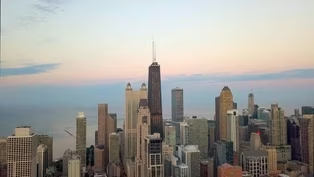
NewThe Rocky Rise of Hancock Tower
Video has Closed Captions
The John Hancock Center was one of the city’s most improbable success stories. (6m 36s)
 New
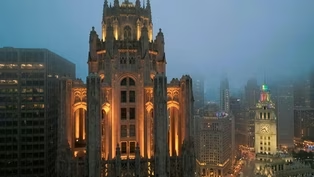
NewThe Wrigley Building and Tribune Tower
Video has Closed Captions
Across Michigan Avenue from one another are two Chicago icons. (4m 50s)
Providing Support for PBS.org
Learn Moreabout PBS online sponsorship







Support for PBS provided by:
Chicago Stories is a local public television program presented by WTTW
Lead support for CHICAGO STORIES is provided by The Negaunee Foundation. Major support is provided by the Abra Prentice Foundation, Inc. and the TAWANI Foundation.