Chicago Stories
10 Unsung Heroes of the Chicago Skyline
Clip: 10/16/2026 | 5m 37sVideo has Closed Captions
Explore 10 skyscrapers that deserve more attention, from Art Deco gems to modern towers.
Chicago’s skyline is full of famous architectural superstars, but plenty of other towers deserve the spotlight. From Art Deco icons and historic skyscrapers to sleek modern towers, discover 10 Chicago buildings with fascinating stories, striking details, and unexpected connections.
Problems playing video? | Closed Captioning Feedback
Problems playing video? | Closed Captioning Feedback
Chicago Stories is a local public television program presented by WTTW
Lead support for CHICAGO STORIES is provided by The Negaunee Foundation. Major support is provided by the Abra Prentice Foundation, Inc. and the TAWANI Foundation.
Chicago Stories
10 Unsung Heroes of the Chicago Skyline
Clip: 10/16/2026 | 5m 37sVideo has Closed Captions
Chicago’s skyline is full of famous architectural superstars, but plenty of other towers deserve the spotlight. From Art Deco icons and historic skyscrapers to sleek modern towers, discover 10 Chicago buildings with fascinating stories, striking details, and unexpected connections.
Problems playing video? | Closed Captioning Feedback
Where to Watch Chicago Stories
Chicago Stories is available to stream on pbs.org and the PBS app.
Chicago Stories - New Season!
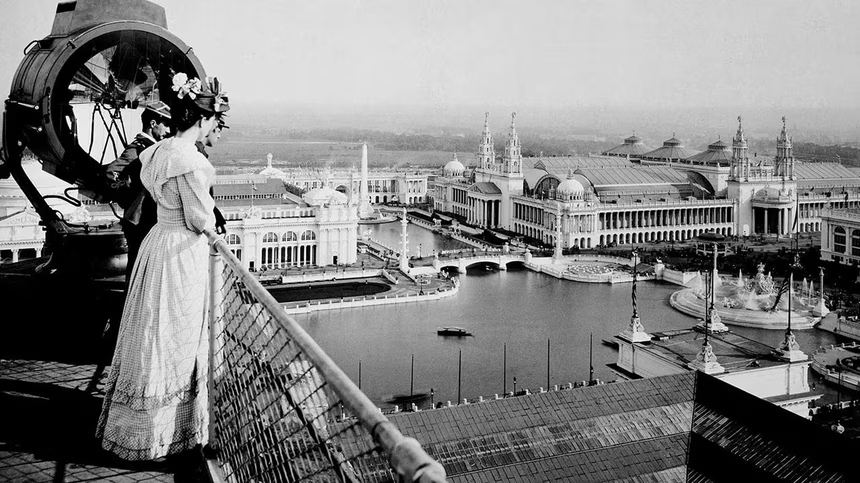
Season 6 includes: The World’s Fair of 1893, Toy Town, Skyscrapers, and Home of the Irish.Providing Support for PBS.org
Learn Moreabout PBS online sponsorship(bright music) - [Narrator] Everyone knows Chicago's architectural superstars, but every skyline needs a good supporting cast.
Here are 10 Chicago skyscrapers that deserve more time in the spotlight.
(bright music) Built in 1955, One Prudential Plaza, originally just called the Prudential Building, helped usher in a post-war skyscraper boom.
It doesn't command attention like its flashier neighbors, but it features a cool architectural detail, a giant rock of Gibraltar sculpted into the side of the tower.
It's by famous artist Alfonso Iannelli, who also collaborated on projects with Frank Lloyd Wright.
Next door, the Aon Center, originally the Standard Oil building, had a rough start.
To cover its facade, the architect of this 1973 tower used Carrara marble from the same quarry that Michelangelo used.
But the thinly sliced slabs couldn't withstand the weather, and they buckled.
The entire building was re-clad in 1992 with a more durable granite.
At 1,136 feet, it's the fourth tallest building in the city.
The Carbide & Carbon Building, now a hotel called Pendry Chicago, is a favorite of many Chicagoans.
It's an art deco beauty that resembles a champagne bottle with a punk rock flare.
Designed by Daniel Burnham's sons, the building is covered in black granite, green and gold terracotta and gold leaf and bronze trim.
The cork in the bottle is a 50-foot golden tower.
Just a block north is another art deco showstopper, 333 North Michigan Avenue.
Designed by Holabird & Root, the building owes its striking silhouette to another architect, Eliel Saarinen.
His runner-up entry in a 1922 competition to design Tribune Tower inspired skyscrapers around the country.
Thanks to the slight bend in Michigan Avenue at the DuSable Bridge, the building appears to sit smack dab in the middle of the street when looking south.
At 35 East Wacker Drive, the old Jewelers Building was the tallest building outside of New York City when it was built in 1927.
For several years, this terracotta building had an elevator for cars so tenants who were jewelers could keep their valuables in their trunks until reaching their floor.
Its dome was also home to the Stratosphere Club, which was said to be a speakeasy run by El Capone.
However fun that sounds, it's an urban myth.
Further north, rising up behind the Drake Hotel, you'll find the Palmolive Building, which later in life was the headquarters of Playboy Magazine.
Completed in 1929, the building used to have a super bright revolving beacon on top named for aviator Charles Lindbergh.
The beacon was turned off in 1982 because it was shining into taller buildings that had been built around it.
As part of the renovation of the building into a residential tower, a new beacon that only shines out over Lake Michigan was installed in 2007.
Situated on a triangular lot where the branches of the Chicago River converge, 333 West Wacker Drive embraces its location.
Its facade follows the bend of the river.
The green glass mirrors the greenish hues of the river and reflects the sky and surrounding city.
The building also once played the role of the dad's office in "Ferris Bueller's Day Off."
In the heart of the loop is Chase Tower.
Designed by C.F.
Murphy & Associates and Perkins & Will, its distinctive sloping shape reaches 850 feet into the air and stands out amongst the Loop's boxier skyscrapers.
Its plaza is home to "The Four Seasons," an impressive mosaic mural by artist Mark Chagall that celebrates the arrival of spring, summer, fall, and, yes, even winter.
It brings a touch of colorful whimsy to an otherwise corporate space.
One of the newest additions to the skyline is the last building designed by legendary Chicago architect Helmut Jahn.
The sleek steel and glass 1000M seems to change shape as it rises, blending into the traditional Michigan Avenue streetscape at the bottom and widening out as it meets the sky.
With construction delays caused by the COVID-19 pandemic, the building was completed in 2024, three years after Jahn's death.
Another recent super tall is NEMA Chicago by internationally acclaimed architect Rafael Vinoly.
At 896 feet, it's the city's 10th tallest, and it's the tallest rental apartment building.
Its nine bundled square tubes reaching to different heights are a reference to Chicago's ultimate super tall and the undeniable star of the Chicago skyline, Willis Tower, or as many Chicagoans still call it, Sears Tower.
(upbeat music)
 New
NewThe Daring Feat of the Auditorium Building
Video has Closed Captions
When the Auditorium Building opened in 1889, it was the tallest building in Chicago. (5m 2s)
 New
NewJeanne Gang’s Mark on the Chicago Skyline
Video has Closed Captions
Architect Jeanne Gang has added two distinctive buildings to the Chicago skyline. (5m 58s)
 New
NewJohn Moutoussamy and the Johnson Publishing Building
Video has Closed Captions
The Johnson Publishing building was the first high-rise in Chicago designed by a Black architect. (3m 4s)
 New
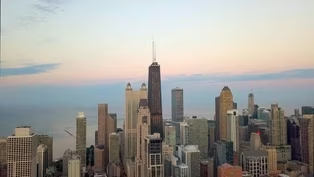
NewThe Rocky Rise of Hancock Tower
Video has Closed Captions
The John Hancock Center was one of the city’s most improbable success stories. (6m 36s)
 New
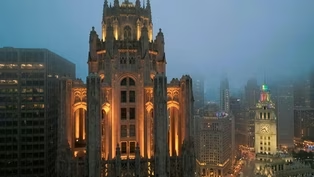
NewThe Wrigley Building and Tribune Tower
Video has Closed Captions
Across Michigan Avenue from one another are two Chicago icons. (4m 50s)
Providing Support for PBS.org
Learn Moreabout PBS online sponsorship











Support for PBS provided by:
Chicago Stories is a local public television program presented by WTTW
Lead support for CHICAGO STORIES is provided by The Negaunee Foundation. Major support is provided by the Abra Prentice Foundation, Inc. and the TAWANI Foundation.