
Is America driven by democratic ideals or self-interest?
Clip: 6/12/2026 | 12m 51sVideo has Closed Captions
Is America driven by democratic ideals or transactional interests?
The panel discusses whether the United States is becoming transactional in its foreign policy, in the style associated with Donald Trump, or whether older idealistic principles still guide it.
Problems playing video? | Closed Captioning Feedback
Problems playing video? | Closed Captioning Feedback
Major funding for “Washington Week with The Atlantic” is provided by Consumer Cellular, Otsuka, Kaiser Permanente, the Yuen Foundation, and the Corporation for Public Broadcasting.
Is America driven by democratic ideals or self-interest?
Clip: 6/12/2026 | 12m 51sVideo has Closed Captions
The panel discusses whether the United States is becoming transactional in its foreign policy, in the style associated with Donald Trump, or whether older idealistic principles still guide it.
Problems playing video? | Closed Captioning Feedback
Where to Watch Washington Week with The Atlantic
Washington Week with The Atlantic is available to stream on pbs.org and the PBS app.
Buy Now
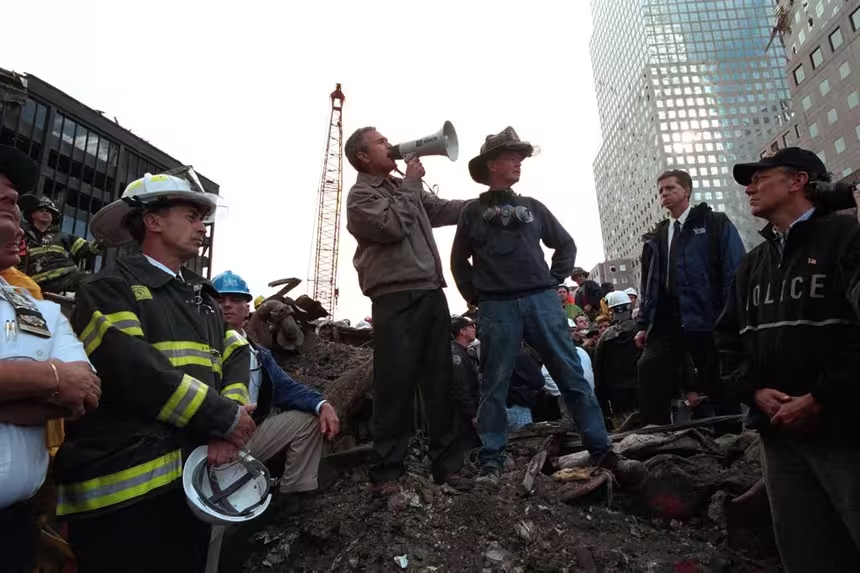
10 big stories Washington Week covered
Washington Week came on the air February 23, 1967. In the 50 years that followed, we covered a lot of history-making events. Read up on 10 of the biggest stories Washington Week covered in its first 50 years.Providing Support for PBS.org
Learn Moreabout PBS online sponsorshipJeffrey Goldberg: You know, it's interesting, whenever we do something morally dubious in the world, let's use the abandonment of Afghan allies as an example, you hear people say, well, that's not who we - - the critics will say, that's not who we are.
But if you ask Kurds or Iranian dissidents right now, or a thousand -- and this is the question.
I mean, I'll put it open to the panel.
I mean, are -- is the nature of America right now transactionalist in the style of Donald Trump, or is that aberrational?
And, actually, is there idealism left at 250?
Susan Glasser: Well, I mean, I think the important point is that we are the most erratic and unstable force in the globe.
Because of our disproportionate both economic and military power, the United States, the uncertainty that we have ourselves, these questions that we're asking ourselves, we're returning on our 250th anniversary, we're having a lot of pretty basic questions about core principles in our society and how long they're going to last or how well they continue to work.
That is a source of global instability.
And I think we tend to be pretty myopic here.
You know, we're a big inward-looking country buffeted by two oceans.
That's been our great strength historically, not just in foreign policy, but in terms of our own ability to, you know, solve problems without reference to the outside world.
Right now, what's happening is the entire world is dependent upon a kind of uncertainty and a kind of superpower crisis of conscience that they don't get a vote in.
And, you know, for me, I just come back to this sort of signal moment for me couple weeks into the Trump era in early 2017, you know, sitting with the head of the Brookings Institution at the time and he said, you know, I just had the Japanese national security adviser here, and I asked him, you know, what brings you to Washington, you know, thinking what's the issue that you're here for.
And he said, well, I'm here because the United States is the number one source of global instability in the world, and I want to, you know, sort of see what's happening.
And I think that's the frame of reference for me, Jeff, that's shaped this last ten years.
Ashley Parker: But can I just add briefly?
I think after Trump's first term, when then Biden won, there was a sense from our allies around the world that Trump won was sort of like a fever dream that they could PTSD black out, right?
And we could go back to being the flawed, complicated, but like America that they had known for almost 250 years.
And Biden reinforced that, right?
I mean, I was on his first foreign trip, and I can't remember if it was a G7 or a G20, but, I mean, he literally arrived and says like America is back.
And once Trump won again, I don't think that our country or our allies know what comes next, but there is a very clear sense that this was not an aberration, and perhaps that Biden interregnum was the aberration, and we have to prepare for where we don't know if the next leader is going to be a J.D.
Vance or someone more far right or skewing to the socialist extreme of the Democratic Party, but it's just all uncertain.
Tim Alberta: Well -- and I would add to that.
I think that, you know, we are dealing with sort of a horseshoe populist phenomenon here.
You go back to 2016, and we, of course, focus so much on Donald Trump.
But you also think about Bernie Sanders in that 2016 election.
And the fact that the two candidates who did the most to energize young voters in this country in their respective party bases had one thing in common, which is that neither of them had ever belonged to those parties, right?
Both Donald Trump and Bernie Sanders were sort of introducing this idea that actually the problems here at home are far worse than have been described to you by the governing class and by these institutions that you've lost trust in, and we need to commence a massive rethink of our priorities geopolitically and economically and otherwise.
And I think that's ten years ago.
We're ten years removed from that.
The fascinating thing for me is when I talk with young people go around the country, speak on college campuses, far left to far right, everywhere in between, the one great sort of generational point of unity is that these are folks who are quite comfortable with the transactional foreign policy.
These young people believe that we have been sort of cheated by previous generations that have paid too much attention to what's going on overseas.
And I think that the question you're posing, Jeff, we don't quite know the answer in this moment, but my suspicion is that 10, 15, 20 years into the future, when these young people, whose entire political consciousness has been shaped by these past ten years of the Sanders-Trump phenomenon, this sort of horseshoe populism, my sense is that they're going to render a verdict on this that we're not going to like.
Idrees Kahloon: I just am reminded, Kurt Vonnegut once wrote, you are who you pretend to be, so be careful who you pretend to be.
And I think that matters because America, as you pointed out, has made lots of mistakes over its period.
But the fact that it pretended to care about democracy, and sometimes did, I think, mattered a lot.
The argument that China and Russia have made to the rest of the world is America's just as nakedly self-interested as everyone else.
It's wrong to trust them, it's wrong to think of them as the kind of rightful hegemon.
And the fact that we have abandoned that that's one thing that Trump has done.
You know, presidents have always ordered troops to do things without really regard for Congress.
I mean, the War Powers Act has never really worked in the way intended.
But what's different is that we're not even saying that we care about those things, and I think that that itself matters.
Jeffrey Goldberg: Right.
I want to read a quote from Jim Mattis, the former defense secretary, the most revered living Marine.
All of us have interviewed him in the past, and one of the things he always -- this is something that he says constantly.
He said -- and if you've asked him this question, you know the answer.
If you ask Jim Mattis what's the most dangerous thing, dangerous threat facing America he'll say, and this is the way he wrote it once, the surest path to catastrophe is to sever those bonds of affection tying Americans together.
And, you know, of course, these worries aren't new.
James Madison in Federalist 10 wrote, so strong is this propensity of mankind to fall into mutual animosities that where no substantial occasion presents itself, the most frivolous and fanciful distinctions have been sufficient to kindle their unfriendly passions and excite their most violent conflicts.
So, the question, Steve, I'll start with you, is how much of this disunity is real, and how would you go about fixing it?
Stephen Hayes: Well, I think a lot of it's real, but it's certainly the case that our enemies are doing everything they can to make it more stark.
There was a fascinating interview that Marco Rubio gave, I think, it was October of 2020 with The Washington Post.
He did this Washington Post Live with Robert Costa, now of CBS News, and they went back and forth on talking about the Russia investigation and all these things, and questions about election integrity and election security, and the divisions among Americans.
And Costa asked him sort of, what's your worst-case scenario?
And Rubio said, Can you imagine if our enemies are successful in getting the American populous or one party or the other to believe that an election was fraudulent, that the results weren't real.
And then, of course, two months later, we saw this in Donald Trump, and four years later, Marco Rubio is his secretary of state.
I think the divisions exist.
I think we are causing ourselves real damage if we pretend that they don't exist.
But we also have to be mindful of the fact that this is being drummed up externally as well in, you know, whether it's the pace of information, whether it's the kind of things that we're seeing on social media in this sort of rapid fire, whether it's what young people are seeing via TikTok and external manipulation of these divisions.
Our enemies want to exacerbate them.
Jeffrey Goldberg: So, Peter, can we survive?
Can democracy survive social media?
Peter Baker: It's a great question because, you know, to Tim's point, you know, when we grew up there was, you know, a more or less common base of facts that we started from, and then we had our debate, right?
We had a relatively commonality among media sources and so forth.
And today you can live in completely different realities if you spend time on the algorithm, you know, that Ashley referred to.
It's not just that.
It's even -- we're physically separating from each other.
We're more and more living in places with people who agree with us, and we don't encounter people who don't.
Jeffrey Goldberg: Right.
Peter Baker: We go to the different media outlets and the social media outlets.
And so the question then is how do you bring them back together?
And I don't see an obvious way to put that genie back in the bottle.
You're not going to fix social media.
You can't have legislation that's going to suddenly make social media nice, you know, and get rid of the sewer aspect of it.
It's just not going to happen.
Jeffrey Goldberg: Right.
Peter Baker: So, absent some sort of external force that brings us together, like a World War II, like a 9/11, I'm not sure what does.
And the truth is, I'm not even sure that one of those would anymore.
I'm a little nervous to think if we had some horrific catastrophe -- Tim Alberta: Maybe like a pandemic.
Peter Baker: Yes.
Exactly right.
Exactly right.
So, how do we come -- Jeffrey Goldberg: You really are dark today, huh?
Peter Baker: And that's what worries us.
Jeffrey Goldberg: Maybe a Martian invasion.
I've been sort of pro-Martian invasion for that reason.
I want to ask you all -- we're going to run out of time soon, but I want to ask you all to go back in time and imagine that you could speak to the founders of the United States 250 years ago, and give them a warning about something, a warning in the way the Constitution is written, a warning in the way the government is constructed, a warning about a problem that they could not foresee.
What would it be?
Steve, sorry.
You're in the hot seat.
Stephen Hayes: No.
No, I mean, I'm thinking very quickly.
This will sound maybe silly.
I don't know that I have a warning.
I mean, I think if you go back and you look at what they did in the Federalist Papers and what they anticipated about faction, about the potential of a demagogue, I think they saw a lot of this.
I mean, obviously, there's so much they couldn't have anticipated.
I think they anticipated a lot.
Jeffrey Goldberg: Yes.
Let's whip through it, because we only have a couple of seconds.
What, Idrees?
Idrees Kahloon: You know, they wrote slavery into the Constitution three times, and that sowed the seeds for the almost destruction of the republic.
You know, it was a compromise, but that's what happened.
Jeffrey Goldberg: That's a pretty big one.
Idrees Kahloon: That's a pretty big.
Jeffrey Goldberg: You're right, yes.
You're right.
Ashley?
Ashley Parker: I guess I would just ask them to address what happens when you -- and again, they recognized some of this, but when people disregard norms and niceties.
And what about one of the branches of government doesn't want to be a check on another, and they just abdicate that, what then?
Jeffrey Goldberg: Right.
Susan Glasser: Yes.
I mean, look, we are seeing the case study right now.
They may have anticipated and worried about a demagogue or a man who wanted to be king, but they gave us an impeachment process that doesn't work in an age of extreme partisanship.
Jeffrey Goldberg: How would you redesign that impeachment process in 10 seconds?
Susan Glasser: Well, I think we better acknowledge that Congress is not governed by its institutional interests as much as its party interests.
Jeffrey Goldberg: But the question is, is it the bravery of the people who are actually elected to represent us, or are there systems, structures that could be fixed?
Peter Baker: I think the biggest problem that wasn't anticipated then, that is affecting our politics today, aside from social media, is money, money and politics.
Because we've defined now money to be speech, they want to.
They want to protect speech, but money obviously drives parties, it drives politics in a way that I don't think they anticipated.
Jeffrey Goldberg: Right.
Tim?
Tim Alberta: I'm sort of with Steve.
You know, if men were angels, no government would be necessary.
These guys were pretty clear-eyed about the threats that we faced.
I don't know that any of this is necessarily new under the sun, but it is new to us.
And I think that's what's so disconcerting as we celebrate 250 years, wondering how we got to this place and how we get out of it.
Jeffrey Goldberg: Well, this has been a great conversation.
I wish we could go on all day, but we can't.
I want to thank everyone on the panel, really, for your expertise and your analysis.
And I want to thank everyone here in our studio, and everyone at home for joining us.
And I want to leave you this evening with a thought from President Reagan, who said in his farewell address, because we're a great nation, our challenges seem complex.
It will always be this way.
But as long as we remember our first principles and believe in ourselves, the future will always be ours.
I just want to say that we do indeed live in strange and unsettling times, but I take comfort in the fact that for 250 years, the United States has forged its way through great and terrible challenges.
And sometimes we merely muddle through, and sometimes everything seem to hang in the balance, but we've consistently made our way to the far side of crisis, and I have faith that we will continue to do so into the future.
I'm Jeffrey Goldberg.
Good night from Washington.
Has America upheld the principles formulated 250 years ago?
Video has Closed Captions
Has the United States lived up to the principles formulated 250 years ago? (5m 49s)
Is Trump a symptom or the cause of political polarization?
Video has Closed Captions
Is Trump a symptom or the cause of political polarization? (16m 16s)

Why is America the economic engine of the world?
Video has Closed Captions
Why has America been the economic engine of the world for so long? (3m 58s)
Providing Support for PBS.org
Learn Moreabout PBS online sponsorship New Episode
- News and Public Affairs

Top journalists deliver compelling original analysis of the hour's headlines.

- News and Public Affairs

FRONTLINE is investigative journalism that questions, explains and changes our world.

 New Episode
 New Episode
 New Episode
 New Episode
 New Episode

 New Episode
 New Episode
Support for PBS provided by:
Major funding for “Washington Week with The Atlantic” is provided by Consumer Cellular, Otsuka, Kaiser Permanente, the Yuen Foundation, and the Corporation for Public Broadcasting.