
Is Trump a symptom or the cause of political polarization?
Clip: 6/12/2026 | 16m 16sVideo has Closed Captions
Is Trump a symptom or the cause of political polarization?
It's hard to find a unifying principle today, but everyone in America agrees that something's broken. The panel discusses whether President Trump is a symptom of dysfunction and polarization or the cause of it.
Problems playing video? | Closed Captioning Feedback
Problems playing video? | Closed Captioning Feedback
Major funding for “Washington Week with The Atlantic” is provided by Consumer Cellular, Otsuka, Kaiser Permanente, the Yuen Foundation, and the Corporation for Public Broadcasting.
Is Trump a symptom or the cause of political polarization?
Clip: 6/12/2026 | 16m 16sVideo has Closed Captions
It's hard to find a unifying principle today, but everyone in America agrees that something's broken. The panel discusses whether President Trump is a symptom of dysfunction and polarization or the cause of it.
Problems playing video? | Closed Captioning Feedback
Where to Watch Washington Week with The Atlantic
Washington Week with The Atlantic is available to stream on pbs.org and the PBS app.
Buy Now
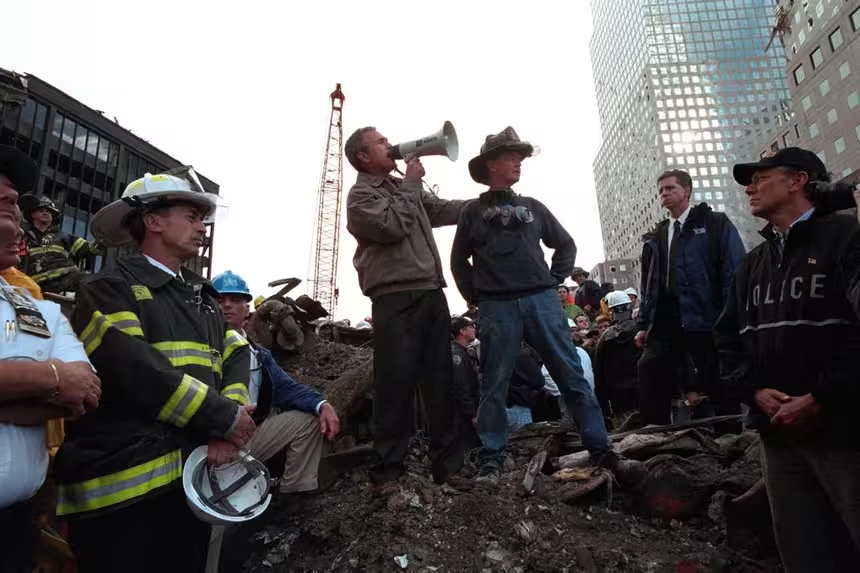
10 big stories Washington Week covered
Washington Week came on the air February 23, 1967. In the 50 years that followed, we covered a lot of history-making events. Read up on 10 of the biggest stories Washington Week covered in its first 50 years.Providing Support for PBS.org
Learn Moreabout PBS online sponsorshipJeffrey Goldberg: Right.
I think everyone in America -- I mean, it's very hard to find a unifying principle today, but everyone in America agrees that something's broken, something's off.
Some people have a set of reaction -- one set of reactions, other people have another set of reactions.
But, Susan, is Donald Trump, is the presidency or the double presidency of Donald Trump, is it a symptom of this dysfunction, this polarization, or has he been a cause of it?
Or you obviously have a choice C, which is both.
Susan Glasser: Yes, I mean, look, there's no question he's an accelerant and you know, a divider, one might even say, you know, by nature, but he wouldn't have been elected -- Jeffrey Goldberg: Are you selling your book right now?
Susan Glasser: He wouldn't have been elected if he didn't play to what a large segment of our society has been asking for.
I think relevant to that, you have to look at the fact that a majority of the country has not said that the country is on the right track.
You have to go back to the early George W. Bush era.
So, we're talking two decades.
You know, the lifetime of our children has been one of complete kind of dystopia as far as the public space, as far as young people are concerned today.
They're astonished when we talk about you know, this sort of mythic past when there was a national consensus, when we were promoting democracy at home and abroad, because the new normal for them is this contentious, divided, polarized environment.
So, Americans don't believe -- what they're united in is believing the country's gone to hell, that they don't think the country's on the right track.
There's been a general diminution in support and belief and faith in all institutions.
That includes religious institutions.
It includes institutions of the government even the military, which until recently had been, you know, and still has higher, you know, ratings.
But even that, as we see in a purposeful way, we do have a political party now that has very purposefully organized itself to attack the legitimacy and foundations of institutions.
That to me is one of the signal differences of Donald Trump, right, is that he is going after the things that make our society work.
The individual -- you know, the sort of superstructure of American democracy are the very things Donald Trump every day calls into question, and that has been very effective in a society that already had major questions.
And partially, Jeff, I think it's been really fascinating to hear these answers, to have pull out of the news and, you know, and hear a little bit more foundational conversation.
But one thing I would say that's so different and head-snapping right now is that we speak still of one America.
We say, well, America is in a tough place right now, or America is no longer promoting democracy abroad.
But it's actually not that.
I mean, it's that we have different, starkly competing visions of America right now, that we can't say there's one American view at 250 years.
I think we can say that there is a clash of definitions, and we've seen head-snapping changes.
Just three years ago, we had a president who believed that promotion of democracy was the essence of American foreign policy, who convened a global summit of democracies as his item one of his presidency.
So, it's not that we've abandoned that, it's that we have a country that can't decide what it wants, and is veering wildly between different competing and incompatible visions of itself.
Jeffrey Goldberg: Yes.
Steve, jumping off something that Susan said, I've used this before on this show and elsewhere, but it the question that plagues me is this.
Are we experiencing, in America at 250 a -- is this a head cold, a nervous breakdown, a midlife crisis, or a terminal illness?
Stephen Hayes: I mean, I didn't go to medical school for a reason.
Jeffrey Goldberg: Right.
But you are an economist, though, right?
Stephen Hayes: Look I don't know.
To be honest, I don't know the answer to that question.
Jeffrey Goldberg: I mean, how do you feel?
I mean, I say that advisedly because this is a show about thinking, not feeling, but -- Stephen Hayes: Yes.
Jeffrey Goldberg: But does it feel recoverable?
Stephen Hayes: Look, I think anything's recoverable.
We've had hard moments in the past.
We had a Civil War, we went through the Civil Rights era.
There's this, you know, Winston Churchill, this may be an apocryphal quote, said, Americans always do the right thing, only after they've tried everything else.
Jeffrey Goldberg: Right.
Stephen Hayes: I feel like we're trying everything else.
We're in the middle of that right now.
Yes, it's recoverable.
I wouldn't pronounce the country dead at this moment.
But I think that these are real concerns.
Like Susan touched on some of them.
And, you know, to return to Ashley's answer, I think one of the biggest questions facing the country right now is sort of the pace of information, the speed of information, and the sort of willingness or even eagerness of the populace to have its views affirmed rather than challenged, and, you know, the relative lack of interest in the truth.
And I don't know that I would say that's new.
It certainly has always been the case, but now it's constant.
And, you know, this isn't a 24/7 news cycle, this is a nanosecond news cycle.
And people are turning to find the things that they think they already know, just to have them told that they're right.
Jeffrey Goldberg: Right.
Stephen Hayes: And in that kind of an environment, I think the challenge is to the country to having a one America.
I mean, we're never all going to agree on anything, but to having a one America and having a conversation about those founding principles and about the things that we've been talking about becomes very, very difficult.
Jeffrey Goldberg: Right.
We have a bit of geographic diversity on this panel, and I want to ask Tim, who lives in Michigan, and Idrees, who's from Kentucky, to comment on what Steve is talking about in terms of what people you live around who aren't immersed.
One of the things that makes them different from what we do in Washington is that they're not thinking about all this stuff all the time.
They actually have lives.
And so I'm wondering, from what you're picking up, is it the speed of information that's overwhelming people?
Is the information just worse than ever?
What is it from your perspective?
Tim Alberta: So, I would cede the point that we are living through this epistemological crisis right now, and it's really, really, really dangerous.
And I just don't think that we could devote an entire panel to talking about the threat of what happens when you have people who no longer share a lived reality or no longer operate from a common baseline of fact and information.
I mean, it's really damaging, and we see it every day, and I think it's accelerating.
I would argue, though, that I think that epistemological crisis is actually downstream from a crisis of trust.
And the thing that is so striking to me, not only when I jump in my truck and do road trips for reporting, but just with friends, family in southeast Michigan in my backyard, people who I grew up with, these are people who -- to the point about sort of institutional decline, these are people who have reached the conclusion that no one is looking out for them, that no one has their best interest in mind, and that no one can be trusted, whether that's higher education, whether that's law enforcement, whether it's the government, whether it's the press, whether it's Major League Baseball, right?
I mean, these are people who have become sort of deeply cynical, deeply calloused.
And I think in that space of real wounding, there is an opportunity for them to be preyed upon and to be manipulated and to be demagogued.
And that is where certain actors in American life have been very successful, Donald Trump chief among them, but he's not the only one.
And I do think that it's very difficult for us to discuss this idea of is it a head cold, is it a terminal illness, how do we rebuild, how do we heal the body politic, until we've really done deep diagnostic work to understand this erosion of trust and what can be done about it.
Jeffrey Goldberg: Right.
Ashley, you understand Donald Trump better than almost anyone.
What -- that's an actual serious observation.
And we thank you for your service.
Ashley Parker: Yes.
Jeffrey Goldberg: You understand Donald Trump.
You spent a lot of time with Donald Trump.
What does he understand about the American people that so-called elites didn't understand?
Ashley Parker: Well, I think it's a couple things.
I think it's what Tim said and what I experienced on my road trip, this sense of grievance, first of all, that people feel like no one is looking out for them, and he is going to take that grievance and channel it, and sort of cast himself as the martyr on their behalf.
He also benefits -- what he understands is that just -- and a lot of these things when I say understands, is at a true sort of gut, visceral level, but that shamelessness is a superpower.
And it's much easier, frankly, to be shameless in a world where trust in information sources and in reality is so polarized to begin with.
I mean, just briefly to go back to the previous question, I was thinking, we have always made choices about our information, right?
Subscribing to The Wall Street Journal or The Washington Post, that's a choice.
You're going to get slightly different news sources watching Fox News or MS NOW, slightly different choices.
But I think what we have not accounted for is that social media, you're not -- at this point, you are not even making a choice.
When you open your phone, based on an algorithm that recognizes that you spent two and a half seconds looking at something, the algorithm is feeding you something it wants you to believe, something it reinforces, something that you may not even consciously know that you believe.
And so if you get fed a bunch of videos that cats commit crimes at an alarming level, right, that influences your thinking.
He understands all of that.
And he also understands that for a lot of Americans, for these reasons we stated just now, facts are fungible.
So, I mean, I think it's worth stepping back and saying he didn't like the results of the 2020 election because he lost.
It was a free and fair election.
But the idea that he just intuitively understood that if he just said, I won this election, it was stolen, and he said it shamelessly enough and frequently enough that he could get a huge portion of the population to believe that in their bones, I mean, that is real understanding of something.
Jeffrey Goldberg: Right.
Idrees, why are cats committing crimes at an alarming rate?
I want you to answer the same question I asked Tim, about what people are thinking and using -- how they're using social media in places that are not Washington, New York, Los Angeles, and so on.
You're from Kentucky.
Talk about that a little.
Idrees Kahloon: Yes.
I think there, there can be a kind of -- you know, in Washington, people are very interested in politics and people who are interested in politics tend to be the ones who sort themselves into these rival camps with these rival epistemologies, and they lob, you know, grenades at each other through podcasts and whatever else.
They're kind of fighting over a kind of mass of people who are, you know, not trusting of politicians, disinterested in politics.
If you look at the voting behavior, they're not terribly consistent from one year to another.
You know, from 2012 up until 2024, probably 2028, Americans have voted for a different presidential party every year.
The midterm elections, they always cycle in and out.
Political scientists have this thermostatic conception of American voters that, you know, they turn it up and then they turn it down, and they turn it up, they turn it down.
And that's been a good model for how people are.
So, in terms of what we're talking about, it's true and it's important, but it's also important to see that that's a description of elite behavior and people who are interested in politics.
And that's important because elites, I think, matter for voting patterns.
They matter for all the things that we're talking about.
You know, respect for losers' consent elections, et cetera, all of that matters.
But I think that, you know, if you go outside of Washington or New York, a lot of people are getting on with their lives.
As we said earlier, America's really rich, and people are -- a lot of people just enjoy having a nice life.
That does still happen here, which is sometimes harder to see for all that we're debating.
So, it's not to say that what we're saying is not right.
It is right, but it's also -- there's also a lot else that's going on.
Stephen Hayes: But I would just add to that quickly.
You know, I think we're separating ourselves in other ways.
It is the case that that's largely an elite phenomenon.
And you have conversations with partisans in Washington, D.C., that like literally don't even make sense to real people in the real world.
They don't think like this.
Why would you vote for a Republican who, you know, is against all of your values and does things that you abhor just because that person's a Republican?
Same thing for Democrats.
But we're also dividing ourselves, I think, in another way.
You have this sort of massive middle of the country that is increasingly so turned off by our politics that they're checking out.
These are people who are news avoiders.
These are people who maybe at one point paid attention in sort of out of civic obligation, and are just saying, I'm helpless to do anything here, so I'm not going to do it.
Jeffrey Goldberg: Right.
Stephen Hayes: And then I think the corollary to that is that the partisanship you see in Washington, we've seen this for a long time in Washington, sort of bleeds out into the rest of the country, where people are now increasingly building their identities around their partisan associations.
And that is, I think, growing at the same time that you have this group that is either apathetic or feels like they can't make a difference.
Jeffrey Goldberg: Peter, small question for you.
Is the post-World War II international liberal order created and maintained by the United States over?
Peter Baker: Yes.
Jeffrey Goldberg: Okay, thanks.
Ashley -- Peter Baker: That doesn't mean that the United States isn't still the most dominant actor on the stage.
It is, obviously.
To Idrees' point earlier, we are still the most, you know, potent economic and military force, even if we don't want to be the world's policemen, even when we don't want to be the hegemon, we don't want to be the leader.
But, certainly, our understanding of what we thought the world order was for the last 80 years is over.
It is.
It just is.
Now, it doesn't mean it can't change again with another president, but this president's made very clear that he does not see it as America's role to be friends with Europe the way every president, Republican or Democrat, since World War II did.
He does not see it as his role to stand up to autocracy, to Susan's point about Biden's summit.
In fact, he is perfectly comfortable with autocrats, maybe more so than with Democrats.
He himself has said that.
It is a very different way of looking at the world.
Having said that, he does not come at it with this coherent ideology other than -- you know, I mean, with his first term, we used the word isolationist a lot.
Today, we would not use that word.
We would use maybe imperialist.
I mean, he's kind of himself evolved over time as he's become more comfortable with power.
But he's using it in a way that Reagan and Truman and Eisenhower and Obama would never have used it.
And I think that that is challenging our conception of who we are in the world, and whether we stand out as that beacon you asked about earlier for the rest of the world.
What strikes me is, how do people see us today?
Do they see us as, you know, a country that's led by Trump, and we may or may not agree with Trump, or do they see America as being what Trump says we are?
And I think that when we have at times been alienated from our friends in Europe, you know, over the Iraq War or over, you know, Pershing missiles during the Cold War or whatever, people didn't lose faith in America.
They might have disagreed with America's leader at the time.
And the difference today, I wonder, and I'm not smart enough to know, is whether we are changing our -- the way we present ourselves to the world and how they see us.
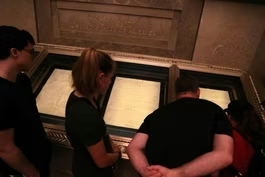
Has America upheld the principles formulated 250 years ago?
Video has Closed Captions
Has the United States lived up to the principles formulated 250 years ago? (5m 49s)
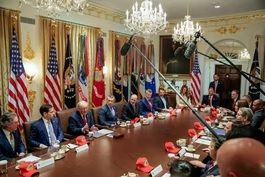
Is America driven by democratic ideals or self-interest?
Video has Closed Captions
Is America driven by democratic ideals or transactional interests? (12m 51s)

Why is America the economic engine of the world?
Video has Closed Captions
Why has America been the economic engine of the world for so long? (3m 58s)
Providing Support for PBS.org
Learn Moreabout PBS online sponsorship New Episode
- News and Public Affairs

Top journalists deliver compelling original analysis of the hour's headlines.

- News and Public Affairs

FRONTLINE is investigative journalism that questions, explains and changes our world.
 New Episode
 New Episode
 New Episode
 New Episode
 New Episode

 New Episode
 New Episode
Support for PBS provided by:
Major funding for “Washington Week with The Atlantic” is provided by Consumer Cellular, Otsuka, Kaiser Permanente, the Yuen Foundation, and the Corporation for Public Broadcasting.