
Aug. 25, 2026 - Full Show
8/25/2026 | 26m 48sVideo has Closed Captions
Watch the Aug. 25, 2026, full episode of "Chicago Tonight."
The new leader of the Chicago Department of Public Health on his vision for a healthy city. And as kids head back to school, President Donald Trump recommends changes to childhood vaccines.
Problems playing video? | Closed Captioning Feedback
Problems playing video? | Closed Captioning Feedback
Chicago Tonight is a local public television program presented by WTTW
WTTW video streaming support provided by members and sponsors.
Aug. 25, 2026 - Full Show
8/25/2026 | 26m 48sVideo has Closed Captions
The new leader of the Chicago Department of Public Health on his vision for a healthy city. And as kids head back to school, President Donald Trump recommends changes to childhood vaccines.
Problems playing video? | Closed Captioning Feedback
Where to Watch Chicago Tonight
Chicago Tonight is available to stream on pbs.org and the PBS app.

WTTW News Explains
In this Emmy Award-winning series, WTTW News tackles your questions — big and small — about life in the Chicago area. Our video animations guide you through local government, city history, public utilities and everything in between.Providing Support for PBS.org
Learn Moreabout PBS online sponsorship>> thanks for joining us on Chicago tonight, Brandis Friedman.
Here's what we're looking at.
The Chicago Department of Public Health has a new leader.
He joins us tonight to discuss his plans for a healthier Chicago.
And medical professional sound.
The alarm after the Trump administration recommends changes to childhood vaccines.
>> First off tonight, Chicago officials say they have a plan to fill the 85 million dollar budget gap that cropped up mid year because revenue that this year's budget accounted for didn't come through.
>> Cannot continue to govern by searching for loose change in the couch.
Or every time that there's a budget challenge.
We revert back to preclude these that have caused tremendous harm.
To working people in this city.
But we certainly cannot build.
A true stable financial future for Chicago with one-time solutions.
>> Mayor Brandon Johnson told reporters the city will refinance about 500 million dollars in bonds.
That's where the city's sales tax revenues to generate between 65 71 million dollars.
The rest of the gap will be bridge with an spent federal COVID dollars.
But the mayor's critics, the ones who crafted the spending plan that went into effect without Johnson support accuse him of slow walking structural revenues and efficiencies for more on the city's financial picture, head to our Web site.
>> Even though Election Day is still over 2 months away.
Cook County election officials are in court encouraging voters.
>> To have a plan in advance.
Yesterday's ruling from the U.S.
Supreme Court could throw into question the use of mail-in ballots used by about a 3rd of voters in the country.
County Clerk Monica Gordon gave a tour of her elections operations center to elected officials and advocates along with the message that voting by mail remains a secure method of casting your ballot.
>> Voting by mail is not a shortcut around the safeguards to protect election.
It is a secure establish voting option that has governed by state law, its subject to multiple checks throughout the Gordon says the drop boxes include built-in surveillance cameras, tamper resistant construction and enhanced ballot tracking technology.
>> She says her office is also working with the sheriff's office to make sure polling locations remain safe amid concerns about the presence of federal immigration agents.
Constantly rushing to catch a flight at O'Hare.
Well, civic and business leaders have a new plan to get you there in 15 minutes from downtown here with me.
That would be the O'Hare Flyer.
A proposed battery powered express train.
This isn't the first time private builders have shared plans to allow travelers to bypass the CTA and Metra.
But unlike previous efforts, the O'Hare Flyer team says a lot of the infrastructure they need is already built.
That rain would use existing freight rail between the 2 locations, although only one of 3 freight carriers has reached an agreement so far.
Legendary songwriter, singer and actor Dolly Parton has died known for her but dazzled outfits and big blond hair Parton was a musical icon writing and performing hundreds of songs during her career, including beloved tracks like Jolene and I will always love you.
She was nominated for 55 Grammy Awards and won 11.
She was in the country Music Hall of Fame and the Rock and Roll Hall of Fame.
She penned the theme song 9 to 5 and that became an anthem for working women everywhere.
And she starred in the 1980, film by the same name.
Parton was also a philanthropist funding coronavirus vaccine Research and childhood literacy.
Her imagination library program operated across the country, including in Illinois, providing free books to young kids.
Earlier this month, the program celebrated its 5 millionth book Mail to Kids in Illinois alone.
Parton was 80 years old.
Up next, one on one with the the new leader of the Chicago Department of Public Health right after this.
>> Chicago tonight is made possible in part by the Alexander and John Nichols family.
The Pope Brothers Foundation.
And the support of these donors.
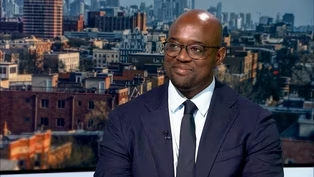
>> The Chicago Department of Public Health has a new leader, Dr.
Garth Walker officially assumed the role of Cdph commissioner this month after he was appointed by Mayor Brandon Johnson and unanimously confirmed by City Council.
Dr.
Walker's experience includes positions like chief medical officer of Rush Health, deputy director of the Illinois Public Health Department and White House fellow with the U.S.
Department of Health and Human Services under the Biden administration.
He now inherit a department that is responsible for managing infectious disease outbreaks, food safety, environmental health, and more throughout the city.
And joining us now to discuss his goals for the health and wellness of Chicagoans is Doctor Garth Walker.
Welcome back.
Congrats on the new gig.
Thank you.
Thank you for having me.
Appreciate it.
So you describe this role as the culmination of your life's work.
How's that?
>> Well, what I described in that manner, I was thinking about all my life's experiences.
I am a lifelong Chicago growing up in Chicago.
My whole life to the Chicago Public schools and one of the most transformative experiences that I had was right after college to Americorps and I worked with DC public schools because I wanted to think about the social and economic barriers that make it hard for this invest in communities to get great resources.
But after that, I pursue medical school and I knew the exact position that I wanted to be.
One that thinks about those issues that those barriers and make it difficult for people to get great health care and throughout that time weather be for my academic standpoint, working at the state level, the federal level as well as for academic medical centers, I tried to make sure that that was important part of how we think about our communities and how create healthier community.
>> So let's talk about some of, you know, what will be your public health challenges in this role?
Chicago has significant disparities in life expectancy depending on where people live throughout the city as well as their ethnic background.
Even though improvements have been made in recent years, for instance, as of 2024 black Chicagoans life expectancy is 73.3 years compared to 81.8 years for their white counterparts.
82.8 years for Latino Chicagoans and 86.9 years for Asian residents, would you believe is driving this gap?
thank you for asking that.
I will.
A lot of is a testament to Mayor Van Johnson and his leadership.
>> In terms of centering health equity thinking about the communities and their lived experiences.
But when I take a step back, I was here last year we were discussing about where COVID-19 is after 5 years and we're still having a lot of the similar challenges and what it takes is leadership.
Many of the leaders within my department focused on where those communities have the largest social and economic barriers and how that relates to their ability to be able to remain healthy.
And in many cases, that means thinking about meeting people where they are, whether be vaccinations, whether it be thinking about our air quality and how we monitor different communities and organizing our department to be able to make sure that they can remain healthy during some of the most difficult circumstances to it.
Sounds like you're saying there's sort of a combination of factors that can influence this.
This age gap of of almost 10 for black and white Chicagoans.
Absolutely.
Where you live the economic opportunities that you have the environment you live in.
But you can walk in the community whether >> you're experiencing violence on a regular basis.
But there you live in a desert or a pharmacy desert.
There's a throughline throughout that and I think public health oftentimes our map to show the level of humanity that our governments able to deliver on.
And I think being able to marry science, people, data in community organizations were able to create healthier communities in that manner.
What do you think your office can realistically do to bridge that gap?
Well, I think one great example is the wellness grants we just put We put out $600,000 to be able to.
Create community wellness activities some of our most marginalized communities to be able to think about those social determinants of health, as well as healthy activities that will be able to spearhead from from those different communities.
I think if you look at our most recent example with the burning from Canada.
We go is the largest as the largest air monitoring system in the nation, the second largest in the world.
But what does it mean for individuals?
that means is communities that may be structurally disadvantaged it in high pollution areas.
They're able to look at the Air Quality index make decisions for their family, their neighbor in terms of how to remain healthy and avoid having any type respiratory issues such as asthma conditions and the like.
Cdph is buzz budget dropped by 68% between 2023 26 records because of that precipitous drop, of course in a >> funding federal funding after coach after the COVID-19 pandemic waned and the return of President Donald Trump to the White House.
What has been the impact funding cuts like that on services that your office provides Significant?
And I think that's part of the reason why I decided to to join at this time.
>> I often times.
Public health is the invisible safety net and people can take it for granted.
And we have to be up to show all the activities that we're doing to be able to make sure that people understand how we're keeping people healthy.
And when you have funding drops, that drastic, the first communities are affected.
Are those from the less means?
And I think we're learning in real time how weather catastrophes are affecting some of our most marginalized communities and our neighbors.
You look at Gary, Indiana.
So what we want to do is have a public health infrastructure that's so resilient.
So strong that we can protect those with the lease when these type of catastrophes occurs.
And when there's a reduction in funds, it you can compromise is quite quite a bit.
>> Cdph recently released a preliminary report HIV and AIDS diagnoses in Chicago showing that they are declining with 540 new HIV diagnoses, the lowest level since the early 1990's.
But there's been some recent criticisms over your department's handling of funds related to HIV AIDS services.
And here's what a protester had to say about that just last week.
>> 5 average 40 million dollars Again, the federal government that was meant to be for HIV.
services and type of when there so many organizations could abuse at 40 billion dollars over last 5 holes by critical care service outside it.
>> How do respond to those concerns about how funding is being given out?
Well, first off, I think it's important to highlight the importance of community leaders and the way that they show up in the way that they're able to advocate for their communities.
>> So I empathize exactly with what is occurring 2 weeks in the role.
So I'm exploring how we're able to be able to make sure that our communities continue to remain protected.
I think the improvement that we've been able to see in terms of HIV and a diagnosis, particularly amongst our most marginalized communities.
It's a testament to the learnings that we've had from the health equity sounds and the public health infrastructure that was invested in over the years.
Because it speaks ensuring that local organizations are the ones to be able to lead a lot of that work.
So I'll continue to listen to so many of the organizations that working so closely with those affected by AIDS, HIV looking to figure out how we can continue to keep Chicagoans healthy as we move forward.
>> The crisis assistance response and engagement or care program has expanded to all 77 community areas this year on it, of course, provide support to individuals experiencing a mental health crisis or social emotional distress on Even though it's technically expanded citywide, it is serving fewer people.
And I know you're 2 weeks into the job.
What we know about why that is and what you can do to change Sure.
Well, I think I'm going to lean a lot on some my operational background and work with from different health systems and >> at the federal and state level, this is an important program and it's important program for a couple of reasons.
One is that we're able to deliver mental health expertise as well as first responders, to individuals and some of their most lowest moments traditionally that could be presented 2 law enforcement and sometimes you can have mixed reactions in terms of what occurs by being able to add this humane approach able to keep Chicagoans healthy and link them to the social determinants of health issues that we weren't first discussing, but also the expertise that is needed to de-escalate those issues.
So that's a testament to this administration and the many organizers and the city council members that have supported this work that to go for as part of Chicago's expansion of public mental health Previously shuttered clinic has also reopened in a couple of new spaces have launched lake.
>> The pills and South Ashland Health hub, the Roseland Health Hub and mental health operations at the Legler Regional Library in West Garfield Park.
Are there plans to reopen additional shuttered clinics or do you think will probably continue to lean into the sort of hub library model for the future mental health systems in Chicago.
I love the Health Library library model.
I still have to examine where the resources are at and how we want to expand.
But I will say this, I've been able to view health care from the state level.
The federal level private perspective and from many different venue points and behavior.
Health continues to follow up.
Come short in terms of >> convening people that deliver the care that we need for those that need it.
The most.
And we're going be able to show up for Chicagoans that are dealing with mental health issues.
>> All right.
You've got your work cut out for you.
See DPS, Commissioner, Dr Growth.
Lot things so much for joining Thank you.
Up next, tackling another concern among health care professionals, shifting requirements for childhood vaccines.
Kids are back in school this month and one of the many things they need before starting classes are their vaccinations.
But parents may feel like they're getting mixed messages after the Trump administration released new childhood vaccine guidance earlier this month, they cut the number of recommended child immunizations from 18 to 11 and split the measles, mumps and rubella vaccine into 3 separate shots.
The order comes after years of vaccine skepticism from health and Human Services Secretary Robert F Kennedy junior.
But medical professionals say the changes aren't supported by scientific evidence and could put children at risk.
Joining us, our Dr, Julia Rose Bush, a pediatrician at Comer Children's Hospital and associate professor of pediatrics at the University of Chicago.
And Dr Anita Shaw and reporting a pediatrician at Northwestern Memorial Hospital and president of the Illinois chapter of the American Academy of Pediatrics.
Welcome back.
Thanks to both for joining us.
Thank Some Dr Rose Bush.
It was just reported today that 2 unvaccinated people in Pennsylvania died from measles.
Nasa's 2 weeks after that executive order from the president than we were just discussing.
What was your reaction to the order when you first learned about it?
So I was surprised.
And of course, very concerned.
I was concerned because of the timing of the release right before children were due to go back to school.
>> And I was also concerned that this really upended or was trying to upend decades of science.
You know, there was no new science that prompted this change.
And so I was very concerned and I'm still concerned that this is going to lead to a lot of confusion amongst providers and also among our patients and their families, Dr Chandra 40, the president has been emphatic about splitting the measles, mumps and rubella vaccine into 3 separate shots instead of one.
The wait is now.
>> What was your reaction to that?
But also some of the claims that he and Secretary Kennedy have been making.
Well, I mean, I think they're executive order just basically creates a lot of confusion.
There is no separate measles, mumps and rubella vaccine in the United States.
There hasn't been a production of separate measles, mumps, rubella, since.
>> I think 2009.
So we've been using Mr as a vaccine for years and years for decades now, very successfully very safely.
And as a practicing pediatrician, there's no by ability to what he's what they suggested we do.
There's no practical way to actually implement that executive order.
It's not based on any science.
And now as patients are coming in to get their vaccines for school, there's just so much more conversation.
We have to have about the safety of the of the process that we use and have used for years.
Unfortunately, the Academy of Pediatrics actually is very emphatic about following a scientific based process.
What have you been hearing from parents have they've been raising questions?
Are you just getting in front of it and making sure that you're having this discussion with them?
I think both.
I mean, there are certainly times when we have to just talk about this is the vaccine we're going to be doing today and then went and patients should abs of their parents really should absolutely ask us about vaccines.
We encourage conversation with your pediatrician.
But appreciate that.
We are the people who have, you know, spent time researching this, studying this understanding this reading about this.
It's our that's our lane, right?
it's something that we do every day.
And we really think that it's important to have those conversations.
Sometimes we are able to convince a family again that everything is safe and OK and sometimes we actually end up having to set, you know, the family will walk away without getting the vaccine.
And at this time when we know that measles is on the rise, this a terrible time for this confusion, Dr Rose Bush.
The order decreases the number of vaccines recommended for all children designating only some as necessary more high risk groups.
Tell us about attempted change.
>> as UN stated earlier, we went down from 17 18 to about 11 and some are listed as being for immune compromise hosts only meaning people with challenged immune systems and others have been termed as shared decision-making despite vaccines.
That should be determined based on shared decision-making simply meaning, you know, you're talking with your provider.
You're making sure that those vaccines are right for you.
The problem is, is that some of those vaccines that have now been moved to share decision-making status have eliminated diseases from the general public on account of those vaccines.
So things like Coronavirus which used to be a huge contributor to childhood Morbidity is now very rarely seen owing to vaccination.
Meningococcal vaccine prevents against bacterial meningitis can be a deadly disease amongst children.
We don't see it that often anymore.
But we do see it on occasion not having those vaccines as a part of the required and routine schedule really puts children in a precarious position in terms of their health Dr.
Sandra, very this executive order to not legally binding, but what would it take for the Trump administration to actually change the vaccine requirements?
>> That's mainly forcing way right into it doesn't necessarily implement these changes.
It very simple radiation.
There is no.
I mean, just for the MMR vaccine, like I mentioned, there is no measles vaccine.
There is no moms vaccine.
There is no rubella vaccine that we could actually use in the United This would have to be a whole overhaul of the vaccine industry where a vaccine company would have to produce separate antigens the process of doing that would probably delay those vaccinations for year's in which case a whole host of children would be unvaccinated.
And we know that if you fall below a certain vaccination rate across the country, disease is spread.
So 95% is the typical vaccine rate that we want to keep our coverage rate at to protect children across the board.
And when we see numbers falling below that we have problems.
We have spread of illness.
And measles is a great example of where it's a very contagious respiratory illness.
If you dip below 95%, all those people could be susceptible to the measles The mean that would be part of the process of how they would have to actually implement the executive order.
Dr Rose Bush.
What could be the implications for children's health if these recommendations were adopted and implemented Dr Chandra just mentioned some of it that, you the production of herd immunity.
Yeah, absolutely.
And I would say that that is absolutely that the key there I'm very worried for children who are unable to receive vaccinations compromised immune systems.
I'm worried that we're going to see more of what we are seeing now.
Right?
We're going to see an absolute increase in the number of cases of vaccine preventable diseases.
And we're going to see.
>> The poor impacts that are that that the impacts that this has on our children's health and in a very negative way.
>> The executive order says that these recommendations are based on, quote, gold standard science in the relation alleged link to autism, which we all know that science and research after, you know, study after study has said that there is no link between vaccinate.
That's artisan.
But the president and the secretary are standing on that.
What does the scientific evidence tell us about these recommendations?
>> Decisions these recommendations are not backed by new science vaccine.
Science should change.
When there is new data basically inform the existing recommendations.
That's what science should do.
It should evolve.
But what is happening here is that decisions are being made politically.
But without consulting the body of evidence without consulting the experts who generally would be making these recommendations.
And that's what's particularly dangerous about what we're seeing right now.
Well, I was gonna say the other thing that I worry about with the executive order and the legality of it is that there may end up being a separation of who can get vaccines and who can't.
There are several states in this country where children are reliant upon vaccines for children program or a federal assistance program to get vaccines.
And if there becomes a disparity between who can get vaccines and cannot based upon.
>> The implementation of an executive order like this, that could become a real problem germs.
Don't know the difference between children who have private insurance and who don't.
Right.
So this is putting everybody at risk.
so that's a significant concern absence of a recommendation.
Insurance companies may not cover it.
If you choose.
Fortunately, our insurance companies know that prevention is cheaper paying for illness.
hopefully hoping have that whole thing that private insurance companies and other insurance companies will be able to continue to pay for That part is good to hear.
Okay.
Thanks to the both of you for joining us and for the work that you do, Dr Julia Rose Bush and and you just wonder thank you so much.
Thank you so much.
>> And that's our show for this Tuesday night.
You can stream Chicago tonight on our W T Tw YouTube channel every evening and catch up on any programs you may have missed.
>> And join us tomorrow night at 5, 30 10.
Now for all of us here at Chicago Brandis Friedman, thank you for watching.
Stay healthy and safe and have a good night.
>> Closed captioning is made possible by Robert a cliff and Clifford law offices, a personal injury law firm,
 New
NewChicago's New Public Health Commissioner on His Plans for the Future
Video has Closed Captions
Dr. Garth Walker was appointed by Mayor Brandon Johnson and unanimously confirmed by City Council. (10m 26s)
 New
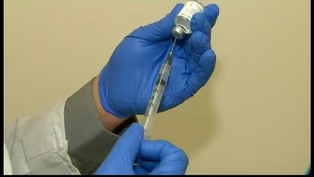
NewDoctors Sound the Alarm After Trump Recommends Changes to Childhood Vaccines
Video has Closed Captions
The administration recommends fewer vaccines and splitting the MMR vaccine into separate shots. (8m 51s)
Providing Support for PBS.org
Learn Moreabout PBS online sponsorship New Episode
- News and Public Affairs

Top journalists deliver compelling original analysis of the hour's headlines.
 New Episode
- News and Public Affairs

Today's top journalists discuss Washington's current political events and public affairs.

 New Episode
 New Episode
 New Episode
 New Episode
 New Episode
 New Episode
 New Episode
 New Episode
Support for PBS provided by:
Chicago Tonight is a local public television program presented by WTTW
WTTW video streaming support provided by members and sponsors.