
Doctors Sound the Alarm After Trump Recommends Changes to Childhood Vaccines
Clip: 8/25/2026 | 8m 51sVideo has Closed Captions
The administration recommends fewer vaccines and splitting the MMR vaccine into separate shots.
The president calls for separating combination shots — including the measles, mumps and rubella, or MMR, vaccine — into separate injections. Currently, there are no individual vaccines in the U.S. for measles, mumps or rubella.
Problems playing video? | Closed Captioning Feedback
Problems playing video? | Closed Captioning Feedback
Chicago Tonight is a local public television program presented by WTTW
WTTW video streaming support provided by members and sponsors.
Doctors Sound the Alarm After Trump Recommends Changes to Childhood Vaccines
Clip: 8/25/2026 | 8m 51sVideo has Closed Captions
The president calls for separating combination shots — including the measles, mumps and rubella, or MMR, vaccine — into separate injections. Currently, there are no individual vaccines in the U.S. for measles, mumps or rubella.
Problems playing video? | Closed Captioning Feedback
Where to Watch Chicago Tonight
Chicago Tonight is available to stream on pbs.org and the PBS app.

WTTW News Explains
In this Emmy Award-winning series, WTTW News tackles your questions — big and small — about life in the Chicago area. Our video animations guide you through local government, city history, public utilities and everything in between.Providing Support for PBS.org
Learn Moreabout PBS online sponsorshipschool this month and one of the many things they need before starting classes are their vaccinations.
But parents may feel like they're getting mixed messages after the Trump administration released new childhood vaccine guidance earlier this month, they cut the number of recommended child immunizations from 18 to 11 and split the measles, mumps and rubella vaccine into 3 separate shots.
The order comes after years of vaccine skepticism from health and Human Services Secretary Robert F Kennedy junior.
But medical professionals say the changes aren't supported by scientific evidence and could put children at risk.
Joining us, our Dr, Julia Rose Bush, a pediatrician at Comer Children's Hospital and associate professor of pediatrics at the University of Chicago.
And Dr Anita Shaw and reporting a pediatrician at Northwestern Memorial Hospital and president of the Illinois chapter of the American Academy of Pediatrics.
Welcome back.
Thanks to both for joining us.
Thank Some Dr Rose Bush.
It was just reported today that 2 unvaccinated people in Pennsylvania died from measles.
Nasa's 2 weeks after that executive order from the president than we were just discussing.
What was your reaction to the order when you first learned about it?
So I was surprised.
And of course, very concerned.
I was concerned because of the timing of the release right before children were due to go back to school.
>> And I was also concerned that this really upended or was trying to upend decades of science.
You know, there was no new science that prompted this change.
And so I was very concerned and I'm still concerned that this is going to lead to a lot of confusion amongst providers and also among our patients and their families, Dr Chandra 40, the president has been emphatic about splitting the measles, mumps and rubella vaccine into 3 separate shots instead of one.
The wait is now.
>> What was your reaction to that?
But also some of the claims that he and Secretary Kennedy have been making.
Well, I mean, I think they're executive order just basically creates a lot of confusion.
There is no separate measles, mumps and rubella vaccine in the United States.
There hasn't been a production of separate measles, mumps, rubella, since.
>> I think 2009.
So we've been using Mr as a vaccine for years and years for decades now, very successfully very safely.
And as a practicing pediatrician, there's no by ability to what he's what they suggested we do.
There's no practical way to actually implement that executive order.
It's not based on any science.
And now as patients are coming in to get their vaccines for school, there's just so much more conversation.
We have to have about the safety of the of the process that we use and have used for years.
Unfortunately, the Academy of Pediatrics actually is very emphatic about following a scientific based process.
What have you been hearing from parents have they've been raising questions?
Are you just getting in front of it and making sure that you're having this discussion with them?
I think both.
I mean, there are certainly times when we have to just talk about this is the vaccine we're going to be doing today and then went and patients should abs of their parents really should absolutely ask us about vaccines.
We encourage conversation with your pediatrician.
But appreciate that.
We are the people who have, you know, spent time researching this, studying this understanding this reading about this.
It's our that's our lane, right?
it's something that we do every day.
And we really think that it's important to have those conversations.
Sometimes we are able to convince a family again that everything is safe and OK and sometimes we actually end up having to set, you know, the family will walk away without getting the vaccine.
And at this time when we know that measles is on the rise, this a terrible time for this confusion, Dr Rose Bush.
The order decreases the number of vaccines recommended for all children designating only some as necessary more high risk groups.
Tell us about attempted change.
>> as UN stated earlier, we went down from 17 18 to about 11 and some are listed as being for immune compromise hosts only meaning people with challenged immune systems and others have been termed as shared decision-making despite vaccines.
That should be determined based on shared decision-making simply meaning, you know, you're talking with your provider.
You're making sure that those vaccines are right for you.
The problem is, is that some of those vaccines that have now been moved to share decision-making status have eliminated diseases from the general public on account of those vaccines.
So things like Coronavirus which used to be a huge contributor to childhood Morbidity is now very rarely seen owing to vaccination.
Meningococcal vaccine prevents against bacterial meningitis can be a deadly disease amongst children.
We don't see it that often anymore.
But we do see it on occasion not having those vaccines as a part of the required and routine schedule really puts children in a precarious position in terms of their health Dr.
Sandra, very this executive order to not legally binding, but what would it take for the Trump administration to actually change the vaccine requirements?
>> That's mainly forcing way right into it doesn't necessarily implement these changes.
It very simple radiation.
There is no.
I mean, just for the MMR vaccine, like I mentioned, there is no measles vaccine.
There is no moms vaccine.
There is no rubella vaccine that we could actually use in the United This would have to be a whole overhaul of the vaccine industry where a vaccine company would have to produce separate antigens the process of doing that would probably delay those vaccinations for year's in which case a whole host of children would be unvaccinated.
And we know that if you fall below a certain vaccination rate across the country, disease is spread.
So 95% is the typical vaccine rate that we want to keep our coverage rate at to protect children across the board.
And when we see numbers falling below that we have problems.
We have spread of illness.
And measles is a great example of where it's a very contagious respiratory illness.
If you dip below 95%, all those people could be susceptible to the measles The mean that would be part of the process of how they would have to actually implement the executive order.
Dr Rose Bush.
What could be the implications for children's health if these recommendations were adopted and implemented Dr Chandra just mentioned some of it that, you the production of herd immunity.
Yeah, absolutely.
And I would say that that is absolutely that the key there I'm very worried for children who are unable to receive vaccinations compromised immune systems.
I'm worried that we're going to see more of what we are seeing now.
Right?
We're going to see an absolute increase in the number of cases of vaccine preventable diseases.
And we're going to see.
>> The poor impacts that are that that the impacts that this has on our children's health and in a very negative way.
>> The executive order says that these recommendations are based on, quote, gold standard science in the relation alleged link to autism, which we all know that science and research after, you know, study after study has said that there is no link between vaccinate.
That's artisan.
But the president and the secretary are standing on that.
What does the scientific evidence tell us about these recommendations?
>> Decisions these recommendations are not backed by new science vaccine.
Science should change.
When there is new data basically inform the existing recommendations.
That's what science should do.
It should evolve.
But what is happening here is that decisions are being made politically.
But without consulting the body of evidence without consulting the experts who generally would be making these recommendations.
And that's what's particularly dangerous about what we're seeing right now.
Well, I was gonna say the other thing that I worry about with the executive order and the legality of it is that there may end up being a separation of who can get vaccines and who can't.
There are several states in this country where children are reliant upon vaccines for children program or a federal assistance program to get vaccines.
And if there becomes a disparity between who can get vaccines and cannot based upon.
>> The implementation of an executive order like this, that could become a real problem germs.
Don't know the difference between children who have private insurance and who don't.
Right.
So this is putting everybody at risk.
so that's a significant concern absence of a recommendation.
Insurance companies may not cover it.
If you choose.
Fortunately, our insurance companies know that prevention is cheaper paying for illness.
hopefully hoping have that whole thing that private insurance companies and other insurance companies will be able to continue to pay for That part is good to hear.
Okay.
Thanks to the both of
 New
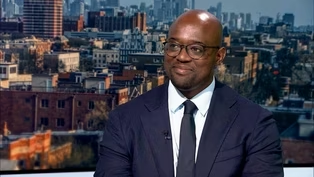
NewChicago's New Public Health Commissioner on His Plans for the Future
Video has Closed Captions
Dr. Garth Walker was appointed by Mayor Brandon Johnson and unanimously confirmed by City Council. (10m 26s)
Providing Support for PBS.org
Learn Moreabout PBS online sponsorship New Episode
- News and Public Affairs

Top journalists deliver compelling original analysis of the hour's headlines.
 New Episode
- News and Public Affairs

Today's top journalists discuss Washington's current political events and public affairs.

 New Episode
 New Episode
 New Episode
 New Episode
 New Episode
 New Episode
 New Episode
 New Episode
Support for PBS provided by:
Chicago Tonight is a local public television program presented by WTTW
WTTW video streaming support provided by members and sponsors.