
What Sustainable Data Center Development Could Look Like in Chicago
Clip: 8/13/2026 | 8m 32sVideo has Closed Captions
The rapidly evolving industry has become a flashpoint in communities across the country.
Mayor Brandon Johnson has called for a temporary moratorium on data centers in the city until new regulations are in place.
Problems playing video? | Closed Captioning Feedback
Problems playing video? | Closed Captioning Feedback
Chicago Tonight is a local public television program presented by WTTW
WTTW video streaming support provided by members and sponsors.
What Sustainable Data Center Development Could Look Like in Chicago
Clip: 8/13/2026 | 8m 32sVideo has Closed Captions
Mayor Brandon Johnson has called for a temporary moratorium on data centers in the city until new regulations are in place.
Problems playing video? | Closed Captioning Feedback
Where to Watch Chicago Tonight
Chicago Tonight is available to stream on pbs.org and the PBS app.

WTTW News Explains
In this Emmy Award-winning series, WTTW News tackles your questions — big and small — about life in the Chicago area. Our video animations guide you through local government, city history, public utilities and everything in between.Providing Support for PBS.org
Learn Moreabout PBS online sponsorship>> Mayor Brandon Johnson says it's time to take a hard look at data center development.
The rapidly evolving industry has become a flash point across the country with questions about public health, the environment and the economy as the build out charges ahead.
Many local leaders are racing to adapt, including in Chicago where the mayor this week signed an executive order calling for a pause on new data centers until new regulations are in place.
Here to discuss the city's role in responding to this developing industry are Angela Tovar commissioner of the city's Department of Environment and Chicago's chief sustainability Officer and Jared Patent, a project manager at the Department of Environment.
We also invited data center industry representatives who declined to join us.
But they did send a written statement which will share shortly.
Thanks to the 2 of you for joining us and welcome.
Thank you for having us.
So Jared, let's start with you.
Please.
What our existing data centers like in Chicago.
Yes, so we currently have about 39 data centers in the city of Chicago.
>> It's important to recognize that not all data centers are the same ones that we typically hear about on the news are very large artificial intelligence training campuses.
We don't currently have any of those in the city.
Most of our facilities tend to be what you call colocation facilities.
That's a data that's owned by one company.
And they went out some or all of their service space to other companies.
So might be multiple users of one building.
There facilities can range in size.
Some are just a few megawatts of energy, some or all the way up to what they call hyperscale facilities.
Have 100 or more megawatts.
Most of our data centers are located in the downtown South Loop is our biggest concentration or and utility corridors leading downtown.
What's the permitting process like to build one?
currently data centers are permitted by, right in most mean at all manufacturing districts, all commercial districts in most business districts.
If there is no additional plan development process unless they trigger that process for other reasons because of the size of the facility or proximity to more sensitive uses our data centers report.
Those recently released has recommendations for how we can change that to have a higher level of review.
It's okay.
>> Commissioner, what is the mayor's executive order?
Do so the executive order does a number of important things.
And primary importance is that it moves very quickly on this topic.
>> The Sustainable Data Center's report conveyed that there are a number of regulations that we have to put in place.
Our policies don't reflect what the modern data center looks like.
And so we have to move quickly to ensure that our regulations mirror what is required of a full environmental review related to data centers.
So it does a number of important things.
It directs the Department of Environment to look at our existing noise and air pollution control permits and to within 90 days make recommendations on how to improve those to think about those environmental impacts.
It also directs the Department of Planning and Development to look at a more enhanced to revive environmental review at the time of the plan development process.
So again, as Jared mentioned, if the data center is larger in scale or if it, you know, it could be the plan.
Development process can also be triggered by, you know, developing near the waterfront, for example, in those cases, the commissioner of the Department of Planning and Development.
Well, director cross departmental team to evaluate those impacts.
And then the other thing that the Iau does is that it creates a interdepartmental task force charged with shepherding this process through to realization I think one of the parts of this EO that got a lot of attention was the moratorium that the mayor called for.
How do you expect City Council to react to that?
>> Sure.
So I I think that council and the mayor have heard loud and clear from constituents.
>> Across the city and frankly, you know, other municipalities and across the nation as well, that there are deep concerns about how rapidly growing this industry is and what the potential environmental impacts are.
You know, we're hearing everything concerns about water consumption, concerns about energy use and energy intensity concerns about our utility Air quality noise, pollution.
And so if this is certainly something that we know that we have to address.
And so the mayor called for a temporary moratorium so that we can evaluate and put forth these regulations to City Council and we expect to be working hand in hand with City Council to get this moratorium passed.
Jared, the executive order.
It also comes on the heels.
You both mentioned a sustainable data Centers.
Working Group report released last month.
>> What did that report learn about the impacts of the current data centers?
>> Yeah.
So working group City Council established department working group 18 months ago for us to do a comprehensive review of what's happening with centers in Chicago.
And we identified a number of local and global impacts that come from data centers.
The global scale.
They use a lot of energy and that has concerns as impacts for energy affordability as well as climate change.
And our energy is not entirely clean.
Currently, they're also a lot of local impacts that come from data centers.
Most notably noise and air pollution.
So noise comes from cooling systems in from backup generators, air pollution comes from backup generators.
The report identified a number of recommendations.
Many of those are going to be proceed through the 2nd quarter for how to adjust.
That's okay.
>> So I do want to get to you know what we heard from the Data Center coalition.
That's the industry group.
Of course, they sent the following statement from Bread to eat his director of state government affairs for the Midwest.
He says, quote, the Data Center coalition and its members strive to be good actors where we operate, which is why we're hopeful this director from the mayor will separate those who are responsible, water and energy stewards from those who are not commissioner.
What your definition of responsible water and energy stewardship.
>> Sure.
I think you know, it's welcome that statement from from Brad.
And we certainly hope to have continued conversations with industry.
There's a lot of best practices that we can consider together.
I think a primary importance.
We need to drive more sustainable out comes the city has a wonderful precedents.
We've done that with are sustainable development policy and requiring, you know, large commercial buildings to abide by sustainable design standards.
That's why Chicago has so many wonderful lead buildings across across our city.
So we can certainly apply that same standard to all industry and to think about ways in which we can think of recycling water, right, reusing water so that we're not taking water from the front from our freshwater resources.
We can think be thinking about higher efficiency design.
We could be thinking about clean energy.
So if you're taking energy off the grid, utilizing creek, clean energy restoring that energy.
Back to the grid.
There's a lot of possibilities.
When we think about more sustainable systems and we can work and welcome that innovation as we think about next steps.
lastly, I want to share one last bit from that statement from Brett.
He's quote, data centers are net revenue generators that provide billions of dollars in economic investment.
>> Create thousands of highways, high wage jobs and help fund schools, transportation, public safety tax relief and other local priorities helping make life more affordable for Chicago.
And so obviously balance that has to be struck.
Commissioner, with regards to economic impact versus environmental impact and protection.
Sure.
And you heard the mayor say IPO signing that Chicago is open to business, but we aren't going to do that at the expense of our people.
>> And our communities and our water.
And that's an important value to lead an we can certainly work with industry to advance sustainable outcomes.
And we have to do that with understanding that these guardrails are important.
And that's the balance that we're trying to strike about.
30 seconds left.
Jerry Hauer, urban data centers, different from what you might see in other parts of the state.
Yeah.
So I mean, it really comes down to land use to local context.
When you're in a city, you don't have the ability to have a large vegetated buffer to cancel out sound, for example.
So, >> you know, when we develop our recommendations were really trying to be thoughtful about our local contacts.
We don't want to copy and paste what's worked in other areas because, you know, we're not a suburban community, Renata community from the East Coast to the West Coast.
We want to think really carefully about our own local contacts, focus on those noise concerns on
 New
NewCybersecurity Expert Talks Recent Water System Hacks
Video has Closed Captions
Several water systems from Minnesota to Georgia suddenly went offline in late July. (7m 18s)
 New
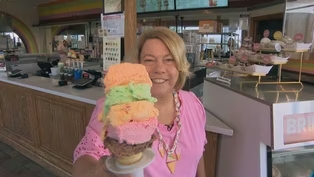
NewRainbow Cone Celebrates 100 Years
Video has Closed Captions
The Original Rainbow Cone started in 1926 on the Far South Side. (3m 58s)
Providing Support for PBS.org
Learn Moreabout PBS online sponsorship New Episode
- News and Public Affairs

Top journalists deliver compelling original analysis of the hour's headlines.

- News and Public Affairs

Today's top journalists discuss Washington's current political events and public affairs.




 New Episode
 New Episode


 New Episode
Support for PBS provided by:
Chicago Tonight is a local public television program presented by WTTW
WTTW video streaming support provided by members and sponsors.