We Witness
We Witness
11/11/2021 | 57m 37sVideo has Closed Captions
The disparities in life opportunities and resources among Chicago neighborhoods.
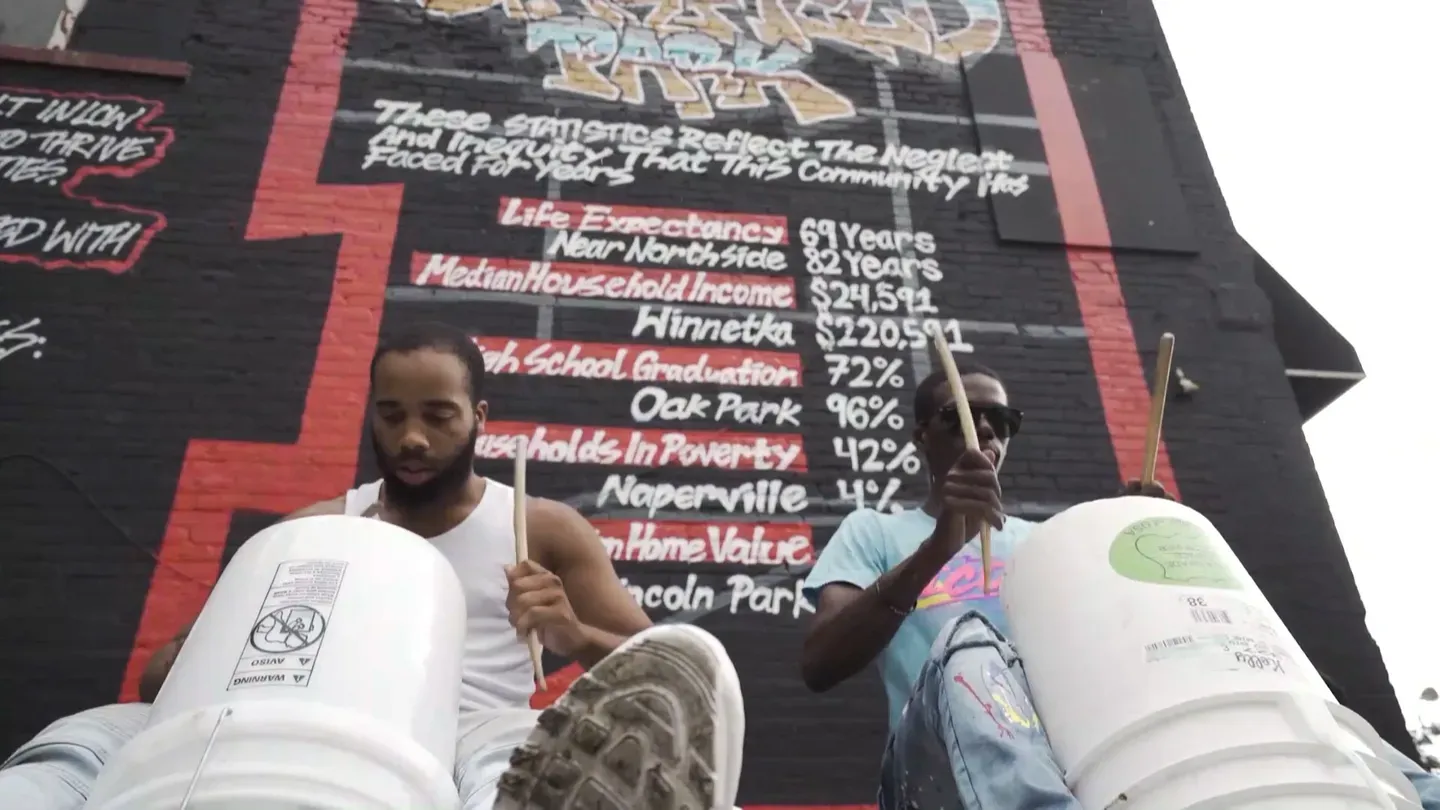
We Witness focuses on disparities in life opportunities and resources among Chicago neighborhoods, following community reaction to a mural that presents data comparing the disinvested Garfield Park neighborhood with more affluent areas. Interviews with residents, business owners, civic and faith leaders, and experts provide commentary and historical context.
Problems playing video? | Closed Captioning Feedback
Problems playing video? | Closed Captioning Feedback
We Witness is a local public television program presented by WTTW
We Witness
We Witness
11/11/2021 | 57m 37sVideo has Closed Captions
We Witness focuses on disparities in life opportunities and resources among Chicago neighborhoods, following community reaction to a mural that presents data comparing the disinvested Garfield Park neighborhood with more affluent areas. Interviews with residents, business owners, civic and faith leaders, and experts provide commentary and historical context.
Problems playing video? | Closed Captioning Feedback
Where to Watch We Witness
We Witness is available to stream on pbs.org and the PBS app.
(loud beeping) - [Paul] Wassup, Joe?
(soothing music) - [Tyreese] Hi, how are you, sir?
- [Paul] Wassgood witchu?
- [Tyreese] Take care of your health and invest your money.
- [Paul] You mean take care of your chickens?
- [Tyreese] Take care of your chickens and-- - [Paul] And your mentals.
- [Tyreese] And your mentals.
- [Paul] There we go.
Take care of your chicken.
Take care of your mentals, the city of Chicago.
We got the report card projects.
- So what this is is essentially a mural that puts up statistics that shows the disparity in the black community, in comparison to other communities.
And the aim is to bring light to why those disparities exist and what can be done to make the playing field a little more even.
- [Paul] Garfield Park.
It's a good area to look at because Garfield Park is like a lot of areas that me and you have grown up in.
- [Tyreese] And hopefully seeing these things can open up some people's eyes and it could be a wake up call to the community.
(upbeat music) - [Tim] So we're at 4333 West Madison, on the West Side of Chicago.
This is our first projects.
This mural will be an indication of what's happening in the neighborhood and a way to hold all the men and our city officials accountable.
- [Crowd] Black lives matter!
(snare drum buzzing) Black lives matter!
(car alarm blaring) Black lives matter!
Black lives matter!
(snare drum buzzing) (crowd chanting) (drum music continues) - We on the West Side of Chicago on Madison Street, one of the main streets of Chicago.
I feel that a lot of people, they're gonna understand and they gonna dwell on this message.
And I think this message is gonna take this strip a long way.
We might get Black Wall Street back.
You never know.
But our first thing is we gotta crawl before we walk.
You know what I'm saying?
Take baby steps and then we'll take the big steps, cause this message right here is gonna make things way more better in the community.
And we need more messages like this in this neighborhood.
- Think it might help or might not help.
But I don't know.
- It's really gonna take us all and just think on the same note.
You know our habit determines our futures and our movements through this, so I know this could be true, but it's still gonna take us to get together and do something (mumbles) ourselves.
Stop asking for so much help out here.
We got enough help ourselves.
- That right there in itself, lets people know that yeah, we in this community as blacks, we give a ****, you know what I'm saying?
We ain't just out here putting something on a wall 'cause we can, we actually care.
- [Videographer] Right.
- Another thing is to get these politicians or whoever is supposed to be representing our community, we need to get them to-- (ominous music) - I definitely think this project is crucial if we're going to memorialize and remember what the challenges are, that are in front of us.
And I think that it's crucial for us to have that, so that we can hold people accountable and hold ourselves accountable.
I think that we need to really come to an agreement on what those data points are and let people know what they are, what they mean, ask the questions for why the data points are what they are.
And I think it was just really important for us to be able to say, "These are the things "that differentiate our community from others.
"What are you doing about it?"
- Get that (mumbles) - She had to work all night, to make sure y'all had a ******* roof.
She had to go to her second job, that's why she couldn't take you (wind drowns out speaker) - [Paul] Some of those differences that I saw was the life expectancy in Garfield Park, in relation to the North Side of Chicago, which is - Mm-hmm.
- 69 years old in Garfield park and 82 years old on the North Side of Chicago.
Household income in Garfield Park is less than $25,000 a year.
And when that cut is $200,000.
That's a big gap, man.
That's a big gap.
Other things I saw, Garfield Park, the home value, 164,000, Lincoln Park, which is on the North Side , 600,000.
Household poverty, 42% in Garfield Park.
(car engine revving) (sirens wailing) - You know, it's sad.
(sirens wailing) It makes you wonder why.
Why the numbers like... - This mural definitely portrays it accurately.
All these are numbers that come from the Federal government, the US Census Bureau, The American Community Survey, the Chicago Community Atlas, a number of data sources.
This is not rocket science.
These are numbers that are available.
But the thing is, is whether people are aware of them and know the extent of the disparities that affect our community.
- So as I was doing my walk, I saw this mural.
I thought it was awesome.
And red and black obviously catch my attention.
And when I read it, I thought it was a good message to our community and to anybody who can read it, and maybe they can come and help the Garfield area 'cause this is a low community, where I mean, where a majority of the... where all the statistics and bad things are happening.
I think the mural is an awesome job.
I think, literally, in Atlanta people know about the Garfield area.
- It's kind of just looking at it, the life expectancy.
Compared to the near North Side - Yes.
- and Oak Park, even the income and the medium home value is a hard pill to swallow, to see the discrepancy, this disparities between the races in the North Side versus the West Side.
- Well honestly, I do think it's very sad.
And I feel like as we were conversating about before, it's like...
This community is basically being set up to fail.
And then Lincoln Park is definitely a big gap and it's like a lot of these things, we didn't know.
So it's like, how can we fix something if we don't even know what's really going on?
So, man, I think that we gotta work on our statistics to get them up.
(chuckles) I hope and pray everyday that it'll change, but I know it's gonna take more than just one little person.
We all gotta do it together, where we have to do something and we just had to be bigger and better than what they think we are.
- The idea of hope is something Reverend Jackson used to say, "If you keep on hoping, you keep on hopping."
So hope is out there.
It's something that drives people forward.
Now, when you get the idea that here's some people who are depressed, here's some people who are sad, here's some people who don't have as much hope as a lot of people with money, and money for college, and money for doctors.
And here's a group of people that don't have money for any of that.
They're just existing from paycheck to paycheck, sometimes without a paycheck and they're existing.
So here comes this project that brings some hope.
- And then, you know what, after a while, all of us who were standing here on the corner, we gonna start dedicating more time to ******* being in the studio.
And when we make music, we don't talk about how we're not on the corner today.
You know what I mean?
That's what it's gonna have to take.
What's gonna take the bridge.
What's the bridge from where we're at now, to where we wanna be.
- And the idea of that is that when you have an opportunity to talk, what happens is in the '90s particularly, we're talking in the barbershop and the conversation, "Did you see Jordan?
"It was three points down, and Jordan brought us home."
In other words, in Jordan, in the barbershop.
Even though he was an underdog at the time, he brought hope to the black community.
(crowd cheering) (hair clippers buzzing) (whistle wheezing) (hair clippers buzzing) (upbeat music) - That's the mural we've created.
It's taken a major effect in this neighborhood.
It's definitely a factor.
I would definitely say it's a factor.
- We're here, we're talking about the mural that we put on the side of next phase, that's gonna try to help bring money toward the community and things like that.
And sometimes I'm outside, enjoying the good Chicago weather, and people get off the bus and they come to the amazing, things that we have in the communities.
And they look at the mural and they say, "Man, I didn't know that those numbers "were like that low in the neighborhood."
And then it's basically educating people on what's going on.
(hair clipper buzzing) - It's very informative.
I'm not from over here, but just based off me watching you put it up, I look at it everyday like when I'm getting out of my car and I just be like, "Dang, "I didn't know that the numbers looked like that either."
- Put it out there, publicize it, muralize it.
Put it out there so that people can say, "Wow!"
It really does make a difference that life expectancy in our community is this.
And in another community that's very close, is that.
When you're putting things on a wall, you're saying, "Remember these things, remember these data points, "remember these disparities and why they exist."
And I think that that's what's important about this project because we cannot afford to continue to let people continue to forget the past if we're gonna change our future.
- Whenever a person receives information, when they become a witness of the truth of what's going on, we then have a responsibility to act with everything that we have in our disposal.
So once we know God, the God of the universe will hold us accountable for acting on that information and being a part of the change that's necessary.
(electric guitar music) - [Tim] When you simply drive from one section of the city to another, such as from downtown to the West Side or the South Side of Chicago, you will clearly see the contrast between affluent communities and the marginalized communities.
You will see one of the most segregated cities in America.
And if that's by design, whose design?
(electric guitar music) - There was a time when this community was vibrant.
As blacks continued to migrate from the rural South and moved into Chicago, one of the last vestiges of opportunity in terms of space was on what we call, the West Side of the city.
Areas were changing, whites were moving out, and as whites moved out, blacks moved in.
The buildings were already older.
Their communities were already crumbling.
There were already things that needed repair and fixing up.
(ominous music) (chalkboard screeches) (firefighter shouting) And then came ultimately (fire crackling) the riots that occurred after the assassination of Dr. Martin Luther King.
(radio chattering) (fire crackling) The businesses and commercial enterprises that were here were also pretty much destroyed.
This corridor has probably lost at least 200,000 good paying jobs over the last 50 years.
We have not seen the reinvestment of either the public resources, nor the private resources (soothing piano music) that would rebuild an area like East and West Garfield.
(soft music) (upbeat music) - Our West Garfield Park has been one of the poorest communities in Chicago, one of the communities with the lowest life expectancy.
There's a life expectancy gap between West Garfield Park and The Loop, which is five Chicago train stops in distance, a disparity of 16 years.
And so, this is a neighborhood of tremendous challenges.
And of course, those challenges have been compounded over time.
- You could look at Cleveland, Buffalo, Detroit, St. Louis, Chicago, Milwaukee.
And they, in fact, perfected a new brand of segregation that is really just something different than what you saw in the Jim Crow South or on the East Coast or on the West Coast.
It was a segregation that separated people to certain areas.
People withdrew from those areas.
And then if blacks moved into new areas, they withdrew from those areas.
And that pattern continues to today.
(somber music) - Probably the number one challenge that America has and it is born out in a community like West Garfield Park, is we have had these increasing levels of disparity between the rich and the poor.
And that is absolutely gonna be unstable for the nation going forward.
And I think there's a tremendous national dialogue going on now of how to literally, often sounds like a bad word, but how to redistribute wealth.
The fact of the matter is that you cannot have a stable body politic when you have a few very rich people at the top and then the masses of people are poor and are in states of survival.
(soft upbeat music) (upbeat music) - These conditions result in low opportunity children to thrive compared to other communities.
This info will be updated with each election cycle.
- [Paul] The report card aspect of it, I think is a great idea.
- I mean We should be holding - Mm-hmm.
- these elected officials feet to the fire when it comes to... You know how it is.
They come in with promises on what they're gonna do - Right.
- for the community.
- Right.
- it's time for them to get re-elected, and they say the same exact thing.
They say things that they've done to the community.
But did it really help?
Are we seeing the gap between-- - Did it move the needle?
- income.
Right.
- Most of the people that you would talk to are sold out.
They have other people that they beholden to and they need to satisfy those people.
But you have to satisfy something called the truth.
And if we satisfied the truth, the truth is that it's not like you say.
The truth is you are not doing, you are not acting in a way that would bring about a wholesome community.
And so therefore, we'd have to hold those guys accountable through communication.
Communication and truth.
Truth not skewed by somebody saying, "I'll give you so much money, (rhythmic music) "I'll give you so much power, "I'll give you so much of this and that."
But truth coming right from the pastor, truth coming right from the neighborhood, truth coming right from a jobless guy, who's off the job search role because he got a part-time job that pays him half the money that he needs to live.
And so, that truth has to be brought out through communication.
(drum music) I got stories to tell about people without jobs, I got stories to tell about people who needed healing.
Let me tell you about my hardship.
Let me show you about what it means for you to say that you're gonna create a bus line, a park.
What does it mean for you to see that and hear the next month, the next year, it's not here.
You're just talking empty talk and we need the truth.
(somber music) - [Paul] My question is like, I don't know why can't America solve the issues that these communities are facing?
- [Tyreese] So, I don't think it's the issue of can't.
I don't think they want to.
I don't think it's important enough.
- [Paul] Yeah.
Yeah.
But here's the thing, okay.
- Whenever there's an issue that's deemed important, they mobilize on it (finger snapping) like that.
- [Paul] Right, So if it's not important enough, what do we have to do?
What do we have to say?
Where do we have to go to make this important enough for them to see it?
- I just feel like we have to get on the same accord.
We have to control our socioeconomic circumstances and we have to wheel that power of leveraging politics, which is something that's not always that important to our community.
Of course there are people in the community that know how important it is, but when you speak to the average high school student, to the average adult, they don't know how important it is to get out there and vote and put certain people in certain positions to get certain things taken care of.
I don't think that's all the way understood.
And you need financial resources to do that.
(somber music) - Culturally, there should be the impetus to vote and then practically, the old adage that all politics is local is very true.
And so, not just voting for president, while that's important, but voting for the mayor, voting for your state rep, state senator, voting for Cook County Commissioner, voting for your alderman and knowing what those positions mean in terms of the levers of power.
How they affect or can affect change.
(upbeat music) - So what we need is first, an infusion of hope.
Individual must believe that change is gonna come.
Then we need every individual to make sure that they make the greatest use of themselves in every way possible.
They must be counted in the census.
They must be registered to vote.
They must develop an attitude of knowing who to vote for, and who to vote against and how to create mass movement that create the environment and will make the difference.
But they start by believing.
(choir music) - What does a neighborhood need?
It needs housing, education, economic development.
And of course, the church is here because it is the faith of people that has given us the resilience to come through everything that we've been through, and in spite of all of the negativity to remain hopeful.
(choir music) - I think that the center of the community is of course the church.
Now, the church in itself is a beacon in the dark.
It represents the focus of the community on God.
The church represents hope for the people.
They can come and get something they need.
They can get kind words, they can have a sanctuary, we have a food pantry.
They can get fed in more than one way from the church.
- And so, where do we start?
We start teaching our children at very early ages to believe.
(choir music) You know, I believe, for every drop of rain that falls, a flower grows.
I believe that somewhere in the darkest part of the night, a candle glows.
If you don't believe, you will not do.
And if you will not do, it will not happen.
It's sound and fury signifying nothing.
And so, believing is the road to achieve.
(soothing music) - I believe this is gonna shed light on a lot of issues 'cause, I mean yes, we march.
We're in the street, we march, we havin' a conversation, but is that enough?
- No.
- It just seems like we're missing a lot in our community.
There's value in our community.
- [Tyreese] Right.
- [Paul] And it just doesn't seem like that value is being invested in.
- [Tyreese] This is correct.
Well, I think a lot of it, bro, is education all right?
So, you gotta be more educated on taking care of your health, what you put into your body.
- Mm-hmm.
- We gotta do way more financial literacy.
You gotta learn how to invest.
We need way more business entrepreneurs in our communities.
And we need to keep the dollars in our community.
If we just keep stripping the resources from the community, the community will never grow and it will never improve.
So there's many, many facets and many, many things that need to be done in order to turn that around.
(soft upbeat music) - We talk a lot about the social determinants of health, right?
We talk a lot about, do you have transportation?
Do you have access to care?
Do you have housing?
Quality, affordable housing?
Not just do you have a place to live?
Do you have fresh fruits and vegetables and a grocery store in your community?
Those kinds of things that play a role into the hierarchy of needs.
(soft upbeat music) - People need things in quantity.
They don't need a little piece here and a little piece there.
They need a lot of things.
They need to be working together, talking together.
And with all of this working and planning, they are satisfying some needs.
There's a hierarchy of needs that people should be aware of.
Physiological safety, belongingness, self actualization.
All of these other things that you need.
Not just little pieces and crumbs, But you need a lot of good things, a lot of big things, in quantity so that you have enough to work with.
(somber music) - To have someone from another country come into our community, and they they're able to get loans, and they're able to build whatever they wanna build in our community, and we're in there buying it, why can't we all get on that page to utilize those dollars?
So we can put things in the community that we need.
Health clubs and just things that would build the community up, that other communities have no problem getting.
- [Tyreese] And maybe we need to stop looking for external forces to do it.
Maybe we just need to organize in our communities and just pull together and start doing it ourselves.
(gate creaks) - Thought wanna open up another (mumbles) skating rink more jobs.
I'm talking to bring back, love, joy, instead of all the pain and the hurt that's going on in the community.
You can bring your family, enjoy with your family.
I think this is gonna be a big thing where people come back together, people are the escape people are the bowl.
- Hey, (mumbles) (foot tapping) - This solid floor - Yeah, I know it's solid.
Yeah, the floor is solid.
Super solid on the floor side.
- Thing about that is, now, whichever one is going to be, which I think that holds the most capacity, would be the- - The skating rink.
- The skating rink.
- Yep.
- On this side.
- On this side.
- Yeah.
- Then that other side has to be wood.
- Just building, building for the community, building for every broken home, bringing back everybody together.
That's all I wanna do.
(hair clippers buzzing) - One thing is best, we gotta have our own.
And you know... And we all need that.
The neighborhood is just gonna be just completely disrupt.
- They want you to put your money in the bank, but won't let you borrow any money.
They'll let outsiders borrow money.
But it's rough for someone that wants to start a small mom-and-pop store and turn it into something more.
A barbershop, beauty shop, any of those things.
Everyone doesn't have a financial means to just open a store or open a business, should I say.
So, sometimes, it just make you kinda wanna cry.
It's rough.
(somber music) (chalkboard screeching) (shoes tapping) - A lot of work, a lot of work.
Boom.
I need assistance from anybody, the banks, from my (mumbles) from the community, from the aldermans.
Hopefully, they'll look at me and say, "Hey, this is a dream.
"And we gonna help this guy get his dream "for the community."
And they wanna see the community grow and bring more revenue, bring more jobs.
'Cause I wanted to see the whole community joining me into to bringing them back the structure-hood that Garfield Park and the Austin area.
So that's what I love to see.
Make sure the kids got somewhere to go, make sure they can grow up in a safe community, make sure that everybody that's gonna see this journey continue.
- We have promising redevelopment of our commercial corridor.
When we reenergize the Chamber of Commerce for West Garfield Park, we'll have quality educational options with the networks that we built among schools.
And then of course, housing, of which we have been involved in for a number of years.
- [Paul] I believe that's a start, - [Tyreese] Mm-hmm.
- But at some point, we need America to invest in these communities.
And I'm not just talking about the ones in Chicago.
I'm talking about the ones in Detroit - Mm-hmm.
Houston, the urban areas with people that look like us.
Some real money.
Some real money that community now doesn't have access to, need to be invested, man.
Somebody really needed to take a look.
Hopefully, with the new administration, something like that could happen.
I'm not gonna hold my breath.
It would be great if something like that happen, but you know- - Right.
- The people here are the greatest asset for this community.
Tragically, it's very difficult to build community in capitalism without capital.
We've been fixated on the murder of George Floyd in Minneapolis.
And it's been sort of a metaphor for black America, a knee on the neck.
And it's almost as if we've had a knee on our neck for four centuries in America, it's what it feels like.
It's the affixation of capital being cut off.
And so, we of course, always try to build a kind of community that can welcome more and more investment.
- We also gotta speak upon the fact that Chicago is one of the most segregated cities in this country, right?
(soft upbeat music) So, there's a lot of things that need to be seen.
These kids need to see doctors, they need to see lawyers.
They need to see business entrepreneurs.
They need to know that there's another way to go about your life so that hopefully, they don't go down that route of gang members and drug dealers and things like that.
Because if that's all you see and that's what's all in front of you and your household is dysfunctional and broken up.
Dad may not be there.
Your mother might be a single parent.
It's kind of hard to see the way out.
(upbeat music) - There are a lot of kids who live in Chicago, who have never seen or experienced a lot of the great things this city has.
And I'm talking about people who live in Auburn Gresham and have never been to the beach or the lakefront.
Never been inside any downtown building and that's sad.
And it is a sense of isolation.
However, you cannot have isolation without insulation.
And there are people who are insulated from the conditions that you see in much of the Western South side.
And they say, "Hmm, in the abstract, yeah, yeah, it's bad.
"I don't go there.
I don't wanna think about it "because it puts my mind in a negative place."
A couple of years ago, the Metropolitan Planning Council here in Chicago did a report called "The Cost of Segregation" And they basically said that more people are dying in Chicago.
Fewer people have bachelor's degrees.
Our economy is this much smaller.
And they quantified the impact that segregation has had.
And they listed a number of ideas that they said would reduce segregation.
We have the answers, it's whether we have the will to do it or not.
- This has been a community that had struggles, but I think what we have learned and what we're really learning, I think in the 21st century is that there's no way that we can be a tale of two cities, that none of us can be safe until all of us are safe.
That the violence and the pathologies that come with poverty are not gonna be contained in certain communities.
And so, what we always have tried to lift up from this place is a vision of one Chicago.
And that when we address the needs of those who are in the margins, that's when everybody flourishes.
And in theology, we call that, that's when the Kingdom of God has arrived.
- So I want equal justice.
I want equal opportunity.
I want fairness.
I want health care for everybody.
- About right.
- [Interviewer] Why do you choose right?
What do you see here that talks to you?
- The life expectancy in the city is shorter than if you stayed North or in the suburbs.
(somber music) - You can look at those communities and see the difference.
You can look at the wealth disparity, economic disparity.
When I can see the fact that 69 years is the life expectancy and that $24,000 is the household income, and you can look at data and see that people who live in poverty, which $24,000 is easily classified as poverty.
People who live in poverty have worse health outcomes.
That's where people can begin to ask questions.
And that's what we have to do now.
This is not a new topic.
And if I can say anything, that's what I wanna emphasize.
This is not new.
Health disparities have been around and been talked about since the 1800's.
(somber music) - Life expectancy, to me, is centered around your living conditions, your health, being able to have opportunity to have things that will improve your health.
Health care, so forth and so on.
That's what improves life expectancy.
Being able to go to a doctor and get the best care for yourself and to understand, have the resources to do that.
Going to doctors is something that should not be a privilege, it should be a right.
And when you talk, got candidates on the ballot that, say healthcare for all, I'm a proponent of that.
Healthcare is something that should be for everyone, not just for the privileged few.
That's what brings down (somber music) the life expectancy.
(somber music) - This area has more hospitals and health resources than some states in the United States of America.
But yet, many of the individuals who live here have not had access, have not benefited from and have not had the education that changes lifestyle.
- As I go to Ukrainian Village or Wicker Park, I see yoga studio that's good for meditation.
There's no yoga studios here.
There's no motivation to wanna take care of yourself.
There's just not anything in this community no more.
There's no resources.
There used to be doctor's offices on every other corner.
There's no more doctor's office, no dentist offices.
Only time, people get health care, or go see about their self, actually, if they're sick, and they go to the ER.
(somber piano music) - We have, unfortunately, also a been a community that has seen a lot of interpersonal violence, some gang violence, and high rates of poverty, and fragile families living in unstable housing conditions.
- I told you, I buried a lot of 13, 14-year-old kids, (radio chatter) who have been shot by the gang.
(radio chatter) (siren wailing) - I would definitely say there are some elements of post-traumatic stress disorder that we are seeing.
The number of individuals that I see in the clinic that are not sleeping restfully because of the gunshots that they hear in their communities or the nightmares that they're having from the loss of a loved one that they had or that they saw killed.
- [Woman] Hallelujah.
But let me tell you that daddy didn't stop.
That daddy didn't stop, that daddy kept on until that boy-- - Since this violence is going on in our community, my brother fell victim to it today.
I sent him home on his home going.
In Jesus name I say, but as we move on, we're gonna turn our kid's communities into gold.
All this violence will turn to gold.
That's all.
Negatives turn to positive.
My brother gave his life for it.
(choir music) (mourners sobbing) (choir music) (mourners sobbing) (people chattering) (mourners sobbing) - [Man] I love you (mumbles) I'm here so (mumbles) (people chattering) (car horn blaring) (siren wailing) - We was trying to get to the funeral line, and then somebody was trying to cut the line.
So they stopped and told them that we are trying to get into the funeral line.
(siren wailing) (crowd shouting) - This is our cousin's funeral.
Y'all see what they doing?
They just stopped him for no reason, no reason at all!
They just bust out on there, snatched him out the car!
You see the police out here pushing us.
Everything because they stopped the funeral line.
(crowd shouting) Y'all just snatched him up out that car boy.
- [Protestor] Aint no probable cause for them to be doing that.
(crowd quarreling) - [protestor] There wasn't no probable cause - [Man] The owner of this car, the Pallbearer, that's Nick, you guys have him in custody right now?
- [prostestor] Yeah - Why?
- [woman] Anybody need to stand up, any body need (mumbles) who you on, who is (mumbles) In Jesus name, oh Lord.
(somber music) - Talk about the life expectancy gap.
We don't talk about the potential life loss statistic.
This neighborhood is number one in potential life loss, which is a metric for premature death.
So on the one hand, our greatest resource and asset are the young people, the younger generation.
On the other hand, these young people are systematically... Their lives are being systematically snuffed out.
Poor education, poor healthcare, poor food, not a lot of workforce development opportunities.
We don't have a trade school at West Garfield Park.
(calm music) It would be great for young people to learn a trade.
So we need to think big.
We need to think creatively.
More importantly, we need to do it ourselves.
And so, we're not expecting a savior to come into West Garfield Park and save us, or our young people.
- High school graduation is like 72%.
Oak Park is higher.
(somber music) (soft upbeat music) - Chicago Public Schools closed 50 public schools about five years ago.
And listen, five of that 50 were in walking distance from where I'm sitting right now, it was a devastation for the community.
It was a disinvestment that did not help matters at all.
(soft upbeat music) (ominous music) - You know we say we hold these truths to be self-evident that all men are created equal and endowed by their creator with certain inalienable rights.
Well, that ought to go right to education.
If it goes right to education, equal funding for all students.
A long time ago, I used to get the old books from the white school.
And then after the white school finished with them, then we would get them.
We didn't have all the wiring necessary for a computer.
And so what we have to do is equalize education.
No matter where they are, everybody should get the same opportunity for the same kind of education.
Now you can do that.
You can do that if we decide to do it.
(soft upbeat music) We already see impact in the Garfield Park community.
The fact that students at a legal prep charter academy in Garfield Park are developing social advocacy projects around these issues, and becoming active in gathering data about the community is remarkable.
(soft upbeat music) (clippers buzzing) - The college was a great experience that got me to meet different people and just experience different ways of life that people were living.
(clippers buzzing) And I could just mirror back to it, like I say, I've met people that were rich, some were poor, some were middle class, and it was just like a great experience.
And I think everybody should experience college because it lets you know who you will be as a woman or a man in life, and what do you want to do.
(hair clippers buzzing) I didn't continue college because the funding.
I couldn't afford it, and things like that.
There were no programs that I could actually go to and try to even raise money.
(somber music) (upbeat music) - I've been cutting hair actually almost 30 years.
I opened this business four and a half years ago.
However, I do see a big vision to create a barber's college or something around here.
We have two vacant lots that can hold a barbers university or some type of cosmetology school.
I would definitely say, (clippers buzzing) we need financial literacy resources throughout this community.
Like people to actually go out and recruit and scout and teach the people in the community how to get funding to open businesses.
How to establish relationships with banks, how to buy property, how to buy some of these lots that are around.
How to build on this land.
- And like you'd mentioned before education, - Right.
- just like me, I'm into the stock market.
So are you, even more so than I am.
Nobody taught us this when we were young.
- Nobody taught us this.
So I definitely want to make it a point.
There are other avenues.
There are other ways.
You can buy some property, you can rent out some property.
There's other things that you can do that I know that I was never taught about.
Not in school, not within my family.
That is life changing stuff that I don't think is spoken about enough and I don't think is deemed important enough.
I think in some ways, it's deemed almost out of reach.
- [Paul] But if you have enough people in those communities talking about that, teaching about anything that has some type of advantage to uplifting our community should be talked about.
It does start with us.
It does start with the people that live in that community.
But it's almost like we start off at zero, at ground zero where in other communities they start off at immediate level or- - [Tyreese] The third floor.
- [Paul] Yes.
- Yeah, so this actually be the board that he say.
well let's go, like this, well, - It do go short like a slide.
- Yeah.
This right here is gonna teach the young kids that you don't have to sell drugs.
You don't have to do break ins.
You don't have to kill or steal.
You can come in here and we can teach you the entrepreneurship, from what I'm doing.
So I would love to teach the little kids how to make it without doing the wrong thing.
You can do all the right things.
And like I said, start from hard work.
It's not overnight.
So I think they come here and I think the people should join in.
Like I said, the community can join in and we help the kids together.
Like I said, it takes a village to raise the people.
So that's what I'm thinking of.
(upbeat music) - I need some jobs.
I need some jobs.
You know, with the pandemic going on right now, I know it's rough right now, but things should pick up though.
- Unemployment is all over the place in the black community.
I mean, I've heard all the stories about unemployment is at a record low.
I heard just about every male, black male that I know, has a problem with employment.
They are either unemployed, they're hustling on the streets, they're selling cigarettes, they're doing all they can simply to make it.
And so, unemployment is definitely a problem.
And I think part of the idea that unemployment is at an all time low is that a lot of our folks just stopped looking for it.
And they start to exist.
Right now, we have a food pantry coming in today and we're gonna have about 40 people coming in to get their food.
They're coming in to get their statement for the day.
Their piece of hope.
So here comes to a bag of groceries.
Here comes a word of hope, and they leave with a certain amount of somebodiness in them as they leave the place.
But unemployment is definitely a problem as seen in these 40 people who be coming through here looking for a piece of bread, a piece of fruit, a way to get back for another day.
(somber music) (shovel scraping) - The temperature today is seven degrees.
(shovel scraping) I've been at Amazon for almost two years now.
And I deliver packages.
The packages range from 100 to 400 packages a day.
The majority of the people that's working the jobs are African-Americans coming from the West Side and the South Side of Chicago.
It's a great experience working at Amazon, but sometimes it can be hard, like you barely making it.
If they can't raise the minimum wage, I don't think nobody can survive off this, especially if you don't have help to anything.
So it's like, you have to actually get up everyday, take your kids to school and still probably gotta work two more jobs just to provide for your kids.
That's not even including the rent and everything.
And then you still have to pay for childcare.
- There's nowhere in America that people work harder than poor people.
When one looks at this present pandemic, for example, the people who have the most essential jobs, who couldn't work at home, were black people and brown people in America.
COVID pandemic has absolutely expelled the stereotypical myth that people of color are lazy because these are the people who have kept the economy going.
People from communities like this one.
(upbeat music) - So what we need to do is to begin to make solutions and have action-driven solutions in place in our communities.
And the only way we do that is when people, everyday walking down the street get upset and they get involved.
And if I was walking up and down the street and I saw what percent of houses were in poverty, that would be egregious to me, right?
That would make me angry.
That would make me want to ask questions about why does that exist?
And then you begin to get to solutions.
Then you begin to call your alderman.
Then you begin to make sure that you're registered to vote.
Then you begin to make sure that you start asking questions and decide, do you wanna run for yourself?
So I think this project and projects like this are so important that we have to begin to, not just implement them here on the West Side, but on the South Side and in Detroit and in Boston and in Baltimore (upbear music) and all these other places.
(upbeat music) - Just sort of started the next stage in this board that'll be going up on 16th Street.
We want the students to connect with what this data means and be questioning why it is that way in the North Lawndale community.
- There's a lot of abandoned buildings, they closed down all the stores.
You have to go to other communities just to go grocery shopping.
Like it's all liquor and tobacco and drugs everywhere, so there's nothing for us to do other than that.
(spraying) - We've been using the phrase, "This is a racial reckoning in our country's history."
And it is true.
This is a moment in our country's history that we have to face community by community, state by state.
What we saw on January 6th is who we are, and we should face that.
We should also look in the mirror and see hope, see the change that we want and embrace it and fight for it.
Our families are worth fighting for.
Our communities are worth fighting for, our unborn children are worth fighting for.
And so, while we're on this earth for the short while that we are, we have a responsibility to fight and engage.
- And so if you can take the dissatisfaction, organize it into some action, then you've got opportunity for change.
And rather than just having one dissatisfied person, you try to have a group.
As a matter of fact, there's a hymn we sang at my church that say, give me 10 men, 10 stout hearted men, who's willing to fight for the things they adored, (crowd chanting) and I would give you 10,000 more.
(upbeat music) - [Crowd] Justice!
- [protestor] When do we want it?
- [Crowd] Now!
- [protestor] What do we want?
- [Crowd] Justice!
- [protestor] When do we want it?
- [Crowd] Now!
- [Paul] Hopefully with this documentary, it can bring light.
Maybe we can get somehow to understanding so we can implement change in these communities so they can thrive because right now I don't see it thriving.
I wanna see our communities do better.
- I mean you gotta plant the seeds, but you also gotta stick around and make sure the plants grow and they're nourished and you gotta pass them on to the next generation.
- Correct.
- Because I just feel like we have the same conversations in our community about every 20 years, it's the same conversation.
- Right, but when does the conversation lead to action?
- Exactly.
- That's what I wanna know.
When do we stop talking about it?
When do we say, okay, enough, enough.
It's time to stop talking about it.
It's time to stop marching about it, actually.
- Right.
- It's time to actually do something.
- Right.
- I don't know.
- I agree.
- That's all I gotta say about that.
That's all I got to say about that, man.
("Pain in Me" by Steve Yu)











Support for PBS provided by:
We Witness is a local public television program presented by WTTW