
Richard Whitney and the Investigation of White Collar Crime
The Senate Banking Committee investigates Richard Whitney and other white collar criminals.
From
Richard Whitney and the Investigation of White Collar Crime
Clip: Episode 3 | 6m 22sVideo has Closed Captions
The Senate Banking Committee investigates Richard Whitney and other white collar criminals.
In 1933, the Senate Banking Committee uncovers rampant corruption, speculation, and market manipulation that caused the 1929 Stock Market crash. Due to loose regulations, few financiers are prosecuted. Richard Whitney, the president of the New York Stock Exchange, is an exception, as he is charged with grand larceny and sent to Sing Sing Prison.
From
Problems playing video? | Closed Captioning Feedback
Problems playing video? | Closed Captioning Feedback
Episodes presented in 4K UHD on supported devices. Major funding for CRIME AND PUNISHMENT IN AMERICA was provided by The Atlantic Philanthropies, Emerson Collective, The Andrew W. Mellon Foundation, and...
Richard Whitney and the Investigation of White Collar Crime
Clip: Episode 3 | 6m 22sVideo has Closed Captions
In 1933, the Senate Banking Committee uncovers rampant corruption, speculation, and market manipulation that caused the 1929 Stock Market crash. Due to loose regulations, few financiers are prosecuted. Richard Whitney, the president of the New York Stock Exchange, is an exception, as he is charged with grand larceny and sent to Sing Sing Prison.
From
Problems playing video? | Closed Captioning Feedback
Where to Watch Crime and Punishment in America
Crime and Punishment in America is available to stream on pbs.org and the PBS app.
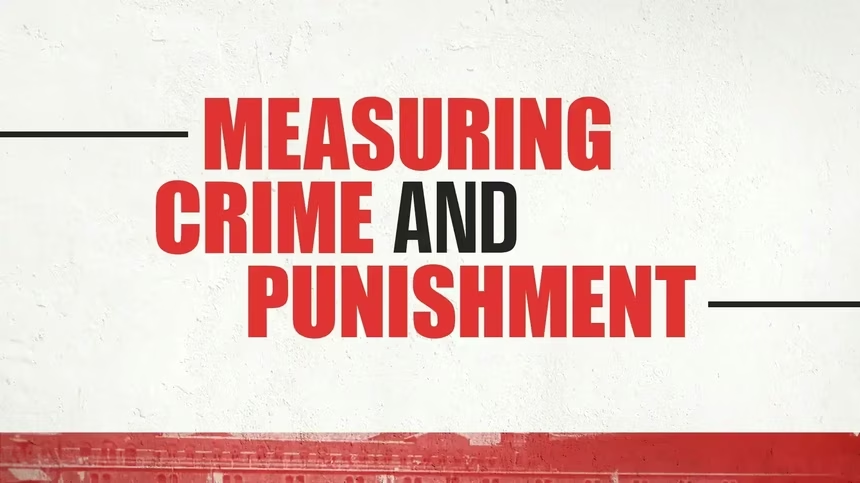
Measuring Crime and Punishment
How does the way we collect and measure crime shape our understanding of it? Crime statistics can tell us how crime changes over time. But the way crime is measured, defined, and communicated can also shape public perception and policy.Providing Support for PBS.org
Learn Moreabout PBS online sponsorshipVoice: The businessman thinks of himself as a respectable citizen and, by and large, is so regarded by the general public.
Even when they violate the law, they do not conceive of themselves as criminals.
In their confidential relations, businessmen speak with pride of their violations of law and regard the enactment of the law rather than the violation as reprehensible.
Their consciences do not ordinarily bother them.
Edwin Sutherland.
Narrator: In 1933, the Senate Banking Committee opened an investigation into the collapse of the financial system that had caused the Great Depression.
They exposed rampant corruption, speculation, and market manipulation on Wall Street.
The head of the National City Bank admitted that he and his colleagues had profited handsomely from short-selling their own bank's stock during the crash, paying no taxes on their big bonuses, rewarding themselves with interest-free loans, and reselling bad loans to unsuspecting customers overseas.
J.P.
Morgan Jr.
conceded that he had made stocks available at deeply discounted prices to powerful friends, including former president Calvin Coolidge and Supreme Court Justice Owen Roberts.
One reporter noted that the only difference between a bank president and a bank burglar is that one works at night.
The Depression-weary public was infuriated.
The financial industry was so loosely regulated that most of what the committee had uncovered was legal, and the titans of Wall Street wanted to be sure it stayed that way.
The president of the New York Stock Exchange, Richard Whitney, promised Congress that bankers and traders could continue to police themselves.
But the hearings did spur Congress to pass the Securities Act and the Glass-Steagall Act and to establish the Securities and Exchange Commission.
President Roosevelt put Joseph P. Kennedy, who had made a fortune manipulating the stock market before the crash, in charge of the SEC.
It takes one, Roosevelt said, to catch one.
Still, crooked financiers were rarely prosecuted and almost never convicted.
Richard Whitney was an exception.
To support his lavish lifestyle and to make up for losses from speculative investments, Whitney had embezzled hundreds of thousands of dollars from his father-in-law's estate, the New York Yacht Club, Harvard University, and from the Stock Exchange's own charitable trust funds.
In 1938, he was found guilty of grand larceny.
Newsreel announcer: The man whose downfall shocked the nation, Richard Whitney.
Now grim Sing Sing on the Hudson awaits him.
Nearing the big house, no private limousine for the former king of finance, who once owned nine.
Now he's just one of a batch of prisoners crowded together in a police-guarded car, as he arrives at the prison to serve a sentence of 5 to 10 years for grand larceny.
[Cell door closes] Narrator: At Sing Sing, Whitney was examined by prison psychiatrists, who concluded that he lacked any trace of remorse.
One of the leading criminologists in the country, Edwin Sutherland, believed Richard Whitney, and others like him, caused far more harm than the bank robbers and kidnappers on the FBI's public enemies list.
Sutherland came up with a new name for them: white-collar criminals.
Voice: White-collar crime is real crime.
Their criminality has been demonstrated again and again in the investigations of banking, public utilities, railways, munitions, the oil industry, and politics.
White-collar criminality is found in every occupation.
The financial cost of white-collar crime is probably several times as great as the financial cost of all the crimes which are customarily regarded as the "crime problem."
Although a million-dollar burglar or robber is practically unheard of, these million-dollar embezzlers are small-fry among white-collar criminals.
Edwin Sutherland.
Narrator: Sutherland had evidence implicating some of the wealthiest families in America-- DuPont, Firestone, Ford, Mellon, Morgan, and Rockefeller.
But he did not dare publish it.
Kevin H. Sharp: Bob Dylan said, "Steal a little and they throw you in jail.
Steal a lot, and they make you king."
There's a lot of truth in that.
And someone who is being prosecuted, under a white-collar criminal statute would be surprised to think of themselves as a criminal.
But it is clearly a crime; it is not a victimless crime.
There are people whose lives are destroyed, and they are destroyed financially, which, then, has its own ripple effect.
Larry Krasner: This is a world where a small number of people have more wealth than everybody else put together.
Our politics work around that.
Our economies work around that.
And the reality is that the court system itself responds to that.
The world's biggest financial manipulators and the world's biggest polluters, the world's biggest drug dealers, who work as executives in Big Pharma, who do terrible things that destroy lives, get away with it.
But we view some kid who is stealing chips and a soda from a convenience store as being a criminal.
That's, obviously, completely upside down.
[Siren]
 New
'Criminal justice ... is as much about regulating morals' as safety
Video has Closed Captions
Clip: Ep3 | 38s | The criminal justice system is weaponized to police morals and regulate women's autonomy. (38s)
 New
Dragnet, the Thin Blue Line, and Improving the LAPD's Image
Video has Closed Captions
Clip: Ep3 | 5m 16s | LAPD Chief William Parker works with the TV show Dragnet to improve the department's public image. (5m 16s)
 New
Fred Korematsu Fights Internment
Video has Closed Captions
Clip: Ep3 | 10m 47s | Fred Korematsu defies President Roosevelt's order to detain everyone of Japanese descent. (10m 47s)
 New
J. Edgar Hoover and the FBI Fight the War on Crime
Video has Closed Captions
Clip: Ep3 | 7m 17s | To win the new war on crime, the FBI sets their sights on famous targets like John Dillinger. (7m 17s)
 New
Prisoners Riot to Protest Poor Conditions and Abuse
Video has Closed Captions
Clip: Ep3 | 5m 32s | There is a string of prison uprisings as prisoners protest abuse and unfair living conditions. (5m 32s)
Providing Support for PBS.org
Learn Moreabout PBS online sponsorship






Support for PBS provided by:
Episodes presented in 4K UHD on supported devices. Major funding for CRIME AND PUNISHMENT IN AMERICA was provided by The Atlantic Philanthropies, Emerson Collective, The Andrew W. Mellon Foundation, and...