
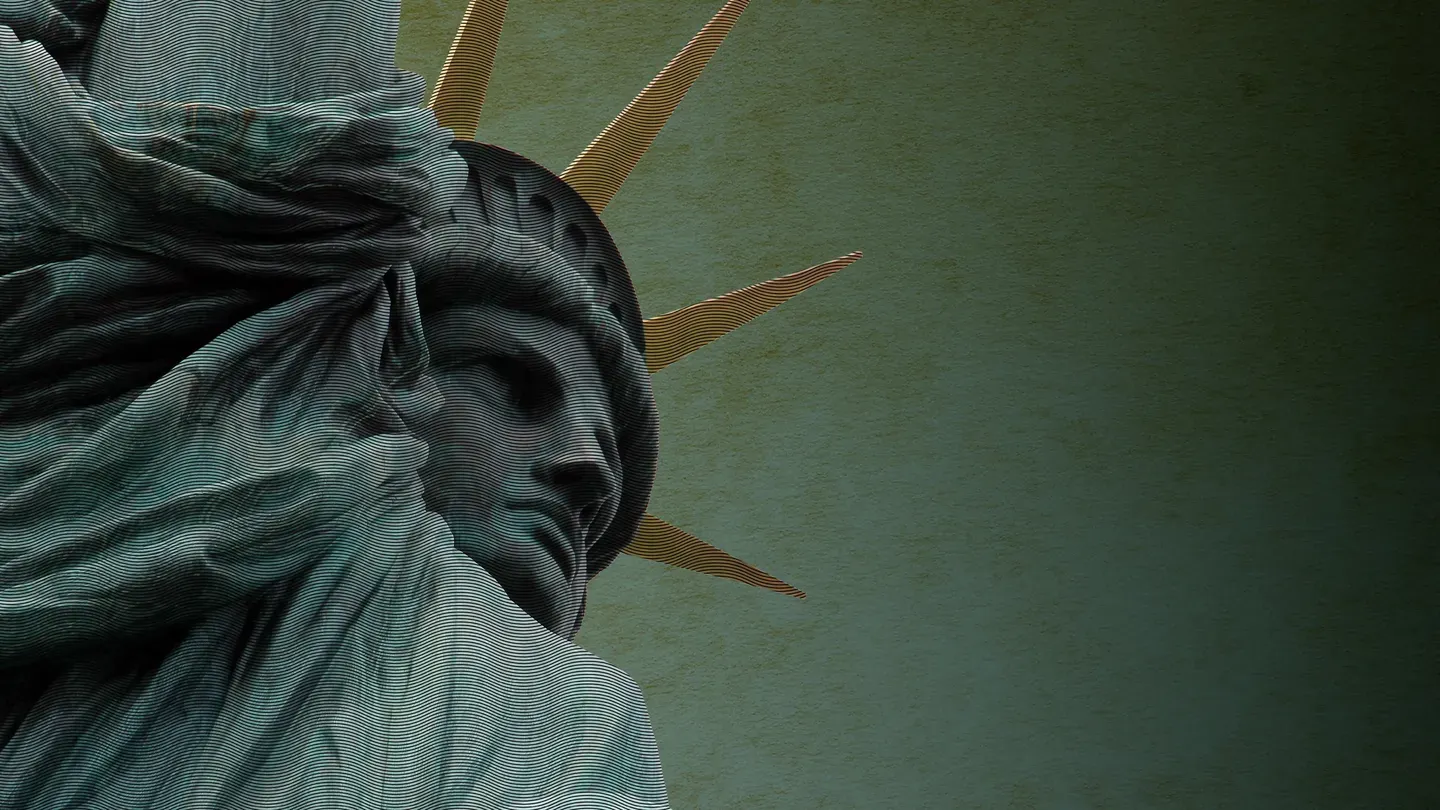
Raising Lady Liberty
Season 23 Episode 6 | 54m 56sVideo has Closed Captions
See how the unique partnership between two countries made the iconic monument possible.
She has stood at the entrance to the New York City harbor for nearly 150 years, welcoming millions who have come to start new lives. The Statue of Liberty is an enduring symbol of freedom and a metaphor for the American dream. With unseen documents and new sources, witness the story of how France and the United States came together to produce one of history's greatest monuments.
Problems playing video? | Closed Captioning Feedback
Problems playing video? | Closed Captioning Feedback
SECRETS OF THE DEAD is made possible, in part, by public television viewers.
Raising Lady Liberty
Season 23 Episode 6 | 54m 56sVideo has Closed Captions
She has stood at the entrance to the New York City harbor for nearly 150 years, welcoming millions who have come to start new lives. The Statue of Liberty is an enduring symbol of freedom and a metaphor for the American dream. With unseen documents and new sources, witness the story of how France and the United States came together to produce one of history's greatest monuments.
Problems playing video? | Closed Captioning Feedback
Where to Watch Secrets of the Dead
Secrets of the Dead is available to stream on pbs.org and the PBS app.
Buy Now
Providing Support for PBS.org
Learn Moreabout PBS online sponsorship♪♪ -Weighing more than 150 tons and standing over 300 feet tall, she's one of the most iconic statues in the world.
-This was going to be colossal, a monument of worldwide proportions.
-Millions visit her every year, drawn by what she represents.
-She symbolizes liberty, immigration, resilience.
-Symbolically, it was incredibly powerful.
It was a beacon of freedom.
-Despite her fame, few people know the behind-the-scenes struggle, the sacrifices an ambitious young French sculptor made for his dream.
-Most people thought it was crazy and he did it anyway.
-Big dreams don't come easily.
-Americans didn't build monuments.
What does this guy want?
-It took decades of determination and fundraising.
-It was enormous.
It was a massive engineering project.
[ Thunder crashes ] -My father came to New York and he saw it for the first time late in his life.
Seeing it just made him so emotional.
-The Statue of Liberty is an immensely powerful metaphor for what the United States of America can be.
It's something worth fighting for.
-This is the story behind one of the world's greatest monuments and those who fought to make her happen.
In the name of liberty, justice and equality.
"Raising Lady Liberty."
♪♪ [ Indistinct conversations, faint dinging ] 1885.
In a vast Parisian workshop, a crisis is unfolding.
The sculptor Auguste Bartholdi is facing one of the worst moments of his life.
He's just finished his masterpiece, the giant statue of Lady Liberty, a gift from the French people to the American Republic when he receives terrible news.
More than 3,000 miles away in New York Harbor, they've failed to build the statue's stone pedestal.
Ten years of work is at a standstill.
The sculpture lies in pieces, stacked in more than 200 crates back in Paris.
Bartholdi must fight to save his dream and decides to write a book to raise funds.
The entire story of the Statue of Liberty.
But would the book sales ever be enough?
♪♪ ♪♪ Hidden away, one of the few remaining copies of the book lies in the archives of the New York Public Library.
It's a tiny 66-page booklet that historian Edward Berenson has been studying for many years, one of the only records of the time Bartholdi spent bringing his grand idea to fruition.
-So here we have "The Statue of Liberty Enlightening the World."
-This is a very short book Bartholdi wrote in the spring of 1885, and the purpose really was to help raise funds for the pedestal.
And he describes really at great length how he actually built the Statue of Liberty.
-The booklet explains the statue's origins, Bartholdi's original inspiration for her, a gift to illustrate the unity between two republics.
♪♪ [ Indistinct shouting, gunfire ] Decades earlier, there is turmoil in France.
After years of revolution, war and instability, the fledgling French Republic is overthrown in 1851 by Napoleon III, who declares himself emperor.
And across the Atlantic, the American Republic is beginning to tear itself apart over slavery, the country's original sin.
-The fundamentals of the inalienable rights of the Constitution really are about life, liberty and property.
What it translates into is human property in the South, the right to hold slaves.
You have this compromise about where slavery can spread and where it cannot spread.
-Abraham Lincoln is trying to limit slavery's expansion into the Western territories.
Everything comes to a head when he is elected president in 1860.
-There's this collision course that the United States is on for much of the 19th century.
It just blows up.
-In 1861, the Civil War breaks out.
11 states where slavery remains legal joined forces under the Confederate flag against the northern states loyal to Lincoln.
The northern forces eventually prevailed, and in 1865, new constitutional amendments abolished slavery.
But President Lincoln is not able to celebrate this victory.
He is assassinated before they are ratified.
♪♪ ♪♪ It's in these troubled times that Bartholdi, who longs for a French republic, has a life-changing encounter, a meeting with Edouard Laboulaye, for whom he'd make a sculpture.
Laboulaye is a professor of law at the Collège de France.
A fellow supporter of the French Republic, he, too, campaigns for liberty.
♪♪ -[ Speaking French ] -For 60 years, America has lived happily and powerfully under the rule of the laws it freely gave itself.
It is in full enjoyment of its government.
The constitutional problem is resolved.
This is Edouard Laboulaye's first lecture at the College of France.
His lectures began to become very popular, not only with students but also with Parisian society.
-When the news of Lincoln's death reaches France, it spurs supporters like Laboulaye into action.
-The republican forces in France were desperately hoping that the American Republic would stay intact.
Then the hope among the French Republicans was that they could do the same thing, that they would be able to defeat Napoleon III and maintain their republican system.
-One evening I was going to have dinner at my friend Laboulaye's house near Versailles.
-Most historians agree that it's at this 1865 dinner when the seeds for the Statue of Liberty were first sown.
-Laboulaye gathered a group of like-minded people, and their objective really was to do something to commemorate the life of President Lincoln and also to celebrate the victory of the North.
The conversation was mainly about what can we French Republicans do to express our hopes that the American future would be a Republican one, and that France maybe could follow in its footsteps.
-Laboulaye makes a bold suggestion, a gift given to the American people to represent their shared belief in liberty and show their unity.
He also hopes it sparks a new desire for democracy among the French.
-One of the notions that Bartholdi tried to put forth in the pamphlet he wrote in 1885 was that they somehow decided to create the Statue of Liberty at that meeting.
From all the evidence, that's just not true.
That idea would come later.
♪♪ -These are the beginnings of the Statue of Liberty.
Bartholdi has a specific idea for what the gift should be.
Perhaps not surprisingly a sculpture.
♪♪ ♪♪ -[ Speaking French ] -We're looking at the oldest known model for the Statue of Liberty.
It's a clay model which Bartholdi sculpted.
He also dated it.
We can see the number 70.
So it's from 1870.
From the very beginning, he envisioned a lighthouse.
This is clear proof that he already had a fairly precise idea of the form he wanted to give his monument.
-Bartholdi realizes his moment has come when, in 1871, Emperor Napoleon's reign ends, paving the way for a French republic.
After sharing his big idea with Laboulaye, the sculptor decides to announce it across the Atlantic.
-Dear sir, I have arranged to leave for the United States at the end of this month.
I thought it was the right time to carry out my monument project.
I will try to glorify the Republic and liberty in America while waiting to find them one day back home.
-In June 1871, armed only with letters of introduction from Laboulaye and a model of his statue, Bartholdi sails for the United States in hopes of finding support for his dream.
♪♪ ♪♪ After 12 long days at sea, Auguste Bartholdi arrives dazzled in the New World.
♪♪ -The sight of the harbor was marvelous in its grandeur and movement.
One cannot imagine such a teeming mass of ships crisscrossing each other.
What strikes you first are the immense steamships, which are called ferry boats.
-Bartholdi immediately recorded his impressions in a travel journal.
And in among his sketches, an island in the harbor.
-The small island seems to me the ideal spot for my project.
-The reason he picked what was then called Bedloe's Island is that it's where the opening to New York Harbor is very narrow.
And so he knew that every boat would have to pass right next to his Statue of Liberty.
It was the first thing that anybody who was coming to America would see.
-Bartholdi has a revelation.
If he can get his statue placed here on Bedloe's Island, his monument would greet people as they arrived in New York Harbor.
♪♪ But first he has to convince the Americans.
Bartholdi gets to work.
But he only speaks French.
-When Bartholdi told the Americans what he wanted to do, they looked at him as if he were this eccentric artist.
-Dinner at Mrs.
Botha's.
I'm given letters and advice.
It's all vague and cold.
-Americans didn't do things like that.
They didn't build monuments.
It was still a new country.
It's not yet a century old, and it was a very practical country.
And we're going to build railroads and we're going to build houses and factories.
♪♪ And so there was a lot of suspicion.
What does this guy want?
-Bartholdi even manages to visit President Grant.
♪♪ But it's futile.
No one seems interested in his idea.
Then Bartholdi tries a new approach.
He makes his way to the city where the Declaration of Independence was signed.
Philadelphia.
♪♪ -When Bartholdi went to Philadelphia, he met Colonel Flournoy, who was one of the people in charge of creating the centennial celebration of the American Revolution.
That gave Bartholdi the idea that that's the way he should present the Statue of Liberty.
It's going to be a gift from the French people to the American people in recognition of the America's 100th anniversary of liberty.
And that really got him some buy-in.
-I'm making my case with a new perspective -- offering a commemorative monument in 1876.
This seems to be a better approach.
-It's the first bit of positive news from the Americans, and Bartholdi returns to France full of optimism.
♪♪ The countdown begins.
Bartholdi only has four years until the 100th anniversary of the American Republic, but in France, the nation is still politically unstable.
Bartholdi faces a daunting challenge.
-The French government was officially a republic, but it was run by monarchists, and so there really wasn't very much interest in the project.
And so he just kind of worked on it on his own.
-This gave me time to think about preparing everything in advance and to make my first models.
♪♪ -America was seen at the time as an ideal society, and Bartholdi wanted his statue to serve as an actual beacon or lighthouse.
But could he find a design that appealed to both countries?
During his visit to Washington, he had seen the statue atop the dome of the Capitol building.
Lady Columbia, who symbolizes the United States.
While in France a similar figure, Marianne, came to represent liberty during the French Revolution.
Bartholdi's new statue would combine the two.
♪♪ ♪♪ ♪♪ Standing like a goddess, she'd appeal to both nations while holding up a powerful emblem.
A torch.
-A lot of the founding religious imagery for the United States had to do with the light and the beacon, and our sense of ourselves as an example of, in Lincoln's words, government of the people, by the people and for the people.
♪♪ -The Statue of Liberty's torch does appeal to the messianic instincts in Americans.
It does appeal to their sense that they have a special place in the world, and that the future will be better for the presence of the United States of America.
♪♪ ♪♪ -The original design had a feature that was ultimately moved to avoid controversy.
-[ Speaking French ] -In this first version of the drawing, the statue holds a broken piece of chain in its left hand.
-In France, this broken chain would have symbolized liberation from emperors or tyranny.
But in America, it meant something else -- slavery, which had torn the country apart.
Bartholdi decides to change his design.
-[ Speaking French ] -In this version, corrected by Bartholdi, we can see what he's done with the ink and paint to indicate the stone tablet instead of the chains.
-The significance of the chains is fascinating.
The Republican Party and the Democratic Party is starting to come together.
And so having that kind of symbolism, it would have been for so many people just too much.
-The chains were still there, but placed nearly out of sight under Lady Liberty's feet.
-I think that removing or putting the chains in a different place, it's a compromise that some of us might have wished didn't occur.
But it's a compromise that perhaps needed to occur.
That sort of notion of racial difference is something I don't think we've dealt with very well in this country at all.
♪♪ ♪♪ -With the final designs complete, Bartholdi chooses a workshop large enough to build the statue, now called Liberty Enlightening the World, piece by piece.
♪♪ One of the few remaining items that shows how the construction was done is kept at the Museum of Arts and Crafts in Paris.
-[ Speaking French ] -Here we have a very precise representation.
We see the workers transporting the plaster and others mixing the plaster like here in a trough.
We see all these highly specialized workers, the elements of construction, the scaffolding.
It's a very realistic, lively image.
♪♪ -There are dozens of plasterers, carpenters, panel beaters, and sculptors.
And that leads to an obvious question.
How will it all be paid for?
Bartholdi and his mentor, Laboulaye, are determined not to use public funds, as was usually the case for a big monument.
♪♪ -[ Speaking French ] -This is not a diplomatic gift from France to the United States.
It's truly a gift from the French people to the American people.
So Bartholdi is actually going to lead a fundraising campaign with Laboulaye, mainly from private sources.
-The timing is perfect.
The new French Republic now allows a free press, and Bartholdi knows exactly how to exploit it to raise funds for his statue.
-At this point, you had something new, which was the illustrated magazine, and they portrayed the Statue of Liberty.
It became real because you could see it, and it was those illustrated magazines that really made it possible for Bartholdi to come up with the money.
-The first big crowdfunding campaign is announced.
Its goal is 400,000 francs, or more than $2.5 million today.
-The appeal generated considerable response.
Mr.
Delhomme, 500 francs.
Mr.
Estevan, Paris, 1,000 francs.
Mr.
Bancroft, 270 francs.
Mr.
Nordsmann, 765 francs.
-French donors rush to contribute, persuaded by the idea of a strong bond of friendship between the two republics.
Soon city councils join in.
-The city of Paris has just voted to allocate 10,000 francs.
Chalons-sur-Marne, 100 francs.
-But this good news doesn't change the fact that time is running out.
The centennial of American independence is now only six months away.
Bartholdi hasn't progressed past a tiny model just three feet tall.
He decides to dazzle Americans into supporting him by showing them one remarkable finished piece of the statue -- the torch.
♪♪ -He had the original idea of Liberty enlightening the world, and so for him, the torch was the most important part of the-- of the Statue of Liberty and that's why he built it first.
-Bartholdi commissions photographs to reproduce and sell, to raise money.
They are the only visual record of the work in progress.
-[ Speaking French ] -It is a series of photographs that illustrate the different stages of the works.
And here we have a truly invaluable record of how the statue was built.
♪♪ -This image shows Bartholdi with the first stage of the hand.
Small wooden strips are nailed to a frame in a rough shape.
♪♪ Then plaster is layered on top to create the exact form.
-Bartholdi is there in Gaget's workshop to check, correct and see if it is satisfactory to the eye.
The plaster dries quite quickly.
It can be corrected and spread fairly easily.
♪♪ -The next step is to make a precise mold of the full-size plaster model using wooden boards.
a template essentially of the hand and torch.
♪♪ -[ Speaking French ] -And on this wooden template, we shape a fairly thin sheet of copper around an eighth of an inch thick to push the copper sheet and give it its final shape.
♪♪ ♪♪ -It's a laborious job, but a few months later, a moment of magic.
A giant copper hand and torch more than 20 feet high, tall enough to reach the workshop ceiling.
♪♪ -To give Americans an idea of the work, the right hand of the statue was sent to Philadelphia.
I returned to the United States.
-Five years after his first visit, Bartholdi travels back to Philadelphia to unveil the first piece of the statue.
America was hosting a World's Fair to celebrate the centennial, and invited nations from around the world to witness the young country's progress.
-City leaders of Philadelphia wanted the centennial to demonstrate for the world the incredible resources of this continent.
The message was there's land, there's work, there's creativity.
You can make it here.
We are the future.
-The torch became the very most popular part of the centennial.
You could go inside.
You could climb up to the -- to the top.
You could take photographs of it.
It was wildly popular.
♪♪ -The Philadelphia crowd is delighted to pay for a photo standing on the torch balcony, and Bartholdi can't resist posing there himself.
-On February 22, 1877, the American Congress voted in favor of accepting the gift from France.
-Bartholdi has won the hearts of the American people.
-The French American Committee got Congress to agree to give Bartholdi space on Bedloe's Island.
There was also a bid to put up $100,000, and that bid failed.
So you're going to have a part of Bedloe's Island, but you can't have any money.
-Back in Paris, for Bartholdi, the question of cash flow becomes urgent when work on the next giant piece begins -- the head.
-[ Speaking French ] -Bartholdi was also a truly remarkable businessman, and he knew perfectly well how to advertise his statue, organizing visits to the workshops where it was being assembled so that people could see it and get to know it.
♪♪ -I visited the Statue of Liberty.
It's one of the most curious sights imaginable.
One workmen on the first floor of the scaffolding corrects the crease of the mouth.
The other, on the second floor, retouches one of the eyes.
-Bartholdi's fundraising plan works and the head is finished just in time for the next Universal Exposition, this time in Paris in 1878.
The giant head is wheeled through the streets, much to the excitement of the city's residents.
-Yesterday, the colossal head representing Liberty was brought to the Champs de Mars.
A considerable crowd accompanied the wagon pulled by 16 vigorous horses.
♪♪ -[ Speaking French ] -The head is large enough to accommodate a small observatory.
There are small windows in the statue's crown that will allow us to see New York Harbor in the future.
-For the sum of one franc, visitors could climb inside and enjoy a unique view over the rooftops of Paris.
And Bartholdi has another surprise for them -- a fairground attraction called a diorama.
-[ Speaking French ] -A diorama is a scenographic device designed to immerse visitors in an atmosphere in an event.
It's somewhat equivalent to today's virtual reality experiences.
It's the same idea, or at least the same fantasy.
Essentially, it's a large, circular painted canvas, like a theater set, that allowed visitors to imagine themselves arriving in New York on the deck of an ocean liner and seeing the Statue of Liberty.
♪♪ -Although only two parts of the statue are finished, it's already causing a stir on both sides of the Atlantic.
-There was a funny editorial in The New York Times.
They said something like, well, okay, so we have the top of the Statue of Liberty, but how do we know that there's ever going to be the foot and the leg and the torso?
♪♪ -By the time he's 45 years old, Bartholdi has spent nine long years working on the statue.
Over and over again, work grinds to a halt, but each time he manages to revive it.
But one of his biggest challenges is how to build a statue so tall.
Fortunately, one of France's most accomplished engineers, Gustave Eiffel, has the answer to Bartholdi's problem.
-A lot of Americans don't know that the skeleton of the Statue of Liberty, the thing that actually holds it up, was built by Gustave Eiffel, who later built, of course, the Eiffel Tower.
You could say that there's an Eiffel Tower inside the Statue of Liberty.
-Gustave Eiffel was establishing his reputation, particularly as a bridge builder.
He was becoming a major figure in the field of metal construction.
-Eiffel mastered a technique for building strong lattices of iron, which allow for immense load-bearing and wind-resistant structures.
Eiffel's team gets to work modeling the forces that could affect the statue.
At over 300 feet tall and with more than 30 tons of copper needed for the exterior, the structure inside needs to be super strong.
It's only on the inside that one can see how it works.
-One of Eiffel's great innovations was to figure out how to support the statue not from the bottom but actually from the top.
The exterior of the Statue of Liberty hangs on a series of supports, which is really quite extraordinary.
There is an internal column pylon made out of wrought iron, designed in the same way that Eiffel designed his bridges.
-At 92 feet tall, the pylon bears all the weight, like the tower on a suspension bridge.
Then a secondary metal framework radiates out from the tower to connect to the copper plate shell on the outside.
The copper was light enough for such a tall sculpture to stand upright.
-A skin of copper that almost floated on this skeleton of wrought iron.
What this system really does is it makes the Statue of Liberty float on what amounts to a series of springs.
♪♪ -[ Speaking French ] -The system allows for a certain degree of mobility, a certain expansion.
The statue is exposed to the sun, so it deforms slightly.
It allows it to absorb the effects of the wind.
-And it had to stand in New York Harbor where there can be hurricanes.
As a work of engineering, it's really extraordinary.
-More than 120 tons of iron, tens of thousands of iron rivets.
The pylon takes shape in the courtyard of Bartholdi's workshop, paving the way for the final stage, the body of the statue enlarging the tiny model to a huge scale.
-[ Speaking French ] -This is one of the copies that was used for the enlargement.
This one is at 1/16 scale.
This is the final dimension achieved using traditional sculpting methods.
At this stage, minor corrections were still possible, particularly in terms of proportions.
Once started, we can't change anything anymore.
-The slightest error could be catastrophic, making the whole structure unstable.
And at that time, traditional methods are the only way.
-The sculptures made the enlargement, using a compass on the lead wires and rulers.
-To create the final mold for the copper, they take measurements by hand, point by point, in three dimensions.
Each of these coordinates is then multiplied to find the final dimensions of the statue.
Ten square feet of copper requires roughly 9,000 individual measurements.
The copper sheet itself is only two pennies thick.
In total, 300 individually molded copper panels are made, joined with roughly 300,000 copper rivets.
-Once manufactured, the copper pieces were transported to the courtyard to be fixed to the iron frame.
♪♪ -Piece by piece over four long years, the giant statue rises 100 feet above the rooftops of Paris, an incredible feat of engineering.
Parisians from across the city are drawn to the workshop, and Bartholdi charges each person an entrance fee.
The sculptor, now 50 years old, has succeeded in creating his masterpiece.
But little does he know that, a few months later, he'll face the biggest crisis of the entire project.
-There was a division of labor and finances.
The French would pay for the statue itself, and the Americans would pay for the pedestal.
But the fundraising campaign really ran into trouble.
-The Union League Club, which was founded during the Civil War to raise funds for the Union cause, takes charge of the design and funding for the pedestal.
-It was really the members of the Union League club who constituted the core of the fundraising committee.
The Union League Club made a resolution -- "We will do everything that we can to raise the funds necessary to build the base, place the statue, erect the statue on the base, and then we will have it dedicated."
The club also had to get an architect, Richard Morris Hunt, who was a member of the club.
-The architect of the pedestal, Richard Morris Hunt, was the first American architect to be trained at the Ecole des Beaux-Arts, the School of Fine Arts in Paris.
It's very likely that he got to know Bartholdi.
-The club members approached New York's business elite for private donations, among them Charles Tiffany, founder of Tiffany & Co.
They then organize a fundraiser, auctioning off art and poetry.
-The most famous work that was auctioned off was a poem by Emma Lazarus called "The New Colossus."
There is just -- It's a handwritten piece of paper that somebody bought at that auction.
And, of course, it became one of the most famous artifacts of the Statue of Liberty.
-For all its success, though, the auction raises nowhere near enough.
They still need more than $100,000.
-You started to see political cartoons.
There's a cover of LIFE magazine that shows the Statue of Liberty as so old that she can no longer have the strength to hold up the torch because she's grown very elderly while she's waiting in vain for the pedestal to be built for her.
♪♪ -The statue is packed in 200 crates, but it's not going anywhere.
Bartholdi's friend, Laboulaye, passes away and is no longer there to support him.
The final words of Bartholdi's book are desperate.
-May God bless my work.
Crown it with the success and moral influence it deserves.
I will be happy to have been able to dedicate the best years of my life to the creation of the monument to Franco-American friendship.
[ Thunder rumbling ] [ Thunder crashes ] -Sales of the book prove insufficient, and it seems the project might never be completed.
[ Birds crying ] [ Fog horn blares ] The irony was that, during the 10 years of the statue's construction, New York City had become richer than ever before.
It had grown unrecognizable with new bridges and buildings, all landmarks of prosperity.
-By the 1880s, New York was growing economically, and New York's super rich are building immense mansions on Upper Fifth Avenue, and it becomes the boulevard of the very rich.
-Rockefeller, Carnegie, and J.P.
Morgan -- the faces of this new social class that emerges during the Gilded Age after the Civil War.
Their apparent greed earned them the nickname "robber barons."
-The robber barons were reorganizing the American economy by establishing monopolies, establishing all sorts of means of reducing their own risk.
It entrenches their position, but it gives many people a feeling that the economy is mired in corruption and inequality.
And that unnerves a lot of Americans.
-These millionaires accumulated more and more money.
-At the time, sharing wealth or the idea of philanthropy was very rare, even for the amount needed for the pedestal, $100,000... ...until one New Yorker becomes particularly annoyed.
-We have over 100 millionaires in this city, any one of whom could have written a check for the entire sum without feeling like they had given a single dollar.
But do these people care about a Statue of Liberty, which only reminds them of the equality of all citizens of the Republic?
-Joseph Pulitzer was a Hungarian Jewish immigrant who became the most famous publisher in America.
In 1885, Pulitzer owns a highly regarded New York newspaper -- The World.
-The New York World is a dramatic kind of newspaper.
It seeks to find readers in the full population of New York City, but especially working people and immigrants.
It's the newspaper of the people.
[ Keys clacking ] -Joseph Pulitzer published all these kind of populist editorials, and he said the rich people of New York could easily pay for this, but they don't really believe in liberty.
-It would be a public disgrace to have France send us this splendid gift without our having provided even so much as a landing place for it.
There is but one thing that can be done.
We must raise the money.
-And so it's the working people of New York who are gonna pay for this.
And so he opened up a campaign.
-The World is the people's paper, and it now appeals to the people to come forward and raise this money to complete the pedestal for the Bartholdi statue.
-And he said, "Send in whatever you can -- a nickel, a dime, a quarter, a dollar."
-"Please receive from two little boys $1 for the pedestal.
It is our savings.
We give it freely."
-Pulitzer said that, "If you send a letter with your contribution, I'm gonna publish it," and it's pretty clear that he wrote most of them.
[ Chuckles ] -The money that comes in is certainly very real.
$2,000 in the first two weeks, $11,000 in the third.
Even if they don't write most of the published letters, people certainly respond.
-And what this does is give ordinary New Yorkers, many of them working people, immigrants or the children of immigrants, a stake in the statue.
It gives them a feeling that the statue is something that belongs to them.
♪♪ -Meanwhile, word of the campaign reaches Bartholdi in Paris.
Without knowing what the future holds, Bartholdi decides to pack the crates onto a ship and send them to New York.
[ Fog horn blares ] In June 1885, the crates arrive.
But it's another two months before Pulitzer can announce the results of his campaign.
-$100,000 -- the triumphant completion of The World's fund for the Liberty pedestal.
-The final third came from Pulitzer's campaign, and it made it possible to build the pedestal.
And they built it pretty quickly.
The pedestal is made out of concrete, with a granite facing.
And concrete is strong, but it's not that strong.
And so Richard Morris Hunt reinforced the concrete with steel bars.
That was another great engineering innovation.
-By using the existing fortress on Bedloe's Island as a base, Hunt's pedestal is even taller than the statue itself.
The statue stands taller than the Brooklyn Bridge, becoming the tallest monument in the city.
Bartholdi's great gamble has finally paid off.
[ Fireworks exploding ] ♪♪ At last, on October 28, 1886, the inauguration finally arrives.
It's a flurry of fireworks and celebration, thrilling people on both sides of the Atlantic.
American journalists dub it "Bartholdi Day."
-It was one nation saluting another.
The spectacle made hearts beat faster.
-At 10:15 commenced the march down on Fifth Avenue.
The 23rd Regiment band played "The Marseillaise."
-Everywhere you saw enormous ships teeming with people.
The dream of Mr.
Bartholdi's life today stands forth in all its grandeur.
-Memorabilia from the banquet and other treasures related to the statue are kept in the Union League Club's library in New York.
-So, in 1886, Mr.
Tiffany, who was a member of the Union League Club, published this.
And this was an official invitation.
Only very select people got them.
And it states on the invitation, "You are invited to be present on the occasion of the inauguration by the President of the United States."
There was a formal dinner.
And this was the menu of the 19-course dinner.
And it's printed in French.
-This was a very elaborate affair.
I mean, there were truffles and -- and things like that.
It just raises my cholesterol just to look at that menu.
-After so many trials, Bartholdi finally has his reward.
And on leaving New York, he creates a painting of his precious Lady Liberty.
-The dream of my life has come true.
I see the symbol of unity between two nations, two republics.
-While the Statue of Liberty is an immediate sensation, not all reactions are positive.
Women demanding the vote -- suffragists -- don't see themselves included in the idea of liberty the statue represents.
-They're on a boat, and they're shouting things out.
They're holding placards, and they're making it clear that it's a mockery to erect this statue, a statue of a woman -- Lady Liberty -- at a time when women don't have the right to vote.
-The statue's powerful symbolism begins to provoke anger among African-Americans.
-And so there's this one newspaper in Ohio, The Cleveland Gazette -- that editor of the newspaper, Harry C. Smith, writes, "Shove the Bartholdi statue, torch and all, into the ocean."
-Shove the Bartholdi statue, torch and all, into the ocean until the liberty of this country is such as to make it possible for an inoffensive and industrious colored man in the South to earn a respectable living.
-Smith is clearly disappointed.
He says the torch shouldn't be lighted until the country can become a free one in reality and why the United States is not free and not really fitting to receive the statue.
♪♪ -Despite divisions and controversies, in time, the statue begins to take on a new meaning.
-The sunshine started, and what do we see?
The Statue of Liberty.
Well, she was beautiful with the early morning light, the whole boat bent towards her, and everyone was crying.
-For anyone to emigrate to the United States of America was to take great risks.
But the welcome of the Statue of Liberty is a beckon to a better future.
-Between 1890 and 1920, more than 12 million people fleeing poverty and violence in Europe arrive in New York.
The Statue of Liberty now stands for something else -- the notion of a generous and welcoming America.
-Emma Lazarus wrote her poem "The New Colossus" in 1883, but it was promptly forgotten.
And finally, there were some prominent people who had immigrated to the United States from Europe who said that this poem should be made important again.
And so there was a plaque attached to the base of the Statue of Liberty.
-I do know Emma Lazarus' poem "The New Colossus" by heart, and I often think about it a lot.
-♪ Your poor ♪ -"Give me your tired and your poor."
-♪ Yearning to breathe free ♪ -The idea of a city and a country that welcomes people from other shores and offers them a better life than the one they left behind, is, to me, immensely powerful and immensely moving.
It's the story of my own family.
-♪ The homeless, tempest-tost to me ♪ -The Statue of Liberty is an immensely powerful metaphor for what the United States of America can be.
-♪ Beside ♪ -It's something worth fighting for.
-♪ The golden door ♪ [ Horns honking ] -The Statue of Liberty has now become a beacon, continuing to welcome newcomers to America.
-I can guarantee you the torch is still one of the favorite symbols of the nation to its people.
That symbol reminds us that that's our special mission.
We are still drawn to that hope, the dream of liberty.
-I'm gonna get a little emotional because my father came to New York and he saw it for the first time late in his life.
Seeing it just made him so emotional, as a man who came up under pretty harsh segregation.
And so, for him... it was a beacon of freedom.
-The Statue of Liberty is something to aspire to.
It suggests what could and should be possible.
It shows the way.
-The Statue of Liberty is now more important than ever.
The idea that we can be democratically self-governing and we are not gonna be under the rule of strongmen is the defining conflict of our time.
-The epic journey of Lady Liberty, her hardships and triumphs, reflects the ideals she embodies, revealing the fragility of our republics and their resilience.
♪♪
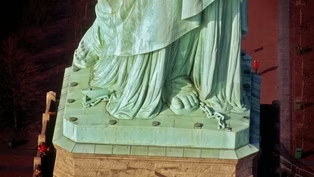
The Hidden Chains Beneath the Statue of Liberty Explained
Video has Closed Captions
Clip: S23 Ep6 | 1m 29s | A controversial symbol was removed from Lady Liberty's original design. Here's why. (1m 29s)
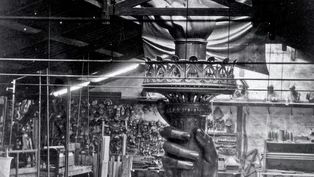
How Lady Liberty's Giant Torch Was Built
Video has Closed Captions
Clip: S23 Ep6 | 2m 28s | Rare photographs reveal how the Statue of Liberty was constructed piece by piece. (2m 28s)
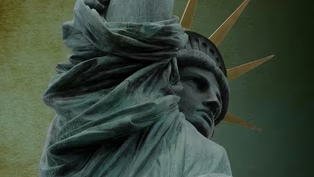
Preview | Raising Lady Liberty
Video has Closed Captions
Preview: S23 Ep6 | 30s | See how the unique partnership between two countries made the iconic monument possible. (30s)
Providing Support for PBS.org
Learn Moreabout PBS online sponsorship











Support for PBS provided by:
SECRETS OF THE DEAD is made possible, in part, by public television viewers.