
Oct. 5, 2026 - Full Show
10/5/2026 | 26m 57sVideo has Closed Captions
Watch the Oct. 5, 2026, full episode of "Chicago Tonight."
What’s in store for the Supreme Court this term? And a Chicago woman’s new lawsuit one year after being shot by an immigration agent.
Problems playing video? | Closed Captioning Feedback
Problems playing video? | Closed Captioning Feedback
Chicago Tonight is a local public television program presented by WTTW
WTTW video streaming support provided by members and sponsors.
Oct. 5, 2026 - Full Show
10/5/2026 | 26m 57sVideo has Closed Captions
What’s in store for the Supreme Court this term? And a Chicago woman’s new lawsuit one year after being shot by an immigration agent.
Problems playing video? | Closed Captioning Feedback
Where to Watch Chicago Tonight
Chicago Tonight is available to stream on pbs.org and the PBS app.

WTTW News Explains
In this Emmy Award-winning series, WTTW News tackles your questions — big and small — about life in the Chicago area. Our video animations guide you through local government, city history, public utilities and everything in between.Providing Support for PBS.org
Learn Moreabout PBS online sponsorship>> Hello and thanks for joining us on Chicago Brandis Friedman.
Here's what we're looking at.
They didn't get much of a summer break, but the Supreme Court justices are back in session today.
What's on the docket?
>> To do what needs to be done and bring accountability for America.
>> And a Chicago woman shot 5 times by a federal immigration agent during Operation Midway Blitz.
Now holds a new lawsuit will hold the U.S.
government accountable.
>> First off tonight, disgraced former U.S.
House Speaker Dennis Hastert has died.
The Illinois native was the longest serving Republican House speaker holding the position from 1999 to 2007 as speaker heavy.
He headed the House role during President Bill Clinton's impeachment trial.
And later helped pass George W Bush's legislative agenda in 2015, Hastert was accused of evading banking regulations as part of a plan to pay hush money to conceal alleged abuse of teenage boys.
He coached on a high school wrestling team.
Hastert pleaded guilty to evading banking laws and spent more than a year in prison.
The Kendall County coroner says Hastert died of natural causes at his home over the weekend where he was receiving hospice care.
He was 84 years old.
A key city panel unanimously agrees to pay more than 260 million dollars to resolve lawsuits related to a disgraced Chicago police detective.
The 16 federal lawsuits were filed by 17 men who spent a combined 383 years in prison after being wrongfully convicted based on evidence gathered by Ronaldo Guevara.
has been repeatedly accused of falsifying police reports framing suspects and coercing witnesses according to records, taxpayers have already paid at least 206 million dollars to defend and settle lawsuits.
Naming Guevara.
That's more than any other officer, including notorious former CPD Commander Jon Burge.
Officials say the agreement calls for the city to make for equal payments.
2 in 2027 into in 2028, the measure passed City Council's finance committee today and now heads to the full City Council for a vote next week.
Up next, a look at the Supreme Court's docket of cases.
That's right after this.
>> Chicago tonight is made possible in part why the Alexander and John Nichols family.
The Pope Brothers Foundation.
And the support of these donors.
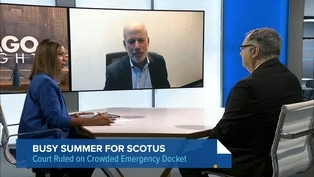
>> Us Supreme Court justices didn't take much of a summer break this year with a busy emergency docket covering cases for mail in voting changes to the White House ballroom construction.
Nevertheless, the nation's highest court is back to start a new term today in the coming months.
The court is set to hear arguments over the separation of church and state greenhouse gas emissions and even Cook County's ban on assault weapons.
Joining us to preview the coming term are David Franklin, a law professor at DePaul University and a former law clerk to Justice Ruth Bader Ginsburg.
And Harold Krantz, a law professor at Chicago can't College of Law gentleman.
Welcome back.
What we call today.
Happy first Monday of October.
Sure that we're going to college What were some of the emergency cases that kept the Supreme Court busy over the summer?
>> Morkel couple who you mentioned the case terms of fighting the ballroom.
That was certainly important spring but also allow deportations to 3rd countries for those who are not citizens to continue, even though that was incredibly controversial remains so they also talked about whether or not President Trump fire the sun cook the I Director, when he claimed that she engaged mortgage fraud years before she was in service.
And actually one that's probably the most telling nationally is that the Supreme Court blocks Trump's effort to restrict mail-in voting before the midterms.
President Trump to attack court and sort chide him for forgetting who pointed them in the first place.
>> David, our emergency decisions becoming more common.
Oh, absolutely.
I don't have all of the numbers at my fingertips, but I believe that during the 2 term presidencies of both George W Bush and Barack Obama, the federal government went to the court about once per year, asking for emergency relief, basically skipping the queue, jumping the line and saying we want the court to act now on an emergency basis during the first Trump term, the Trump administration did that some 35 earth or 40 times.
So that's, you know, 10 times the amount.
And during the first 20 months or so, the second Trump term boy, the Trump administration has been going back to that.
Well, dozens and dozens of times and and justifiably so in their eyes because they're having success.
Most of the time the Trump administration winning on these emergency docket cases, even though lower court to have the benefit of full briefings, seeing all of the evidence being able to take their time with the cases, those lower courts have overwhelmingly found the Trump administration policies are unlawful and yet they run to the Supreme Court.
And the court allows the administration to continue those policies.
Harold, still on the topic of, you know, the emergency docket, an emergency decisions.
How is that process different from the courts, regular process of deciding cases?
>> Well, there's generally no oral argument.
There's no The decision is dawn on papers from that were filed in the court below.
So the idea is the issues not battling this much is not open process.
And the standard center different because of likelihood of success and they were of the Har are considered much more than the merits themselves, per se.
And indeed, one of criticisms of the show talking recently is that the court is seemingly healthy, any kind of impairment of the presidential agenda automatically irreparable and rises to the level of the need for protective decision by the Supreme Court.
least in most cases.
Obviously there's exceptions mentioned before.
So it's not open to the public.
She's our family.
and sometimes I think many observers think that that seems that our our Courtney not well thought >> David, so the court heard arguments today in a case over greenhouse gas emissions.
Tell us about that one.
>> Yeah.
So the and county of Boulder, Colorado, soon a handful of oil companies basically saying you've deceived the public over the years.
You knew about the risk of climate change that your petroleum products for causing.
And we have to foot the bill.
We're bearing the brunt of the costs of the sort of downstream costs of climate change already.
And those costs are only going to multiply.
So that litigation was basically modeled on cases against cigarette companies, opioid manufacturers that I'm sure your viewers are familiar with.
The question in the case for the justices today.
Well, there were some technical legal questions that only a lawyer could love.
I'll skip those unless you really want to get into that.
I know I made my sound very exciting.
Did not.
But the core question is is really crucial, which is.
Is it permissible for a state through its judicial process to, in effect, regulate what a company from another state did in that other state.
And the lawyer for the oil companies today basically said no, issues particularly of air and water interstate spillover effects are reserved only for Congress and the federal government, not for individual states to regulate.
So we'll see how it comes out.
There was some skepticism on that latter point.
Interestingly enough from the chief justice who normally allies himself with big business and Justice Samuel Alito did the right thing and recused himself from this case because of some investments that he has.
So it's possible that the case ends up in a 4, 4, Thai, which would mean that the Colorado proceeding would be allowed to go forward, at least for now.
And you're right.
I did.
It does have, you know, sort it does remind me of the cases against big tobacco and Big Pharma.
>> Before we move on to that case have possible implications here in Chicago.
Well, Chicago was recently declared one of the more climate resilient cities in the world.
>> So, you know, let's all hope the climate related costs in Chicago and Illinois remain lower than in other parts of the country.
But I think the the broader implications of the case extend not only to this kind of climate based litigation, questions of the to what extent can for lack of a better term, a blue state right?
Tried to regulate harmful activities by corporations in an environment where the federal government is unlikely to pursue those kinds of regulations.
Herald, another case argued today Johnson versus the United States.
This one has to deal with disability benefits but could have broader impacts.
What can you tell us about those?
>> Sure.
has to do with where individual who's been allegedly entered can bring a constitutional right and the individual was receiving benefits.
He was incarcerated as benefits were caught.
And he argued that that cut and benefits was no but That was really Congress against him up because after he'd already been punished without any kind of due process of law, he tried to bring it in federal court and the argument that launched against was that this is a special statute and relegate all constitutional claims not to the federal courts, which usually hear constitutional claims.
But instead to administrative tribunal under of 8 Veterans Administration control with review ultimately in a So outside of the purview of the traditional courts, which means more delay.
less likelihood of a sympathetic reception to the constitutional claims.
This is called the species channeling where Congress either explicitly or implicitly decide particular claims can be brought.
And this has been incredibly important indication against the Trump administration, the hundreds of thousands of federal employees who are wrecked the 500 billion dollars.
grants that were canceled.
All were subject to constitutional claims.
But the court who said you can't a constitutional thing here is you have to go to specialize tribunal that con Congress has created.
That means incredible to wait more expense more time and the injuries are not remedied.
So even though this case has to do with just veterans benefits, one person who made kind of long-shot constitutional argument.
The ramifications could very, very important.
>> David, the courts also going to be hearing a challenge to Cook County's ban on assault weapons.
It's been in place since 1993.
Why is it being challenged now?
Well, the Supreme Court decided in 2008, which is not that long ago for the very first time into cited that.
>> The Second Amendment protects an individual right to have a handgun in your home for self-defense.
since that time, the court is only double down on its originalist sort of history based approach to the Second Amendment.
Basically saying that in order for a state or locality to regulate gun ownership that state or locality has to show that its regulation has roots that go back to the beginning of the republic or at least to air of the civil war.
So in this case, the debate is really about what kinds of arms, what kinds of guns to the Second Amendment protects on the one hand, these assault weapons are unfortunately very common in this country.
There millions and millions of them out there on the other hand, they're basically weapons of war that are the weapon of choice for people who want to engage in mass shootings.
Is that the kind of arm that our founders meant to protect the ability of individuals to possess and use.
That's the question.
>> Harrold, what we know about, you know, how justices have ruled in recent Second Amendment cases.
>> So court has become supporters are backing of second Second Amendment protections.
All cases sort really interesting because obviously through dangerous weapons.
And everybody I think agree with that.
And court in the past has said military-type weapons can be regulated.
They don't have to be, but they can't be based upon the state grenades can be regulated growing not regulate it.
But the difference is the number of people profession.
Franklin suggested all of that on maybe 15 to 20 million people United States and own AR 15 or similar assault weapon.
And so this is a kind issue.
If you want to look at tradition, history can say yes, this is clearly a dangerous type of weapon long has been regulated up to the individual states.
But you look at the number of never you can come out of different way.
So the court has choose between the tracks of of analysis.
>> David, before we run out of time, a Catholic school in called Colorado is suing to get state funding.
But they don't want to admit students who themselves or their parents are members of the LGBTQ+ community.
What is at stake nationally in this case?
Well, there's so many overlapping strands of Supreme Court law that are involved here, but basically in short.
>> The Supreme Court used to believe in separation of church and state.
So it was in permissible for the government to.
Hand over taxpayer money to religious schools or institutions.
Now under the Roberts court, the opposite seems to be the case.
Not only is it permissible, but it often is required.
That is to say if the government has a program has Colorado has here with its universal Pre-K program that provides benefits to schools.
Those benefits have to be available.
Says the Roberts court to religious schools like to have that extra wrinkle in this case, is that the schools at issue here did not want to sign an antidiscrimination pledge that Colorado requires all recipients to sign.
Basically, you've got to let same couples and their children attend these preschools, these catholic schools and dioceses didn't want to sign that pledge and they say it discriminates against religion to fence us out of this program because of our religious refusal to agree to your antidiscrimination proviso.
Alright, court stays busy.
Thanks again to the 2 of you for joining us, David Franklin and Harold Craig, thank you.
Thank you.
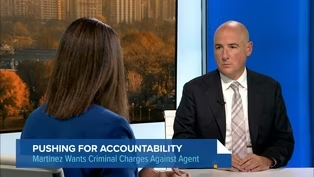
>> Chicago woman's new lawsuit one year after being shot by an immigration agent.
Almost exactly a year ago, Marty Martinez survived being shot 5 times by a Border Patrol agent in Brighton Park after the shooting.
She was charged with assaulting federal agents, though the case was quickly dismissed and the Department of Homeland Security website still rough.
First Martinez has a, quote, domestic terrorist in last year.
She's been speaking out and now she's taking a new legal step filing a federal lawsuit against the U.S.
government.
Joining us to talk about this in depth is Christopher Peretti, a criminal defense attorney at law firm Sher Otis in per NT.
He represents.
Marty Martinez, thank you for joining us.
Thanks for having on.
So she she's had to recount this story over and over again over the last year or so to investigators to the Illinois Accountability Commission and to Congress.
Here's a bit of what she said today at your news conference about why she continues to tell her story.
>> I don't, then who else?
look at what happened to remain all these victims.
Why I have a voice.
I don't matter because what's happening is not normal.
We should see here in the malaise was happy.
>> what does she want people to understand about the shooting and what this past year has been like for You know, she wants accountability, which is what we all want right.
And once the government dismissed the indictment against memoir, she was ready to move on and what happened was we saw what happened in Minneapolis with the killings of Renee Good, Alex Pretti and she said Chris, we can't stay silent anymore.
They need to see what happened to me because the truth is that it was an unlawful shooting.
And so what we did today in releasing these findings is proving night, not a he said.
She said it's what science says.
It shows us and it shows the American people that this Border Patrol agent lied about being in front of vehicle that he shot her from the side of the vehicle and from behind the vehicle, which is just simply unacceptable to any political party, Republican or Democrat in Miramar wants accountability.
You pursued other legal efforts surrounding this case.
Of course, what does this new lawsuit accomplish that some of your previous efforts could not?
>> Yeah.
So we waited a full year for the FBI and U.S.
attorney's office to do anything.
Right?
There's a civil rights division at DOJ specifically designed for cases like this where an agent act unlawfully.
They've done nothing.
And so what this case does is it puts out there in the you know, stream sort of the facts and the truth.
And so again, this isn't a he said she said anymore.
It's not Miramar versus Charles It's science.
Its trajectory analysis of how those bullets hit her body and hit her car.
And it clearly shows from the images we released today by an independent expert that used by the government as well as defense and all these cases around the country that this agent was not in front of vehicle.
He was to the side of the vehicle and he shot that final shot through the rear passenger window at Miramar.
>> So your lawsuit named the federal government as the sole defendant, not the Department of Homeland Security, former Secretary Kristi Noem or even the agent who you just mentioned, Charles why go that route?
Because, you know, federal agents has, as we've heard from this administration have tremendous immunity, right?
And it's not like Chicago police or local law enforcement.
>> They are protected by very significant immunity protections.
And so here we're using what's called the FTC.
The Federal Tort Claims Act.
And so the United States is the party, but they are held responsible for the actions of other employees, which in this case it would be Border Patrol Agent Charles Action.
What are what are you asking the government to be accountable for what he's seeking here?
So we're seeing we're seeking financial recovery for for Miramar, for the, you know, the 7 holes in her body that were put there unlawfully by Charles Jackson.
But more importantly for Marmara and for us is to get the truth out there so that the public can see that when the agent told the FBI that he shot her 5 times through the windshield, that that's just simply not true.
And I think that's important because we continue to see the shootings take place because these immigration agents are being told that they have full immunity and can do whatever they want whenever they want, which is why we see people continuously being shot on the streets of every city in this country.
And it will continue to happen until there's accountability.
So what what we're hoping for is that this is the first case that brings real accountability against an immigration officer for for shooting an innocent person.
You've named the photos on and you've said that Charles was not justified in shooting Martinez.
What evidence do you believe proves that?
>> So remember, he's interviewed the day out of the shooting so well, Greg Bovino is is sending him an email saying great work in Chicago, shooting this young Montessori school teacher were going steady retirement age.
>> Greg, second is also being interviewed by the FBI and he says I shot her because she was driving directly at me and I shot her 5 times through the front windshield and I ceased firing once.
I was no longer front of a car.
Well, again, we had we took the car from the government.
We had an independent expert Dr Jeremy Bauer, who specializes in this come out and examine those bullet holes and examine Mayor Mars body.
And from doing that, you can do a trajectory analysis and he can determine exactly where Agent was when he shot those 5 shots.
And it certainly was not in front of the vehicle.
Has he said it?
Was it to the side into the rear of the vehicle and we have you shared with us.
Also the some of the images of that of that shooting or about re creation.
>> Did you learn anything more from from It's just for me as a former federal prosecutor who used to prosecute, you know, cases like this and worked hand-in-hand with law enforcement.
It was appalling.
You know that that image of him shooting through the rear passenger window it to me.
It looks like it is.
It's not the United States of America and no at no time have can I come up with a reason play U.S.
Law enforcement officer.
We need to shoot young Montessori school teacher through the rear passenger window as she's hovered over the steering wheel, trying to get away to safety.
>> You've also said that you still hope criminal charges could be brought against She has filed a report with the Chicago Police Department.
What is the status of possible criminal charges?
There is a Chicago police detective who is actively working this case.
We have turned over these slides to him.
We have turned over everything that we have.
We're hopeful that the U.S.
attorney's office will also turn over their files.
>> To Chicago Police Department so that if the federal system Department of Justice will not bring charges as we hope they will, that at least the Cook County State's attorney's office could bring forth some sense of justice because, again, this is an unlawful shooting that occurred on Kedzie Avenue on a beautiful Saturday morning a year ago.
And if the federal government or not is not going to hold Charles Exxon accountable, then hopefully the Cook County State's attorney.
Well, do you have faith do believe that that progress is being made in that direction.
A guy understand a detective someone with CPD has been assigned to her case.
It I do.
I have almost daily contact with this detective at this point.
And I have been, you know, giving him everything that we have.
>> And again, you know, the Illinois Accountability Commission appointed by Governor Pritzker made up of retired federal judges retire federal prosecutors, former police chiefs.
They looked at this case and they said so there's you know, there's reason to believe that criminal charges should be brought here.
The need to look at this.
So this isn't just, you know, defense team saying that this is, you know, the Illinois Accountability Commission themselves who are made up of independent people who know this space said, yes, this needs to be examined because it certainly appears that that something went wrong here.
What accountability looks like for my team and I I think she wants Charles in jail.
You know, she had to spend the for night in the MCC of Chicago at the Federal Detention Center.
She did it while she would have, you know, bandages all over her and she's leaking blood on the floor of the jail.
Charles should have to be held accountable.
Not.
I mean, look, he lied about what happened.
his fellow agents covered it up he shot her for no reason, right?
I mean, the reason he lied about being in front of the vehicles, the same line here and there in a good case in the Alex Pretti case, they try to justify the chute by saying that they were in fear of being run over in here.
Science just proves that didn't happen.
just it's not a he said.
She said science proves that he was not in front of the vehicle when he shot her.
Okay.
That's where we'll have to leave it.
Christopher Corrente, thank you so much.
Thanks for having me.
And we're back to wrap things up right after this.
>> And >> that's our show for this Monday night.
Stay connected with our reporters and what they're working on by following us on Instagram at W T Tw Chicago and join us tomorrow night at 5, 30 10, Pat Ryan junior talks about Northwestern University's new 875 Million Dollar Ryan Field football Stadium.
Now for all of us here at Chicago Brandis Friedman, thank you for watching.
Stay healthy and safe.
Have a good night.
>> Closed captioning is made possible by Robert a cliff and Clifford law, offices personal injury, law firm that gives back to the community through law and philanthropy.
 New
NewUS Supreme Court Starts New Session. Here's What to Know
Video has Closed Captions
Justices will hear arguments on Cook County's ban on assault weapons. (13m 9s)
 New
NewWoman Shot by Federal Agent Hopes Lawsuit Could Spur Criminal Charges
Video has Closed Captions
The lawsuit comes almost a year after Border Patrol Agent Charles Exum shot Marimar Martinez. (8m 6s)
Providing Support for PBS.org
Learn Moreabout PBS online sponsorship New Episode
- News and Public Affairs

Top journalists deliver compelling original analysis of the hour's headlines.
 New Episode
- News and Public Affairs

Today's top journalists discuss Washington's current political events and public affairs.

 New Episode
 New Episode
 New Episode
 New Episode
 New Episode

 New Episode
 New Episode
Support for PBS provided by:
Chicago Tonight is a local public television program presented by WTTW
WTTW video streaming support provided by members and sponsors.