
NITA Leadership on Changes Coming to CTA, Metra and Pace
Clip: 10/12/2026 | 14m 17sVideo has Closed Captions
The Northern Illinois Transit Authority was created last year to oversee CTA, Metra and Pace.
The Northern Illinois Transit Authority was created last year to oversee CTA, Metra and Pace. The new governance model came along with an additional $1.5 billion in annual funding for transit to prevent the three operators from going over a fiscal cliff.
Problems playing video? | Closed Captioning Feedback
Problems playing video? | Closed Captioning Feedback
Chicago Tonight is a local public television program presented by WTTW
WTTW video streaming support provided by members and sponsors.
NITA Leadership on Changes Coming to CTA, Metra and Pace
Clip: 10/12/2026 | 14m 17sVideo has Closed Captions
The Northern Illinois Transit Authority was created last year to oversee CTA, Metra and Pace. The new governance model came along with an additional $1.5 billion in annual funding for transit to prevent the three operators from going over a fiscal cliff.
Problems playing video? | Closed Captioning Feedback
Where to Watch Chicago Tonight
Chicago Tonight is available to stream on pbs.org and the PBS app.

WTTW News Explains
In this Emmy Award-winning series, WTTW News tackles your questions — big and small — about life in the Chicago area. Our video animations guide you through local government, city history, public utilities and everything in between.Providing Support for PBS.org
Learn Moreabout PBS online sponsorship>> Coordinated schedules, improve public safety and a universal fair system.
Those are just some of the main priorities for the Northern Illinois Transit Authority which took control on September first overseeing CTA, Metra and pace.
was created after years of debate about how best to run and fund the Chicago area's transit system after the massive hit in passenger revenue caused by the COVID pandemic.
Leaders say they're now optimistic about not just getting transit back on track, but creating a world-class system for future generations to enjoy.
Get a break down all the changes writers can expect our Tom put our chair of the need to board of directors.
Jamie Rhee, interim executive director of media and Molokai shutout need is chief transition officer.
Thank you all for being here.
We appreciate it.
Thank you for having So as we said, you all up in just about a month and a half since need officially took over from the regional Transportation Authority.
Obviously, this transition process has been going on for some time.
Lots more to be done.
But what if the main priorities bend so far?
Nick, it's great to be here.
We're about a month old and there's a lot going on in terms of priorities.
outgoing RTA board.
>> Set a process for transition and the need to act in the law has a lot of requirements for transition.
Our priority from day one is to focus on the top issues that the writers are facing that have been reflected in the need to act ranging from public safety on transit, getting our services coordinated between the agencies and making sure that riders can get seamlessly across the system and they're able to do that while we are busy setting up the new agency.
Yeah, I do want to dig into some of those those priorities in the things people can see.
I mean, Tom Water.
>> So the biggest changes that you would highlight the passengers will start to notice over the next few years as its roll-out.
Sure, ready.
We're starting to see some of the benefits come online and one of those is better access to the system through fares.
So give me example.
Students in the past would only get access to the student fared during the school day and during school hours.
So if you are 16 year-old high school student and you had job on a Saturday or wanted to go to church on Sunday.
We're even in the summer.
You had to pay full fare and one of our first actions as a board was to increase that across the board for all students and for someone using the system pretty often, that's maybe 400 to $600 a year back in their pocket.
Yeah, not insignificant at all.
You know, Jamie Rhee, you don't have direct experience and transit that you've had a long career in local government many years as the city's aviation commissioner.
>> Are there particular skills or approaches from that position that you see as being especially valuable in your role Yeah, absolutely.
And it's been an honor to serve this great city over 3 decades and having served in many roles.
Like you said that most recently.
>> As the Commissioner Vo Ti Ation for both overseeing O'Hare and Midway.
>> You know, I liken it to not a lot of transit experience.
Exactly.
But I was able to directly effect of the things that people care about in transit, which is it's got to be safe.
It's got to be reliable.
It's got to be clean.
It's got to be accessible.
And that is the same focus that we bring here.
I was very fortunate during my tenure the commissioner of aviation to work with the transit officials.
And so, you know, we were blessed to have both the blue line and the orange line, but also Metra and pace bringing our workers and writers to the airport.
So really focusing on what matters most to make sure that we allowing people to use transit need to every day and with a focus on again, keeping it clean safe and on time.
>> Well, and also, you know, in this new role trying to help coordinate among CTA, Metra and pace, certainly with aviation.
You know how you have experience a complicated couple of entities with a lot different actors that play their fair to absolutely one of the most heavily regulated industries in the world.
You know, that federal, state and local levels, but also, you know, managing that very complex organization which had multi-billion dollar capital programs heavily.
You know that unionized workforce as well as very complex ground.
Transportation systems.
And so bringing all of that in as well as all the other rules that I got to serve.
And as a city, been almost a decade as the chief procurement officer as well.
And so procurement, some very fond of that.
And there's a lot of work to be done in that way at need as well.
you know, Tom Public safety, a major component of NIDA legislation, certainly top of mind in recent days after the tragic killing of a CTA employee at the Damon Green Line Station.
>> What are your priorities in terms of not only making sure the system is safe but making sure that that riders know that infield first, I want to extend my condolences just sadness that the entire transit system in a team in the CTA team feel over the loss of Julian Mobley.
I listened to his daughter.
>> As she express the devastating moment that she learned about the news.
And it's anything, absolute wake-up call to all of us across the system to make this the top priority.
We are not doing enough and we need to do more.
And the General Assembly acknowledge that the governor knowledge that when they created the Northern Illinois Transit Authority, we have our board meeting on Thursday.
One of our first actions was to create a public safety committee that's required by law.
We're gonna do that in our second meeting.
We're going to be rolling out in November.
app where if you're on CTA, Metra pace, you can directly text or use a QR code and send what you're seeing right now.
If you're on CTA on the train, you have to hit a button.
If you're seeing something which is really not the easiest way to flag a problem now you'll be able to do that and honestly in real time and we have our budget coming up and I reached out to the leadership and the labor unions to work with them to make sure that the worker and the rider safety is the top priority.
I think the projects really reflect the principles and priorities an organization and the public safety of our workforce.
And our riders is going to be top of the list for a budget.
You know, Jamie, there's also the transit ambassador program that's set to come online.
How do you think those?
>> of non law enforcement employees can help, you know, make riders feel safer, improve their overall experience.
Well, it directly related to that.
And, you know, there's not one single entity that you know, obviously fix and move this ball forward.
There's a lot of work to do in that area.
>> And we believe that the transit ambassadors, which are the training, scheduled to be completed by the beginning of the year and with them being on board fully by June.
We are very excited about that because we think that the more visibility there is and the more folks that are out there, for the people feel we are being judged by how people feel when they ride the transit system.
And so each and every day, every decision we make has got to be focused on our riders in a front line.
Workers.
>> You know, Malik, there's also set to be a universal fair system in place and the next couple of years.
What would that look like for riders?
There's a lot to on our first system.
I think you know that better than anyone, We are already working towards on the policy changes we can make first.
>> Because we have the ability to as the chair describe start to make it easier our current technology for students to write.
We are looking at other special fair programs looking at are moving chance for penalties for using one system transferring to another.
So the big decisions that will come in front of and the need to board.
Welcome from the process of how we bring Metra more into art fair system.
Currently the ventra app does provide ability to buy a couple of past products that work regionally.
I buy the reason that they pass sometimes, but I know that it takes several clicks to get there.
We need something more seamless.
So king of the next Gen Procurement Systems.
Really good to have Jamie here to bring that expertise because a lot of the long-term changes to our fair system where you can get from point A to point B without really thinking about it like you can do in Paris.
The fear I would say is not as affordable as it is in Chicago.
But the writer really doesn't have to think about They don't have to do the math.
How can we take all of that work with the newest technology, the newest physical or emotional affair product and how to centralize that procurement at Nida by Twenty-thirty.
As you mention, it's sort of our north star, the way we after launch additional products, simplified, fair system as well as what's called fare capping.
So you are not having bypass front.
When you get to how much you've spent to a pass.
You get the rest of the right for the month of the for free.
These are all the that London has.
No New York getting Chicago should have them.
And I think will.
But does believe the to provide the resources will be able to get there by 2030.
Yeah, some kind of a rolling series of changes before kind of the big one comes through.
>> You know, Tom, thinking about, you know, sort of oversight of of meta of the different service sports, you know, past appointees to boards have been criticized for not having experience with transit or transportation issues.
Do appointees necessarily need to be transit experts?
I think that they need to be experts in their field in a really, you know, well-functioning board brings that expertise and a diverse expertise to the decisions that we're making.
The really innovative thing.
I think that the General Assembly in the governor's done with the need to act as really think beyond just the transit service.
But even economic development and media will have enormous powers to develop around transit stations to create a virtuous circle of development.
That includes things like affordable housing and commercial development using those revenues and plowing them back into the system.
So you may not necessarily be a transit expert, maybe an expert in real estate or law banking.
And we have a pretty good group of a pretty good you know, set of experiences and background in the 20 person board.
We have a need to.
I think the the right challenge that we're facing how do we you?
Take that and focus the right places to achieve the goals that we have?
Well, and there's also a lot of, you know, cross appointments of some folks working on the need to board who also serve CTA, Metra Pace.
Is that something that you think could?
>> You know, help create greater no accountability when it comes to truly integrating the system.
Yes, absolutely.
I think, you know, the at the essence of the need to act is making the system seamless and integrated the line that's in the legislation is one timetable.
One network won fair and that comes from the German model where you can ride the system seamlessly in the same way that Malik and spoken about.
And that begins with the bout with the board and the leadership.
And so having the board members serve double duty on Nida Khan CTA, Metra Pace and having the executive leadership team also a line all the way up to need was the governance innovation that the General Assembly and the governor put in place for us.
And I think when you're the same person, it's essentially one team, one dream.
Yeah, that we're all working towards the same end in the same calls.
Absolutely.
You know, Jamie, you retired from the city and are collecting a pension and now drawing a salary for this position which other public officials have done it.
Is it that sort of an arrangement, you know, best practices for a public body?
I'm very honored by my public service.
Having served 30 years, the city.
>> And when I was approached to come and be an interim until the new director is selected, it was an opportunity me to bring all of those skill sets and all the different departments and I've worked But it was real estate have been a general counsel procurement officer for a decade and then leading nope, the world's busiest airport system in the world.
So to me, this was an opportunity for me to come in and again, if the structure set up the foundation so that they're able to deliver on these very critical and fast moving and fast coming mandates.
And you said that, you know, you weren't going to put yourself or for the permanent position unless the board should ask.
Is that still your thinking correct?
Yes, you know, agreed really to come in and set up the foundation.
I wanted to make sure that I bought in the transparency in all the reforms that I've been part of.
>> Having served under 4 mares.
It is.
I've had the opportunity really get a peek inside of government and how it should operate and how it operates when it really serves the people is removing barriers.
And this was the perfect opportunity for me to bring some of those skill setting new for You know, Tom, one of the sticking points coming up with this legislation was concerns from Collier County executives about getting.
>> Just one appointee each to the board.
What do you think needs to happen to sort of allay any concerns that they won't be adequately represented?
Yeah, I think you know, the system itself is one system that is at the core and the essence of the need to act the way we travel doesn't really end at the end of worst township is a visiting my sister, for example.
I don't stop there and then get off on another piece and that's how people move.
And that's how transportation works.
It's a network.
And so having, you know, Teller County representatives bring their experience to the same decisions that we're making collectively is really at the heart of what the media is about and making sure that that participation is full and well coordinated amongst all of us is is absolutely the the essence of what we're about and what we're doing.
You all have a public engagement event on Wednesday Mark.
What are you hoping to hear from folks?
>> We want to engage our riders and the general public at the Union Station this week.
To be able to hear from them generally about need to and what kind of an agency be aspire us to deliver for them, but also about the upcoming budget.
As the chair mentioned, it's it's our first sort of blueprint of what we believe should be funded.
That would be Jamie and myself and others will bring to that need a board for approval.
And we want the writers and the public to be at the heart of There's a survey that's open on our website collecting People can't make it.
It's really about prioritizing the RD know what people care about service on time.
Safe, clean.
But how would we have a fixed amount of resources?
How should be allocate them?
That's really our priority to get from all the engagement activities that will be doing.
And we've already had over 3500 responses, which is great, but we need more.
We really want to hear from the public as we try to shape this transit system for the >> the world class system that's come because Chicago and certainly aren't shy.
So I'm sure they will answer that call.
 New
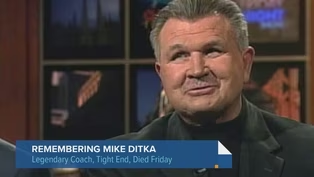
NewRemembering Mike Ditka and His Appearances on 'Chicago Tonight'
Video has Closed Captions
The iconic Chicago Bears coach and Hall of Fame player died at 86. (5m 25s)
Providing Support for PBS.org
Learn Moreabout PBS online sponsorship New Episode
- News and Public Affairs

Top journalists deliver compelling original analysis of the hour's headlines.
 New Episode
- News and Public Affairs

FRONTLINE is investigative journalism that questions, explains and changes our world.
 From My Station
 New Episode
 New Episode
 New Episode
 New Episode
 New Episode


 New Episode
 New Episode
Support for PBS provided by:
Chicago Tonight is a local public television program presented by WTTW
WTTW video streaming support provided by members and sponsors.