
How Tariffs, Imports and Droughts Are Impacting Beef Prices
Clip: 9/17/2026 | 9m 23sVideo has Closed Captions
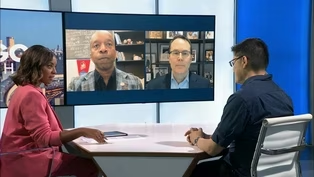
The rising cost of beef says a lot about the impacts of fuel prices, trade policy and the climate.
According to the Bureau of Labor Statistics, the price of ground beef is up 7.9% since last year. That's more than double the inflation rate for all items — and nearly triple the inflation rate for food as a whole.
Problems playing video? | Closed Captioning Feedback
Problems playing video? | Closed Captioning Feedback
Chicago Tonight is a local public television program presented by WTTW
WTTW video streaming support provided by members and sponsors.
How Tariffs, Imports and Droughts Are Impacting Beef Prices
Clip: 9/17/2026 | 9m 23sVideo has Closed Captions
According to the Bureau of Labor Statistics, the price of ground beef is up 7.9% since last year. That's more than double the inflation rate for all items — and nearly triple the inflation rate for food as a whole.
Problems playing video? | Closed Captioning Feedback
Where to Watch Chicago Tonight
Chicago Tonight is available to stream on pbs.org and the PBS app.

WTTW News Explains
In this Emmy Award-winning series, WTTW News tackles your questions — big and small — about life in the Chicago area. Our video animations guide you through local government, city history, public utilities and everything in between.Providing Support for PBS.org
Learn Moreabout PBS online sponsorshipbeef, you probably noticed higher prices at the grocery store.
>> And even if you don't, the price of beef still says a lot about the impacts of fuel prices, trade policy, the climate industry consolidation and more.
>> According to the Bureau of Labor Statistics, the price of ground beef is up 7.9% since last year.
That's more than double the inflation rate for all items and nearly triple the inflation rate for food as a whole.
Joining us now are Josh Saint Peter's, the executive vice president at the Illinois Beef Association and Brittney Goodrich, a professor of agricultural economics at the University of Illinois.
Thanks to both for joining us.
Just first, tell us about the steps that are needed to to get be from the farm to table.
>> So we have about 14,000 farmers in our state here in Illinois who are raising cattle on their farms to produce beef.
And it's a longer production cycle that a lot of commodities.
So you think about corn crop, we can grow that in summer.
We can produce poultry or chickens on the farm and a few weeks beef takes us over 2 years from the time that we have conception, Bertha calf and then race that animal all the way to harm us.
And so it it takes a lot of time and a lot of steps in the supply chain.
And so when we talk about the price of beef, one of the things we have to consider is that it takes market signals.
That farmers and respond to and not just months, but years for farmers to be able to catch up to what the market signaling.
Of course, it is not just, you know, the time it takes to raise that cow.
You know, it goes to market and then it goes to slaughter and then it gets processed, maybe or there's there's additional steps after the cowgirls up.
>> The and a lot involved in raising that animal.
The feed that goes in to enable the fuel that we use on the farm.
A lot of other factors that come into that pricing, too, that our farmers end up being the price taker, not the price maker along the LAC.
So what control do farmers have over the price of beef at the store?
So farmers don't set the price of beef.
In most instances.
We do less than about a 10th of our farmers in the state that maybe sell direct consumers where they get to set the price of beef if they're selling farmers market, for example, and maybe they have a freezer case at a local retailer.
The majority of farmers are selling into a cash market, though, where Packers and processors other people along the way.
Oftentimes multi national corporations are directly involved in the harvesting of that animal and they're setting the price for that beef.
That's on the grocery store shelf or on the restaurant menu.
>> Brittany, what's the current status of the beef herd in the United States?
>> interestingly, the beef or does the smallest that it's been since the 1960's part of that is due to some, you know, efficiencies gained.
So we're getting more meat or animal now than we were back in the 60's.
But really, until recently, within the last 5 or so years, we Josh talked about economic incentives, the economic incentives have really been.
They favoring decreasing herd sizes because the prices hadn't been great in input.
Costs were high.
And we've also had pretty consistent droughts over the 5 to 10 years as well.
That makes it hard for farmers to actually expand their part science.
So we're at a very low point.
Brittany, what what impact is the smaller heard size have on prices?
>> Yeah, it really makes prices fluctuate a lot more.
basically the small herd size makes any Whether they're real changes are anticipated changes to supply and demand.
It basically exacerbate those changes.
So when you things trade, uncertainty, trade announcements like we've seen in the last you have slaughter and processing plant closures.
You have different concerns with new World Screwworm.
You basically have really high price fluctuations.
So we've actually seen in you know, 2 months or so feeder cattle prices dropping by 10%, which makes fluctuation really makes hard for these beef, cattle farmers to invest in their pardon, actually expand the herd size.
Josh, how do farmers decide whether to grow or shrink their own herds?
>> They're looking for those market signals.
And it's it's a very challenging situation in this volatile environment because you're trying to plan for something that's not an expense that you're going just for next week or next quarter.
But we're really looking at this point into 2027 and 2028.
And you're looking at the volatility of what it cost to to purchase an animal to keep her breathing or to put something on your balance sheet.
And Sam going to say that animal back and keep it for breeding versus selling it into the market where it would be beef a time where the signals are not clear and where things like trade and tariffs and announcements coming out of the federal government are just muddying the waters of trying to help a family farmer understand what their profit opportunity looks like in the months ahead into next year and beyond.
And in the case of the ground beef prices, specifically that you started with you with the top of the segment here, ground beef has seen some of the highest increases this specific to our consumer preferences and the amount of lean beef it takes to make hamburger to make ground beef.
And that is just further compounded.
What we're seeing happen at the grocery store shelf.
Brittany, how long would it take to grow the U.S.
cattle herd, especially given what we heard from Josh about how long it takes to grow in individual heard.
>> That's the million dollar question.
But if I had answer to I I don't think I'd be working at University of Illinois.
the real saying is, is we've seen historically high prices for the last few years now, and we still haven't seen that herd size increasing at all.
And again, this is what Josh was talking about is that you have farmers making these decisions where they could sell their feeder calves or really high prices right now or they could retain for a couple of years and potentially get higher feeder cattle prices then.
But but there's so much uncertainty going on that it really hasn't panned out to make that investment look like a good idea.
So we don't know how long it would take because we haven't seen the herd's size start to expand yet.
Josh go ahead.
>> I'm just going to add to that.
I think that I think really important for consumers to understand as well.
Specifically here in the Midwest is that most of our beef producers in Illinois and throughout the upper Midwest, our diversified farms, meaning that they raise beef cattle.
But they also raise corn and they re soybeans.
They grow other crops.
And when we look at the broader AG economy over the last 2 years, farm income has been down.
And so the ability to pay your bills, the ability to cover taxes in the other things that the small business owners family farmers have to plan for means you have to look for those profit opportunities.
And so we're coming out of a period of time where for a lot of those farmers, the way to pay the bills was to sell more of the cattle, you know, into to a high-paying a just compound that makes it even more complicated.
>> And Josh, in an effort to lower the price of ground beef is we're talking about the Trump administration is incentivizing imports of hundreds of thousands of metric.
Tons of lean beef, trimmings.
What impact could that have on the industry here in the U.S.?
But for our farmers here in Illinois, that was extremely frustrating announcement for the president to make.
>> Because it didn't come from a market signal.
It didn't come from the marketplace saying we need to import more trend to balance out based on what we have.
This seemed to be just said overnight deal that was announced via social media posts that had a lot of our economists that cover the beef industry.
But even just the day-to-day farmers and ranchers scratching their heads about where this was coming from.
There's a lot of concern that what it's done in a very short period of time here is reduced the amount of income by $600 per head for every beef animal.
We sell off the farm in Illinois.
And meanwhile, as your data should we haven't seen that price come down at the grocery store.
So the promise was we were doing this to help the consumer and actually we just put the farm or an even worse position than they were already.
Britney, just a couple seconds left.
How are consumers reacting to be prices in the high price price of beef?
>> You know, I think this is part of the reason why we've seen consistently high prices of beef is that even though prices have been really high in recent years, our per capita beef consumption has remained fairly constant.
So consumers are still desiring to purchase be even at higher prices.
And obviously there can be distributional impacts were lower.
Income consumers are are more highly affected.
But that's kind of that that constant demand is is really bolstering that that beef prices at the grocery store and consumers, it sounds like are still willing to pay
 New
NewThe Push for AI Regulations Intensifies. What Is the Path Forward?
Video has Closed Captions
An Anthropic researcher resigned last week, citing AI's potential to endanger humanity. (10m 11s)
Providing Support for PBS.org
Learn Moreabout PBS online sponsorship New Episode
- News and Public Affairs

Top journalists deliver compelling original analysis of the hour's headlines.

- News and Public Affairs

FRONTLINE is investigative journalism that questions, explains and changes our world.

 New Episode
 New Episode
 New Episode
 New Episode
 New Episode
 New Episode


 New Episode
 New Episode
Support for PBS provided by:
Chicago Tonight is a local public television program presented by WTTW
WTTW video streaming support provided by members and sponsors.