
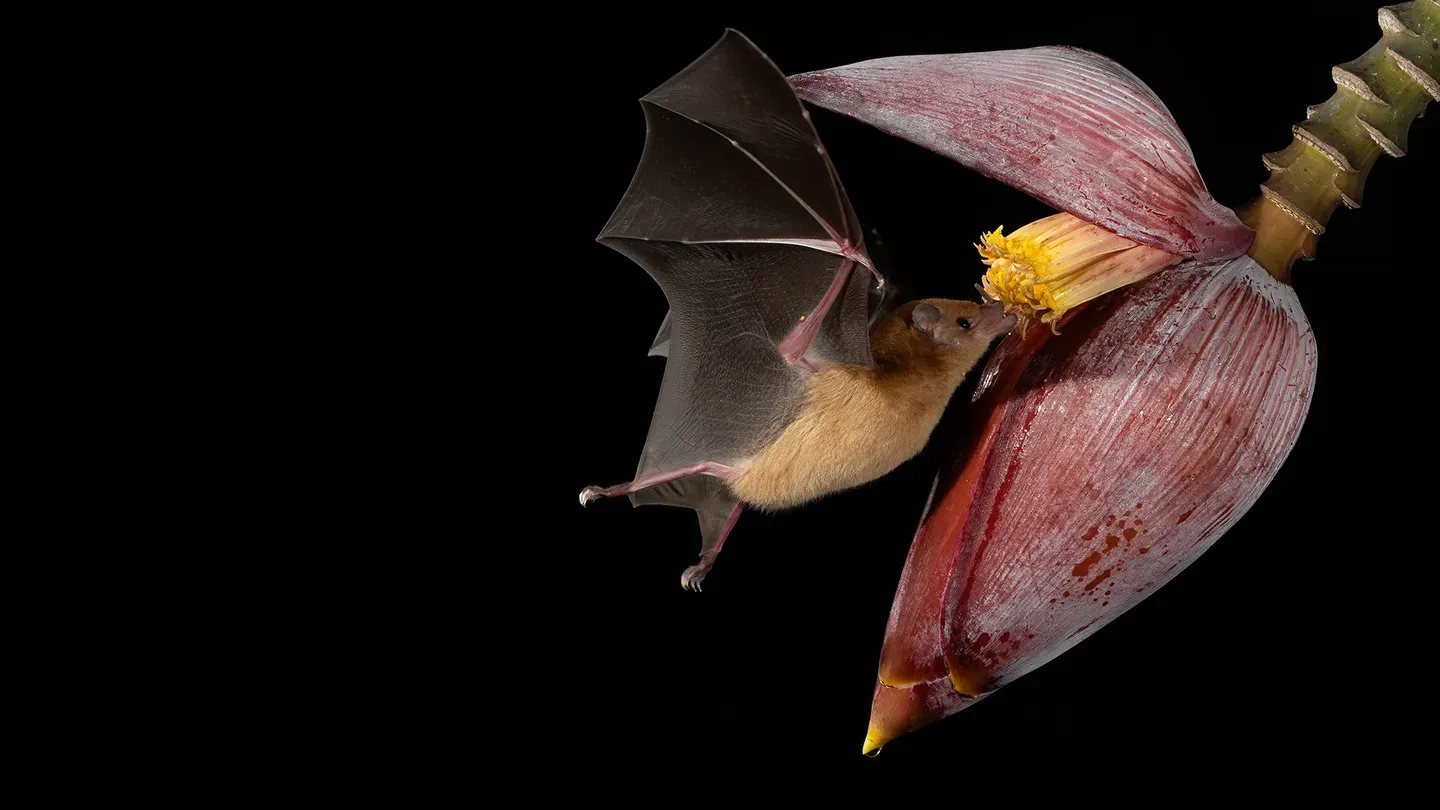
Evolution: Need to Feed
Season 53 Episode 14 | 53m 46sVideo has Audio Description
Discover the untold story—full of surprising evolutionary leaps—behind every bite we take.
The relentless pursuit of energy, the very act of eating, has profoundly shaped life on Earth. Discover the surprising story of how our planet's diverse creatures became the furious feeding machines they are today, one mutation at a time.
See all videos with Audio DescriptionADProblems playing video? | Closed Captioning Feedback
Problems playing video? | Closed Captioning Feedback
National Corporate funding for NOVA is provided by Carlisle Companies. Major funding for NOVA is provided by the NOVA Science Trust and PBS viewers.
Support provided by:


Evolution: Need to Feed
Season 53 Episode 14 | 53m 46sVideo has Audio Description
The relentless pursuit of energy, the very act of eating, has profoundly shaped life on Earth. Discover the surprising story of how our planet's diverse creatures became the furious feeding machines they are today, one mutation at a time.
See all videos with Audio DescriptionADProblems playing video? | Closed Captioning Feedback
Where to Watch NOVA
NOVA is available to stream on pbs.org and the PBS app.
Buy Now
NOVA Labs
NOVA Labs is a free digital platform that engages teens and lifelong learners in games and interactives that foster authentic scientific exploration. Participants take part in real-world investigations by visualizing, analyzing, and playing with the same data that scientists use.Providing Support for PBS.org
Learn Moreabout PBS online sponsorship♪ ♪ NARRATOR: Every bite you take is part of a story hundreds of millions of years in the making.
STEVE BRUSATTE: Every organism is in a quest to find energy.
♪ ♪ If you're an animal like us, you have to go out and get food.
♪ ♪ EMILY MITCHELL: We are all literally feeding machines.
NARRATOR: But feeding doesn't just sustain life.
SURESH SINGH: Many major leaps forward are down to just trying to find something to eat.
NARRATOR: It shapes it.
SEAN CARROLL: It's that quest for food that's driving a lot of evolution.
♪ ♪ NARRATOR: So how did the need to feed make us who we are today?
♪ ♪ BHART-ANJAN BHULLAR: It's pretty shocking that the bones that you use to hear were once part of the jaw of your ancestors.
NARRATOR: How did the ability to digest food evolve... MARY DROSER: I think, as humans, we do not appreciate the butt or the bottom, whatever you want to call it, but it was one of the greatest evolutionary innovations in the history of life on Earth.
NARRATOR: ...and shape animal life on our planet?
ANDREW GILLIS: Everything that flies, everything that slithers, everything that crawls, 99% of animals alive today have a head end and a tail end, and they can trace it back to a common ancestor over half a billion years ago.
NARRATOR: How did eating as we know it come to be?
"Evolution: Need to Feed."
Right now, on "NOVA."
♪ ♪ ♪ ♪ NARRATOR: Food.
One of my favorite snacks is peanut butter.
Dark chocolate with roasted almonds, always.
NARRATOR: We all have to eat.
Actually, I really like meat.
My favorite food is a crab cake.
So, my body runs on chocolate chip cookies.
NARRATOR: It's an urge that cannot be denied.
GILLIS: Within an hour or so, that food has been converted into the energy that powers my cells and that allows me to move, to breathe, to think.
NARRATOR: Eating is fundamental, but it does more than just power our bodies.
Animals are hugely complex forms of life, and to build a complex body requires enormous amounts of energy, and so the drive for raw materials to power that assembly has been an enduring feature of the evolution of animals.
BRUSATTE: Nearly every species is in a race to eat or to be eaten.
(animals lowing) And over millions of years, that has shaped bodies, behaviors, entire ecosystems.
♪ ♪ ♪ ♪ NARRATOR: Gomantong Cave in Borneo.
It's dark, humid, and crawling with bugs.
What's in here might not whet your appetite, but it's a great place to see how feeding has shaped animal evolution.
NOOR HALIZA HASAN: For most people, caves can be a bit scary.
But for a scientist like myself, it is a very interesting place.
♪ ♪ NARRATOR: Biologist Noor Haliza Hasan studies the unique collection of species found in the cave.
HASAN: You can see everything is moving.
There's millions of cockroaches.
(insects chittering) These beetles and cockroaches are the food source of other organisms such as spiders, centipedes.
There's crabs, as well.
NARRATOR: These organisms form part of an intricate food web founded on one thing.
HASAN: You can immediately smell the guano.
(laughs) A very distinct type of smell.
NARRATOR: A mountain of nutrient-rich poop.
HASAN: Definitely not a smell that everyone can get used to, but it's food heaven for the invertebrates.
♪ ♪ NARRATOR: Over three quarters of a ton of guano is deposited in this cave every single day by a remarkable animal that makes its home here.
♪ ♪ (bats squeaking) HASAN: For some people, bats can be ugly and scary, but for me, they are just an amazing creature.
NARRATOR: At least 12 species of bat are found in this cave... ...though the wrinkle-lipped bat is the most common.
HASAN: The wrinkle-lipped bats are insectivores.
So they prey on insects.
(bats squeaking) NARRATOR: And each evening, the hundreds of thousands of bats that roost at Gomantong begin to stir, driven out of the safety of the cave by their colossal need to feed.
♪ ♪ ♪ ♪ ♪ ♪ KORY EVANS: I love bats.
They're, like, these mice that have warped their hands into these tiny little dragon wings.
SINGH: Other mammals have evolved the ability to climb up to the tops of trees and glide down, but bats are different.
DROSER: Of all the mammals you can name on Earth, there's only one that actively flies, and that's the bat.
♪ ♪ NARRATOR: Able to fly over 200 miles in one night and change direction in a fraction of a second... ...bats are some of the most agile hunters in the animal kingdom.
But these abilities come at a profound cost.
HANS SUES: Flying is probably one of the most energy-consuming activities that a mammal can undertake.
DROSER: Bats have to have very, very high metabolisms in order to actively fly, about five times the metabolism of, say, a mouse.
So, insect-eating bats actually have to eat about half their body weight every single night just to meet their energy demands.
SUES: For humans, that would translate into consuming several hundred burgers a day.
And even though I like burgers, I would not go more than two or three at the maximum.
(laughing) ♪ ♪ NARRATOR: While many bats get their energy from eating insects... ...others consume nectar or fruit.
Some even drink blood.
♪ ♪ But no matter what they eat, one thing unites all the species of bat that live on our planet: giant appetites.
They are champion eaters of the animal kingdom.
So how did bats become such furious feeding machines?
The answer lies in the extraordinary power of evolution.
♪ ♪ And to discover its secrets, we must go back in time, way back in time, to meet a handful of the bat's ancient relatives and undertake an epic journey through half a billion years of life on Earth.
A journey that begins here.
♪ ♪ This alien-looking underwater ecosystem is known as the Ediacaran Garden, home to some of the first and strangest animals ever to live on Earth.
The Ediacaran is so fascinating and mysterious to scientists because we really don't still understand it.
If you were to just jump back in time and swim around in the Ediacaran, it would totally look really weird.
Everything kind of looks a little like it does today, but then you look closer and you're, like, "Wait, what?"
BRUSATTE: This would've been an alien world.
A world of fantastic, sublime creatures.
So this wonderful fossil is Charnia, and it looks like a plant, but we know it wasn't a plant, because some of them lived in the very deep ocean, where it was totally dark, so it couldn't have got its energy from the sun.
Instead, it fed from the water, and it's one of the first animals to have ever existed.
DROSER: This is a fossil called Dickinsonia, and this is a pretty small Dickinsonia.
They grow to be about three feet long.
It would look sort of like a bath mat on the bottom of the sea floor.
♪ ♪ NARRATOR: Unlike in modern ecosystems, there's little evidence of predators or prey in the Ediacaran Garden.
In fact, the bizarrely shaped animals that live here have plenty to eat, thanks in part to this strange green material.
Not plants, but microbes.
So numerous, they form a mat about an inch deep.
Here we've got a little bit of the Ediacaran sea floor, and we can see this wonderful texture here, and this texture is formed by microbial mats, so these are colonies of microbes that have built up over long periods of time.
In the Ediacaran, they covered virtually the entire sea floor.
DROSER: This would have been this 24/7, all-you-can-eat buffet.
Animals can find food wherever they go and eat at their leisure.
♪ ♪ NARRATOR: One animal that will rely on the microbial mat for food is just about to hatch.
It may seem small and unassuming compared to other Ediacaran fauna, but scientists think this little organism-- a distant ancestor of not just the bat, but of us, too-- leads to the evolution of a trait that would revolutionize eating forever.
♪ ♪ And yet, unlike other Ediacaran animals, we have no fossil for this one.
CARROLL: We're not seeing these ancient organisms in the fossil record because they were tiny, soft-bodied.
They don't have any hard parts to leave behind a trace, so we have to figure out what they were like from other clues.
Modern-day animals can provide some guidance for how we understand these ancient extinct creatures.
NARRATOR: And one such animal is a tiny marine organism... ♪ ♪ ...called an acoel.
Acoels eat in a very basic way... ...taking in food through their mouths into a very simple gut.
And then sometimes expelling anything that's left after digestion back out through the same hole.
♪ ♪ It's thought that this little Ediacaran organism eats in a similar way, taking little mouthfuls of microbial mat here and there... ...before, a short while later, regurgitating the leftovers.
A way of eating that, although unusual now, is common in the Ediacaran Garden.
However, all of this is about to change.
Because this individual is different from the others of its species.
A mutant.
Mutations are crucial, the driving mechanism for evolution.
I'm holding a model of the molecule DNA.
We call it a double helix.
DNA can be divided up into sections, and these sections are called genes.
The genes are like little packets of information that we need in order to develop, in order to grow, in order to make life.
CARROLL: So you can think about DNA as essentially being the recipe book for the making of a particular creature.
♪ ♪ NARRATOR: Whenever an organism reproduces, the DNA inside its cells must be replicated.
But this copying process is not completely perfect.
MITCHELL: Sections can switch around, they may double up, they may change, and these are called mutations.
Some mutations can be dangerous or even fatal.
Other mutations can be neutral or can have no effect.
And some mutations are advantageous.
They actually increase the performance of the organism.
What that means is, you'll get more of the animal surviving, more of the animal reproducing, which means that good mutations will get passed on to a much greater proportion of the population.
It's really a numbers game.
With enough mutations, enough time, evolution can transform one body part into something completely new, with a whole new function.
♪ ♪ NARRATOR: It's thought this individual has a mutation that changes the location of a body part.
An opening used for releasing sperm is closer to the animal's sac-shaped gut than normal.
And as the creature survives and reproduces, it passes this difference down to its offspring.
With each generation, further mutations drive the gut and the pore closer and closer together, until they connect... ...forming a continuous tube through the body, which proves to be so useful, the animal is changed forever.
♪ ♪ Evolution has transformed it... ...into a worm.
♪ ♪ Now possessing a gut that goes all the way through its body, a through-gut and a brand-new body part, it can do something no animal has ever done before.
Poop.
I think, as humans, we do not appreciate the butt, or the bottom, or our anus, whatever you want to call it, but it was one of the greatest evolutionary innovations in the history of life on planet Earth.
BHULLAR: Having a mouth and an anus allows you to detect and to take in food from one end while you're expelling waste from the other.
DROSER: Imagine if we had to eat and then sit around and wait and then have our waste products come back out the same way they came in.
BHULLAR: That would take a long time, it would be inefficient, and it would just be gross.
♪ ♪ NARRATOR: Armed with a through-gut, the new worms can eat continually, consuming much more efficiently than any animal that came before.
In their quest for food, each worm burrows into the microbial mat, devouring it and churning it up.
A collective feeding frenzy that may have had profound consequences.
DROSER: At the end of the Ediacaran, we see the beginning of many more things that are burrowing and moving around in the sediment, eating the microbial mat.
We also see about 80% of animals go extinct.
There is this massive change in the number and diversity of animals that we're seeing, and this is very much debated about why this happens.
DROSER: We know oxygen was fluctuating a lot during that time.
And animals need oxygen, so when oxygen drops, we tend to have extinctions, and that's happened many times in the history of life.
NARRATOR: But there is another possibility.
Because the worms eat so much, they disrupt the very foundation of the Ediacaran ecosystem.
♪ ♪ Over millions of years, this could have caused the decline of not only the microbial mat, but many of the species that rely on it for food, as well, resulting in the first mass extinction of complex animal life on Earth.
But whether or not the through-gut really does cause this devastation, one thing is certain.
Its evolution changes the shape of life forever.
The animals of the Ediacaran had a very diverse way of building their bodies, very different body plans.
MAX TELFORD: Some looked like fronds, so a bit like the leaf of a fern.
MITCHELL: They had what's known as fractal branching, so they had branches out of branches out of branches.
TELFORD: Some were round, like jellyfish.
DROSER: There were tri-radial organisms, organisms with three-way symmetry.
BRUSATTE: Others were bilaterally symmetrical.
You could cut 'em in two, and each side would be a mirror image of each other.
There were just so many different kinds of body plans that none really dominated.
♪ ♪ NARRATOR: But with the evolution of a gut that ran from one end of the body to the other, suddenly, the scales were tipped in favor of one of these body plans.
MITCHELL: If you're bilaterally symmetrical and you evolve a through-gut, what it often means is, you end up having a different front end to a back end.
DROSER: If you imagine an organism with a mouth at one end and an anus at the other end, where does it make sense to have your sensory organs?
They're all gonna be at the mouth end.
The mouth is looking for food, and so that's where the eyes end up.
And because the eyes are there, that's where the brain ends up.
GILLIS: It's crazy to think that in order to evolve a head as we know it, we first had to evolve a butt at the other end.
NARRATOR: A head end and a tail end, joined by a through-gut, proved to be a winning formula.
Meaning that today, we see animals with bilateral symmetry everywhere.
♪ ♪ One-and-a-half million species counted so far.
♪ ♪ BRUSATTE: Around 99% of all animal species today-- including us-- have a head end and a tail end, and that's because all of us trace that back to a common ancestor that lived in the Ediacaran more than half a billion years ago.
♪ ♪ It was a tipping point in animal evolution.
NARRATOR: The drive to find and digest food efficiently had changed the course of life on Earth, and it would not be the last time.
This new way of eating unleashes a wave of biological innovation.
With their efficient guts providing more energy, the worm's descendants develop bigger bodies, stronger muscles, and some a primitive backbone.
♪ ♪ In fact, just 35 million years later, one of these descendants is a worm no more.
We might even call it a fish.
Its home an ecosystem transformed.
Now dominated by a rival group of animals with bilateral symmetry: the arthropods, early ancestral cousins of insects.
♪ ♪ Scuttling trilobites and shrimp-like creatures, some over a foot long, that are among the earliest top predators to swim in Earth's oceans... ♪ ♪ ...making this a very dangerous world for a little fish.
♪ ♪ One scientist who studies life forms from the Cambrian period is paleontologist Karma Nanglu.
NANGLU: The Cambrian world was very different to the world of today.
While animal life hadn't made its way to land yet, we can see in the oceans that actually, life was incredibly diverse already.
So, this is a fossil called Metaspriggina, and it's an absolutely beautiful fossil for a ton of reasons.
In most fossil-bearing sites, you only get really the hardest parts of the body preserved, like scales or bones or teeth.
But with this specimen here, we get soft tissues preserved.
♪ ♪ NARRATOR: Fish fossils like this one owe their exceptional preservation to an underwater mudslide that buried animals instantly.
NANGLU: The first thing that you'll notice are these two dark structures, which are actually the eyes of this fossil.
As you move down the body, you can see almost like a series of tire tracks or arrows, and these are actually the muscle blocks of this animal.
So, based on this alone, we can tell that this was an animal that was sensing its environment and could actively swim through its environment, as well.
Here is another image of Metaspriggina.
But what's really important here, and most interesting, I think, are these seven pairs of what we call the gill arches.
NARRATOR: These gill arches are made of cartilage-like material, and they support the gill filaments, which fish use to breathe.
But they also are about to give Metaspriggina an edge in evolution's Hunger Games.
Metaspriggina spends most of its time swimming close to the sea floor.
From water drawn in through its mouth, it obtains not just oxygen, but also tiny particles of food... ♪ ♪ ...breathing and filter-feeding at the same time.
And doing this efficiently is critical... ...since those active swim muscles require a continuous supply of both food and oxygen.
♪ ♪ So the fish that obtains the most of both has the best chance of surviving these perilous waters.
NANGLU: What's particularly exciting about this fossil is, if we zoom in, the first set of gill arches is actually different from all the six that come after.
They're a little bit thicker and more robust and they don't have gill filaments associated with them.
NARRATOR: Scientists believe these differences are a clue that the front set of gill arches may have started to take on a different function.
Keeping the fish's throat open.
♪ ♪ And because the wider the throat, the more oxygen and food can be extracted from the water, having the largest front gill arches is a clear advantage.
One that may have opened a window to another.
♪ ♪ Because individuals with the largest front arches thrive, they have more offspring.
And over generations, new mutations lead to the arches becoming even thicker.
New connections are made and new structures erupt, until, after tens of millions of years, what was once a gill arch has become a jaw.
Which means, unlike its now extinct cousin, Metaspriggina, this fish can bite.
(fish bites) The evolution of jaws is actually one of the, the biggest mysteries in animal evolution.
♪ ♪ EVANS: In the fossil record, you go from these jawless fish to completely fully formed fishes with jaws, with almost no intermediates.
GILLIS: Many of the structures that were important for the evolution of jaws were made of cartilage.
Like, the tissue that makes up, you know, our, our ears and our noses.
Um, it doesn't preserve as well as bone in the fossil record.
Luckily, we have other lines of evidence.
BRUSATTE: Studying the development of embryos is a huge clue that can help us unpack what happened over the course of evolution.
Body parts that share an evolutionary origin will often start off in the same place in an embryo.
So, here I have an image of a skate embryo.
Here's the head, and we can see the developing eye and the ear.
And on the side of the head, we have these little blobby structures.
And the ones at the back of the head will form the gill arches, and the one at the front of the head will form the jaws.
And significantly, when different body parts have a shared history, their development can be controlled by the same genes.
NARRATOR: Scientists can track if a gene is active in a particular body tissue using special stains.
GILLIS: We can see, with this purple staining, that the genes controlling the development of the gill arches are the same genes that control the development of the jaws.
And this reflects their common evolutionary history.
♪ ♪ BRUSATTE: This is what makes modern evolutionary science so exciting.
This theory has been around since the 19th century, but modern techniques have now really supported this idea that jaws, our jaws, evolved originally from gill arches.
♪ ♪ ♪ ♪ NARRATOR: The development of jaws was a huge moment in the evolutionary story of fish.
NANGLU: Jaws are incredibly useful.
♪ ♪ We can start with this red snapper here.
If you stick your finger just sort of along the bottom part of its bottom jaw, there are tons of teeth.
You can feel, they're needle-sharp.
And so this would be good for eating really small animals, things like worms, things like little shrimp.
NARRATOR: Unlike their filter-feeding predecessors, species with jaws can eat a wider range of foods.
Including each other.
NANGLU: Sharks are obviously very efficient predators, they have very streamlined bodies, and that story is told in their jaws, as well.
Some sharks have jaws and teeth that are well-adapted for tearing apart flesh or for holding on to animals.
♪ ♪ Some are better at crushing harder things, like mollusks, for example.
So, there's a huge diversity of different jaws.
NARRATOR: And significantly, jawed fishes can live in a much wider range of habitats.
GILLIS: So previously, fish were filter-feeding.
When you're a filter-feeder, you're fully dependent on water to get food.
And if you leave the water, you can't get food anymore.
EVANS: However, if you have jaws, you can go out and catch the food yourself and you're not tied to needing water to deliver the food towards you.
So, the evolution of jaws was a critical step in fishes eventually leaving water permanently and colonizing land.
♪ ♪ NARRATOR: Today, thanks in part to the evolution of jaws, there are more than 30,000 species of vertebrates living on land.
SINGH: Through the course of time, many body parts have been lost, but not jaws.
Jaws always remain, and that's because they are fundamental to what animals need to do to feed.
♪ ♪ NARRATOR: Some of these jaws are lined with teeth.
Others have become beaks.
And some open so far, their owners can swallow meals wider than their bodies.
BRUSATTE: Those first fishes that crawled out of the water more than 375 million years ago, they were not only the forebears of us, but of all the vertebrates on land today that have jaws.
So, we're all essentially jawed fishes, which is pretty remarkable, I think.
♪ ♪ NARRATOR: Equipped with an efficient through-gut and a jaw, fishes migrate to land.
Now able to exploit new kinds of food, such as terrestrial plants and insects, their descendants diversify and spread to every corner of the globe.
♪ ♪ (thunder claps) Until, over 200 million years later... (dinosaur growling) ...we find one of those descendants fresh from the hunt.
(animal chirps) This is Agilodocodon.
♪ ♪ She is tiny, the size of a mouse.
Having fur, and likely warm blood, too, she's an early mammal, known as a mammaliaform, and one of the first that we know of who spends most of her time in trees.
♪ ♪ Right now, with her belly full, she's heading back to her den... ...to do something that none of the dinosaurs she shares her world with can do.
♪ ♪ In the forests of Borneo, biologist Siew Te Wong and his team work with one of the island's most endangered mammals.
Hello, Romol, my girl-- come here, girl.
NARRATOR: The smallest species of bear in the world, the sun bear.
WONG: The most important surviving skill that a baby sun bear might learn is try to find food.
Without finding food successfully, they're not gonna make it in this forest.
♪ ♪ A lot of the sun bears that we rescue are captured from the wild after their mother had been brutally killed.
They are sometimes very small, so the first thing that we need to do is bond with them, so that they can trust us.
NARRATOR: Like all mammals, young sun bears rely on their mothers to survive, for one reason above all.
WONG: The infant depend 100% on Mom's milk to grow.
So we need to nurse them and take the place as a surrogate mother, to nourish them, to give them food, to care for them.
♪ ♪ SINGH: Mammals are rather unusual in that they make food for their young in the form of milk.
But the origins of mammalian milk are still a bit of a mystery.
SUES: It's thought now that milk glands initially evolved from some kind of sweat gland.
In later mammals, of course, they get more complicated structures that provide that milk.
BHULLAR: Milk has been tailored by evolution to be a one-stop shop for the nutritional needs of a newborn mammal, which are considerable.
SUES: Providing milk for the young gives mammals the advantage that the baby can safely develop over a considerable period of time, and that's something that's very different from, say, reptiles or birds.
NARRATOR: Some animals bring back food for their young.
While many youngsters are left to fend for themselves.
But for the ancestors of mammals, being sustained on a liquid diet while young didn't just help them survive.
It also set the stage for an anatomical change that today sets modern mammals apart from other animals.
WONG: Right now, in front of me, there is two different kind of skull.
This is a crocodile skull, and you can see crocodile have a lot of teeth, and all of these teeth are very pointy and uniform.
And then, uh, when I close the skull, there are gaps in between their teeth.
NARRATOR: These sharp but simple teeth, which the crocodile continually replaces throughout life, are perfect for ripping off chunks of food to be swallowed whole.
In contrast, sun bears have several different types of permanent adult teeth.
WONG: First of all, they have the incisor, which is more, like, biting off the food, followed by four canine teeth, which is for gripping.
And after that, there is a set of molar teeth.
And when I open and close the skull, the molar fit perfectly.
BRUSATTE: We might not think about it very much, but our molar teeth, the teeth at the back of our jaws, they have very complex surfaces.
There's lots of bumps and grooves and crevices on them.
And so when we close our jaws like this, the teeth fit together very snugly, they interlock.
Surprisingly, the evolution of these interlocking molars is actually related to the evolution of milk.
NARRATOR: As the predecessors of mammals began evolving milk, their young became less and less reliant on having teeth at birth.
Allowing a shift away from simple teeth that are continually replaced toward having fewer and fewer sets of increasingly complex teeth throughout life.
Meaning that by the mid-Jurassic, it's thought Agilodocodon's young are born toothless.
Soon, just like us, they'll get a set of simple baby teeth to help them transition to solid food, and only when their jaws are almost fully grown will their adult teeth, with those interlocking molars, emerge.
BRUSATTE: If the fully formed adult molars came in when the jaw is still growing, it would be like doing a jigsaw puzzle and the puzzle pieces are constantly getting bigger and changing in shape.
It would just be almost impossible to get them to fit together tightly.
NARRATOR: Milk combined with simple baby teeth means adult molar eruption can be delayed, allowing that perfect fit.
And that perfect fit is vital, because it helps mammals do something that is surprisingly rare elsewhere in the animal kingdom.
WONG: I am taking a lot of effort to chop this pumpkin all, but for the sun bears, it is very little effort, because all of them are equipped with the correct kind of teeth.
NARRATOR: The sun bear's teeth don't just tear food into large chunks.
They are capable of much more.
WONG: Okay, well, here, she's coming, okay?
She's looking for food.
She's eating.
Great, she love her food.
Chewing, chewing.
EVANS: Chewing is a uniquely mammalian trait.
Mammals are really the only ones that can process their food in this way.
BRUSATTE: The interlocking molars in mammal jaws allow for efficient chewing.
When the upper and lower jaws come together, those teeth interlock, they grind food to a pulp in just a few strokes.
SINGH: Chewing is an important part of digestion, because when it breaks down the food into smaller bits, each bit has a greater surface area, allowing the stomach to more easily digest the food.
BHULLAR: So we can digest food in a matter of hours that it would take a reptile that swallowed something whole days, perhaps, to do.
NARRATOR: But for mammaliaforms like Agilodocodon, reliance on chewing helps drive another surprising evolutionary change.
And that's because effective chewing doesn't just require complex teeth.
♪ ♪ It also requires strong jaws.
So, a weaker, multi-bone lower jaw, over generations, is gradually reconfigured.
One bone grows while others shrink, until a single-boned lower jaw that's able to deliver a more powerful bite is formed.
The old jawbones continue shrinking, but instead of being lost, some take on a new function.
SINGH: Here in the palm of my hand, I have these teeny tiny little bones known as the incus and the malleus.
SUES: These are remnants of early jawbones in the precursors of mammals.
BRUSATTE: These bones are among the smallest in our body, and we can actually see their evolutionary history during our own development.
In the womb, these bones start out attached to our jaws, and then they move, they migrate, into the ear.
And there, they're joined by another bone called the stapes.
And it's these three bones that make up what we call the ear ossicles.
And they link the eardrum to the inner ear.
EVANS: So whenever we're hearing things, whether it's a sound or a song or anything like that, it's actually sound that's being transmitted through bones that used to be in our jaws.
♪ ♪ NARRATOR: The evolution of the middle ear bones supercharged mammalian hearing, allowing them to hear higher-pitched frequencies and making their hearing among the most sensitive in the animal kingdom.
♪ ♪ SUES: So the gill arches started out from supporting the gills for breathing to being jaws, and then part of the jaws eventually became our little ear bones.
That's the way in which evolution works.
Everything new is built from something older.
Parts are used and reused and reused for different purposes.
If you were designing something from scratch, you wouldn't think of doing it this way, but evolution isn't intentional.
It has to start with what's already there, and that's why it's always tinkering, always repurposing.
And through that process, sometimes you can get these completely crazy adaptations, and that's what makes evolution so magical.
NARRATOR: Time leaves Agilodocodon behind.
♪ ♪ But mammaliaforms keep evolving... ...transforming into true mammals.
And the Jurassic gives way to the Cretaceous.
SINGH: There's a remarkable similarity between the mammals of the Cretaceous and the mammals of today.
All of the features that we associate with mammals-- fur, tooth changes, hearing, feeding the young with milk-- all those things were already developed.
NARRATOR: But the Cretaceous period is about to be brought to a shocking end... (impact pounds in distance) (explosion roars) ♪ ♪ ...when an asteroid about eight miles wide plunges into the ocean off the coast of Mexico.
In the more than a decade-long winter that follows, over 70% of species, including all of the non-avian dinosaurs, are erased from the face of the Earth.
BRUSATTE: Luck, chance, circumstance, they all play a major role in evolution, because you can be the best-adapted organism to your environment, you can be T. rex at the top of the food chain, but if the world changes quickly around you, those adaptations might become liabilities, so evolution, it is survival of the fittest, but also, in many ways, survival of the luckiest.
SINGH: We know that mammals survived the asteroid impact, because we're mammals.
Mammals are all around us today.
If they didn't survive, we wouldn't be here.
♪ ♪ NARRATOR: And after that apocalyptic day... ...the fossil record shows us the descendants of those who survived.
And in a world largely vacated by dinosaurs, mammals diversified fast.
Among them a remarkable group emerged, one that would push mammalian capacities to eat and hear to their extremes.
BHULLAR: This is a cast of a fossil mammal called Icaronycteris.
It's about 52 million years old.
The first thing that you notice are these enormous arms.
And in particular, giant elongated fingers.
And that enormous hand, in fact, is the wing of an ancient ancestral bat.
X-rays of this fossil reveal this bat had already an enlarged inner ear and some specializations of the ear bones that suggest that it already had the modern bat echolocation system.
(bats squeaking) NARRATOR: Bats echolocate by emitting ultrasonic pulses and using the echoes to build a picture of their surroundings.
Echoes they can hear thanks in part to those mammalian middle ear bones, the ossicles.
But exactly how and when echolocation evolved remains a mystery.
SINGH: Bats are very small, and their bones are very thin and lightweight, and so preserving them as fossils is very difficult.
BRUSATTE: The first bat fossils we find, they're already bats.
They're not a half-bat.
They're not in transition to becoming a bat.
So that means that we really don't know, for instance, if echolocation evolved first or flight, or maybe they evolved together.
But what we do know is that together, they unleashed incredible potential for bats.
For bats, that was a game changer.
(insects chirping) (wings flapping) NARRATOR: Flight may impose a huge energy demand on bats, giving them one of the biggest appetites of any animal.
But when combined with echolocation, this is a price worth paying, because it has allowed bats to master finding food in the night sky and become one of the most successful mammalian lineages.
♪ ♪ Today, there are around a thousand species of echolocating bats that have evolved to exploit a wide range of habitats... ...and foods... ...in every continent except Antarctica.
♪ ♪ CARROLL: These remarkable creatures taking flight, plucking things out of the middle of the air in massive quantities to fuel their very unique lifestyle.
Bats are a beautiful example of how evolution shapes the search for food and for energy.
BHULLAR: Bats are maybe the pinnacle of what the vertebrate body can do because they have not only taken all of the things at which mammals are good-- thinking quickly, burning hot with their fast physiology-- they've added onto that the ability to fly.
MITCHELL: But while bats are extraordinary in so many ways, when you look at their evolutionary history, they're actually pretty similar to us.
NARRATOR: A through-gut, jaws, complex teeth, and ossicles haven't just allowed bats to thrive.
They've allowed you to thrive, too.
♪ ♪ EVANS: Evolution is a story of us and it's a story of how we're connected to all the things that used to live and live among us today.
BHULLAR: Because of those connections, we share not only times in our history, but also features of our bodies, from our DNA to our organs to our behaviors.
♪ ♪ BRUSATTE: It's really incredible what evolution can do.
It can produce completely new structures, completely new organisms.
This is the engine of variety and variability.
The complexity of life that we see today is all down to the power of evolution.
♪ ♪ CARROLL: But the story of evolution is by no means finished.
It keeps going.
It's been running for more than 3.8 billion years and, uh, with prudent management, it has a long way to run.
♪ ♪ ♪ ♪ ♪ ♪ ♪ ♪ ♪ ♪ ♪ ♪

- Science and Nature

Follow lions, leopards and cheetahs day and night In Botswana’s wild Okavango Delta.
 New Season







Support for PBS provided by:
National Corporate funding for NOVA is provided by Carlisle Companies. Major funding for NOVA is provided by the NOVA Science Trust and PBS viewers.