Chicago Stories
Chicago Stories: The World’s Fair of 1893
10/2/2026 | 56m 23sVideo has Audio Description
Journey back to the “White City” – the 1893 World’s Fair that put Chicago on the map.
A mere two decades after a devastating fire leveled much of the city, Chicago prevailed in a fierce competition to host a global event: The World’s Columbian Exposition. Journey back to that magical “White City” – exploring the immense challenges in building it and the many innovations that are still a part of our daily lives. Audio-narrated descriptions are available.
See all videos with Audio DescriptionADProblems playing video? | Closed Captioning Feedback
Problems playing video? | Closed Captioning Feedback
Chicago Stories is a local public television program presented by WTTW
Lead support for CHICAGO STORIES is provided by The Negaunee Foundation. Major support is provided by the Abra Prentice Foundation, Inc. and the TAWANI Foundation.
Chicago Stories
Chicago Stories: The World’s Fair of 1893
10/2/2026 | 56m 23sVideo has Audio Description
A mere two decades after a devastating fire leveled much of the city, Chicago prevailed in a fierce competition to host a global event: The World’s Columbian Exposition. Journey back to that magical “White City” – exploring the immense challenges in building it and the many innovations that are still a part of our daily lives. Audio-narrated descriptions are available.
See all videos with Audio DescriptionADProblems playing video? | Closed Captioning Feedback
Where to Watch Chicago Stories
Chicago Stories is available to stream on pbs.org and the PBS app.
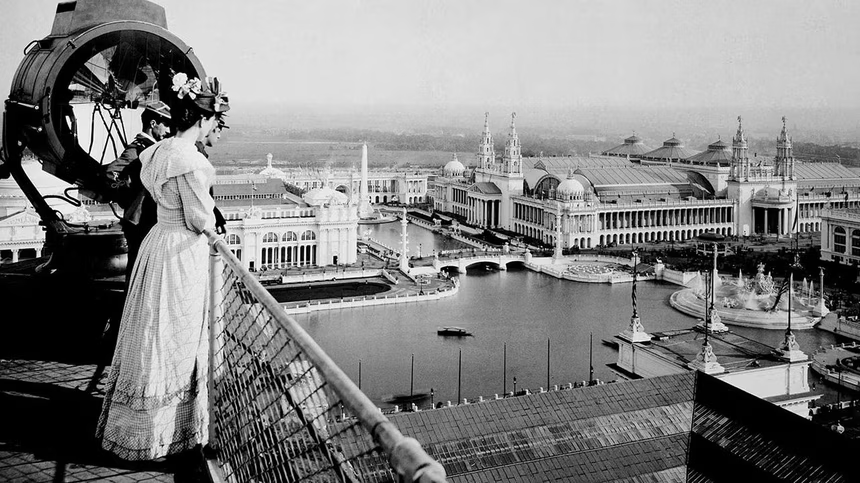
Chicago Stories - New Season!
Season 6 includes: The World’s Fair of 1893, Toy Town, Skyscrapers, and Home of the Irish.Providing Support for PBS.org
Learn Moreabout PBS online sponsorship(riveting music) - [Narrator] Coming up.
In 1893, Chicago promised the world.
- Everybody was coming to Chicago.
This was the place to go.
- [Narrator] The Columbian Exposition.
A dream city of wonder and light.
- You see this shimmering white city.
- [Scott] These were the largest buildings ever constructed.
(light clicks) They were being transported into a magical world.
- [Narrator] The Midway reels them in.
- [Rebekah] Buffalo Bill.
- [Clarence] Harry Houdini.
- [Rebekah] The Ferris wheel.
- [Narrator] A city illuminated by a demanding visionary.
- Daniel Burnham.
They called him a benevolent dictator.
- [Narrator] And darkened by a devil.
(suspenseful music) - The story of H.H.
Holmes is a guy who built a hotel to prey on people who came to Chicago for the World's Fair.
- It's hard to imagine the energy that this man put into destroying other human beings.
- [Narrator] "The World's Fair of 1893," next on "Chicago Stories."
(intriguing music) (train rumbles) Lead support for Chicago Stories is provided by The Negaunee Foundation Major support is provided by the Abra Prentice Foundation the Tawani Foundation and the Matt and Joyce Walsh Family Funding for Chicago Stories: The World's Fair of 1893 is provided by Clifford Law Offices Shirley Z. and Peter C. Welsh the Henry Nias Foundation ...and viewers like you.
- [Narrator] Just 60 years after its founding, and only 20 years after it burned to the ground, Chicago came of age.
A city of iron, smoke and ambition.
- Chicago is a rocket ship.
It's been incorporated as a town in 1833 with only 400 people.
60 years later, the population is now more than 1 million.
It's the fastest growing city in the world.
- [Narrator] A city of towering skyscrapers, sprawling rail lines, and filthy stockyards.
- Chicago at the time would've been dirty, smelly, and terribly exciting to be in.
- [Narrator] Fierce labor strikes filled the streets, and yet Chicago overflowed with optimism.
- So it was just a booming city.
It had both amazing, technological marvels and amazingly strong and challenging social problems at the same time.
(gentle music) - [Narrator] Chicago saw a chance to boast in 1889 when cities across America competed for the right to host a World's Fair.
It would mark 400 years since Christopher Columbus's voyage.
- The point of it is to show that you are the best, that you are the brightest, that you have the most innovation, that we were the height of civilization.
- [Narrator] Several cities lobbied to host the fair.
New York seemed the obvious choice, but Chicago's civic boosters pledged another $4 million to bring the fair west.
- There was very sharp criticism coming from New York.
They were pointing their jabs at Chicago saying, "There's no way the city can pull it off.
"It's a cow town."
- [Narrator] Congress stunned the Eastern establishment and chose the Windy City.
- This became a very big thing for the city of Chicago.
A generation before, most people probably hadn't heard of Chicago.
Now, all of a sudden, it was hosting the World's Fair.
- The next big question, which turned into a giant fight, was where would the fairgrounds be?
(gentle music) - [Narrator] Chicago's business titans hired America's finest landscape architect, the visionary behind New York's Central Park.
- You cannot go wrong when you hire Frederick Olmsted to be the landscape architect, the man who will design beautiful, beautiful plots and beautiful, beautiful parks all over the world.
- [Narrator] Olmsted knew the dazzling Lakefront was the city's real showstopper and perfect backdrop.
He had designed Jackson Park years earlier, but it remained a marshy wasteland.
This was the site chosen to host the world.
- It was a swamp, it was a bog.
We have less than three years to get this in gear, convert it from Mud City into a temporary city that will fulfill all of these dreams.
(soft music) - [Narrator] Chicago turned to Daniel Burnham and John Wellborn Root to show the world what it could do.
They had designed The Rookery, a skyscraper flooded by light, where commerce was elevated to art.
The partners were a study in contrasts.
Burnham: driven, disciplined, commanding.
Root: Instinctive, imaginative.
A man able to see every brick of a building in his head before putting pencil to paper.
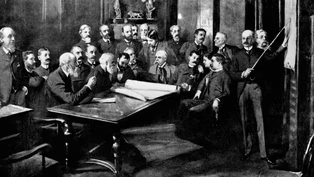
Meeting with Olmsted in their office atop The Rookery, they faced a daunting task: to build an entire city from scratch.
- And so they had this incredible session where Root was drawing on this huge brown paper.
- [Narrator] They anchored the site along Lake Michigan, weaving lagoons, waterways and a wooded island.
Visitors would enter a monumental Court of Honor, flanked by five enormous exhibition halls.
- A member of the Chicago Commission said that the fair had to be designed to dazzle and delight.
- [Narrator] Burnham appealed to the nation's most celebrated architects, mostly Easterners, to design the Court of Honor.
John Root welcomed them to his Astor Street home.
- One of the very sad things about the story is that it was time for everyone to leave.
And he was walking each of the architects out to their carriage and didn't have on a coat.
He had a terrible cold.
It turned into pneumonia, and then he died several days later.
- [Narrator] Root was 41.
The loss devastated Burnham at the very moment he needed him most.
- He carried on.
Like so many Chicagoans, he carried on.
(riveting music) - [Narrator] Within weeks, construction was underway.
Crews drove forests of wood pilings into the soft ground to hold the fair and Chicago's future.
- Daniel Burnham, the man who famously said, "Make no little plans," that could have been the theme of the World's Columbian Exposition, because they tried everything, and if it didn't stick, they moved on.
And they kept trying and trying and trying, knowing that New York was waiting in the wings.
- [Narrator] Among the 40,000 laborers who built the fair was a carpenter named Elias Disney.
Walt Disney's father earned a few dollars a day, one more working man whose name never appeared in the official record.
Burnham agreed to an 8-hour day, but the work remained brutal and dangerous.
- Buildings were going up, and then a roof would collapse due to snow, or wind damage would knock down some structures.
- [Narrator] There were 700 accidents and 18 deaths in only 20 months.
Men fell from scaffolds, were crushed by falling beams, died in fires.
- Daniel Burnham was so dedicated to this cause that he moved all the way to the fairgrounds and stayed there, just to make sure that these great, great plans were realized.
- [Narrator] Away from his wife and beloved children, weighed down by Root's death and unforgiving deadlines, Burnham kept vigil by a fire at night, steadfast in purpose.
The punishing pace took a toll on everyone, especially landscape architect Frederick Law Olmsted, 68 years old and in fragile health.
- He's struggling.
He had a lot of ailments.
He had terrible bouts of depression.
He was under so much pressure.
- [Narrator] Olmsted walked the grounds constantly, watching its contours take shape.
He was obsessed with his lagoons, boats and wildlife.
- Olmsted was so particular about every single element.
It's so fascinating that he ended up being the person who actually decided on what the list of birds would be.
700 ducks, 700 pigeons, 100 geese.
(geese honk) - [Narrator] While Olmsted counted ducks and geese, the Exposition buildings rose along Lake Michigan.
Wooden frames coated in staff, a fast-setting mixture of plaster and jute.
They were never meant to last.
- They would make something that some people called counterfeit marble.
It was cheap, it was easy, and it was a lot faster to put together.
- [Narrator] The fair's crushing deadline left no room for stone or steel.
These were not buildings, they were illusions.
- The outside of the buildings looked like palaces, but they're just wood frame construction.
Large machines would quickly spray paint the outside of the buildings white, having them all the same color would save time if they had to do any patchwork.
- [Narrator] In the end, The White City was built to open on time, not to last.
As Burnham and Olmsted turned swamp into spectacle, anticipation swelled across America.
Chicago drew them in: capitalists, dreamers and schemers.
- Everybody was coming to Chicago.
If you wanted to build a fortune for yourself, this was the place to go.
(soft music) - [Narrator] Among those who flocked there in the years before the fair was a charming doctor who would become one of Chicago's most infamous killers.
(dramatic music) H.H.
Holmes.
Born Herman Mudgett, his early life in New Hampshire offered only a faint warning of the depths to which he would descend.
- He was bullied as a child, and these bullies had taken him to the local doctor's office and had presented this skeleton to him and basically tried to scare him.
He said initially he was scared, but then he became curious, and he said that's why he decided to go into medicine.
- [Narrator] Mudgett married, and studied at The University of Michigan.
Classmates recalled his zest for dissection.
Rumors swirled that he robbed graves for cadavers.
- There were stories that he even used to go out to graveyards at night.
He just barely graduated.
A couple of the professors said that they graduated him out of pity.
Just what you wanna hear about your doctor.
- [Narrator] His wife left him and took their young son back to New Hampshire.
Mudgett eventually headed west under a new alias, Harry Howard Holmes.
He quickly learned that deception was more profitable than healing.
- He didn't really do much practicing in medicine.
Eventually he became a pharmacist in Chicago and then got into wheeling and dealing in real estate.
- He would just go under different aliases.
He would start companies.
You had swindle schemes, insurance fraud.
I mean, you name it, he was into it if he could make money.
- [Narrator] Holmes owned a modest building in a south side neighborhood called Englewood.
With the fair under construction just a few miles east, Holmes saw his biggest opportunity yet.
He set out to build a third floor with more rooms.
A World's Fair hotel.
- He borrowed a lot of money from investors.
He was able to swindle flooring companies, hardware companies.
He took out several fire insurance policies on it, and then lo and behold, right in the middle of the fair, before it had actually opened, that third floor caught fire.
The insurance companies were not fooled for a second.
(suspenseful music) - [Narrator] It was not a hotel in any conventional sense, but the intersection of Wallace and 63rd Street became a place where people, especially young women new to the city, vanished.
- Ned and Julia Connor moved into the building Holmes was operating in Englewood.
They brought their 4-year-old daughter, Pearl.
Holmes very quickly started having an affair with Julia.
- [Narrator] The Connors divorced.
Ned left.
Julia stayed behind with her daughter, serving as Holmes's secretary.
- He seemed to have a way of making people like him, and he charmed everyone.
- [Narrator] On Christmas 1891, Julia and Pearl disappeared, leaving behind an untouched meal and a cherished doll.
Holmes said they'd left suddenly for a funeral in Iowa.
- After they disappeared from the building, a woman moved in by the name of Emeline Cigrand.
(suspenseful music) - [Narrator] Cigrand had recently moved to Chicago.
Holmes spotted the 24-year-old beauty at an employment agency, and hired her as his secretary.
They took music lessons together.
After rumors spread that Emeline was pregnant with Holmes's child, she also disappeared.
Holmes said she'd left to get married.
Her trunk was sent to her family in Indiana.
(trunk clicks) - It's hard to imagine the energy this man put into destroying other human beings, all the while being likeable.
And I think it's one of the great mysteries about Holmes, of how he pulled it off.
- [Narrator] There was too much excitement in the air to notice another young woman had gone missing.
The world was converging on Chicago.
The fair was about to begin.
(suspenseful music) (rain splashes) Rain fell early on the morning of May 1, 1893, but the sun broke through as up to 200,000 people gathered in Jackson Park for the opening ceremony.
- And over the treetops, you see this shimmering White City.
And you get closer and you get closer, and you see all of these buildings that are neoclassical by design and just dazzling and white.
(bright classical music) - [Narrator] Workers were still putting finishing touches on the grounds.
But nothing could dim the crowd's excitement when President Grover Cleveland stepped onstage.
- Grover Cleveland pushed the button.
It was a gold telegraph key, and that sent a signal over to Machinery Hall to start the engines, and flags unfurled, and the fountains were bursting with water.
A giant drape fell off the Statue of the Republic.
- [Narrator] Visitors were awestruck, erupting in applause.
- This big golden statue known as Big Mary, basically welcoming everyone to the Western hemisphere and welcoming everyone to Chicago.
It must have been a sight to see.
- [Narrator] Daniel Burnham looked on with pride.
The Columbian Exposition, three years in the making, had opened at last.
- So you walked in and you were surrounded, absolutely dumbstruck, I imagine, by these buildings.
And then you catch your breath and you look around and you see that every state in the Union is represented.
Countries from all over the world are represented.
And the fair goes on for another 700 acres.
- It was its own city.
It had a capitol in the Administration building.
It had its own daily newspaper.
It had its own elevated train line.
- [Speaker] "The most beautiful and impressive thing "in the World's Fair was, to me, "the Court of Honor.
"A true land of enchantment."
Agnes Repplier, Philadelphia, Pennsylvania.
- These were the largest buildings ever constructed.
The single largest building in the world was the Manufacturers and Liberal arts building.
- [Narrator] Twice the size of The Great Pyramid in Giza.
Its grand hall could seat more than 200,000 people.
- Some of the exhibits inside had the largest stove in the world.
It was actually not a real stove, it was a display pavilion to look like a stove.
Everything had to be the largest and the biggest to capture attention.
- [Narrator] A few buildings managed to stand apart from the sea of white facades.
The Palace of Fine Arts was the only major structure built of fireproof materials, designed to protect thousands of prized artworks.
Nearby, a golden doorway beckoned visitors into the Transportation building, architect Louis Sullivan's striking exception to the fair's European classicism.
At the edge of the grounds stood another statement.
The Woman's Building rose at a time when American women were still three decades away from winning the right to vote.
- We are at the height of the suffrage movement, of the women's feminist movement.
How do you get the world to see you?
This is a great venue.
- [Narrator] Bertha Palmer, of the Palmer House hotel, was the city's most influential hostess and tastemaker.
She helmed a board of lady managers, which sponsored a national design competition.
The winner was a 21-year-old fresh out of M.I.T.
- Sophia Hayden was the architect chosen to design the Woman's Building, which was a huge deal to have a woman architect, a woman professionally trained architect, design this.
- [Narrator] Hayden's building should have been a career-making moment, but Palmer and the board were demanding clients.
- They micromanaged this woman to death.
She checked herself into a clinic because she was suffering from nervous exhaustion.
She was paid $1,000 compared to the average of $10,000 that most of the male architects were paid.
- [Narrator] Inside, the massive exhibition halls were more than 65,000 exhibits: weapons, locomotives, early automobiles, taxidermy, fisheries.
The incandescent light bulb had existed for over a decade, but for many visitors, this was their first glimpse of electricity on this scale.
- You gotta imagine coming from a small town, you've been reading about electric light bulbs in your local newspaper for a while, but there was no place in your small, isolated town to see one.
- [Narrator] Inside the Electricity building, fairgoers encountered the future: a Victorian-era fax machine, electric chairs for more humane executions, an electric kitchen that promised to change homes.
- I think they had a lot of electrical appliances for women to make their lives better, like electrical irons and the dishwasher.
Of course, you'd have to have electricity in your home, and not everyone did.
- [Narrator] One invention barely caused a ripple: a clumsy little fastener.
- So this fair introduced so many firsts that we now take for granted more than a century afterwards.
But the most important innovation without question: the zipper.
- [Narrator] This fair didn't just fire the imagination, it fed the nation, popularizing brands that would become household names for generations.
- [Clarence] Cream of Wheat.
- [Rebecca] Vienna Beef Hot Dogs.
Wrigley Juicy Fruit Gum.
- [Clarence] Pabst Blue Ribbon beer comes in so handy the night before payday.
- If I could go back in time to the World's Fair, I would, first of all, wanna watch people trying Shredded Wheat, which was introduced there, and by all accounts was not a hit.
It would be kinda like feeding people Malort nowadays.
(soft music) - [Narrator] Bertha Palmer asked the Palmer House chef to create a dessert suitable for boxed lunches.
He whipped up a dense square of chocolate and walnuts, finished with an apricot glaze, a recipe generally considered the first brownie.
Inside the Agricultural building, food become theater.
- Visitors could find not one, not two, but four different giant statues carved out of chocolate to represent Christopher Columbus and the Venus de Milo.
- [Rebecca] A knight and horse made of prunes.
- [Scott] The largest wheel of cheese in the world.
- [Rebecca] You go to the dairy exhibit and see the butter sculpture people.
- How are they gonna see all of this?
One of the most ingenious ideas were called rolling chairs.
So you could rent a rolling chair, you could rent someone to push it for you.
A lot of them came from divinity schools, so sometimes they were called the Holy Rollers or the Gospel chariots.
(bright classical music) - [Narrator] Visitors needing a respite from the overwhelming sights and sounds could take a gondola to the Wooded Island created by Frederick Law Olmsted.
The real magic emerged after sunset.
160,000 electric bulbs flickered to life, transforming the White City into a dreamland.
- The illumination at night drew people to the fair.
It really brought people into a sense of enchantment.
- Gosh, we don't have these back home.
All of these things that must have just knocked people over.
And they tell all of their family, "Wow, you gotta go to Chicago."
(bouncy music) ♪ A little maiden climbed an old man's knee ♪ - [Speaker] "The time approaches "for me to leave this wonderful place, "and I go most reluctantly.
"I have not seen half of what I'd like to, "and yet how lovely it has all been, "and I want y'all to come and enjoy it, too."
Nan Toby, Waco, Texas.
- Yes, this is the city of the future.
(suspenseful music) Little did they know we have a man, H.H.
Holmes, and that he was conducting his evil deeds within walking distance of the fair.
(suspenseful music) - [Narrator] That summer, Holmes romanced a young woman from Texas named Minnie Williams, an orphan with a small inheritance and land in Fort Worth worth thousands.
- She had run outta money trying to launch a theatrical career, decided to give up on her dreams and come get a regular job.
There's probably a lesson here about giving up on your dreams.
The first thing she did was start working for H.H.
Holmes.
But they started dating.
Minnie's long lost sister, Nanny, moved in.
Both of those young women disappeared in July of 1893.
- [Narrator] Holmes began making financial transactions in Minnie's name within days of their disappearance.
The sisters slipped from view in a city moving too fast to notice.
As the summer wore on, the fair faced problems of its own.
After an early burst of crowds, attendance sagged.
- There were a lot of concerns that the fair was not gonna be able to end in the black, and East Coast papers would constantly point to this impending failure, this financial disaster that was about to befall Chicago.
- [Narrator] The White City was built as a vision of the future, an antidote to the labor and social unrest roiling Chicago's streets.
- They thought if they built this rational city, the people would be different sorts of citizens in that you would walk through this ordered place and in your own life become sort of more ordered and logical, too.
- [Narrator] But that order reflected the deepest divisions of the present.
To Black activists Frederick Douglass and Ida B. Wells, the White City was a place that excluded them and their contributions.
- It was clear from the very start that there was no place for them.
The White City was the white city.
- [Narrator] In 1893, Chicago was home to roughly 15,000 Black residents, about 1% of the population.
Many were accomplished business owners, professionals and civic leaders.
- They believed in their country, and they believed in their place in it.
They were not asking for a handout or a hand-me-down.
They had earned it.
And they had earned it with blood, sweat, and tears.
They were not going to take being excluded lightly.
- [Narrator] Douglass and Wells printed a protest pamphlet and handed out 20,000 copies.
Douglass agreed to help organize a colored people's day.
Wells refused to participate, fearing it would become a spectacle.
Among her concerns were reports that fair officials planned to entice Black visitors with watermelons.
- Ida B. Wells said, "Nope, not gonna do it."
Frederick Douglass not only said, "I'm going to do it," he was the keynote address speaker.
- [Narrator] As Douglass spoke about America's failure to protect African Americans from discrimination and lynching, hecklers shouted at him.
Douglass paused, set down his notes, and demanded to be heard.
- Everybody who was there was absolutely impressed, including many of the skeptical members of the white press.
And so this was a wonderful stepping stone for the African American experience in spite of how it might have appeared at the moment.
(gentle music) - [Narrator] Beyond the White City's soaring halls and serene lagoons, a very different energy pulsed along a mile-long strip called the Midway Plaisance.
Here, a Harvard anthropologist curated ethnological villages, turning non-European peoples into attractions for Western audiences.
- You have the recreation of all of these little native villages, which everybody thought was wonderful, but then in hindsight, it's really just underscoring the marginalization of many people.
- [Narrator] After a 21-year-old showman named Sol Bloom took over, entertainment ruled the Midway.
Bloom transformed the strip into a panoply of villages, cafes, concert halls, and thrill rides.
There were mosques and pagodas, Hindu jugglers, and a traveling zoo.
- The Midway was where all the fun stuff was.
There was a lot of exciting things happening there.
It inspired a lot of imaginations.
- [Narrator] The Midway wasn't just entertainment, it was a way to earn back the fair's investment.
Visitors flocked to the more exotic attractions.
Bloom gave prime real estate to a crowd favorite: the Street in Cairo.
- With vendors and camel rides and donkey rides.
And every day, they'd have a wedding celebration of sorts.
("The Streets of Cairo") - [Narrator] Nearby, the Algerian village drew controversy.
Belly dancers performed what Americans quickly dubbed the Hoochie Coochie.
The name came from a catchy tune composed by Sol Bloom.
- And he composed a tune that goes like this.
(mouths "The Streets of Cairo") It takes on a life of its own.
And over the ensuing century, that is what our collective minds default to when we think of a snake charmer.
("The Streets of Cairo") - [Narrator] The White City may have inspired awe, but on the Midway, fairgoers could let down their guard.
(cheerful music) - I love all the cafes.
It'd be fun to just sit in Old Vienna and have a beer.
In addition to that, you could have an ostrich egg omelet because they had a California ostrich farm.
They did not actually cook ostrich eggs.
It was just chicken eggs.
- [Narrator] A 19-year-old escape artist was still just another act trying to draw a crowd.
- Many Americans for the first time saw Harry Houdini at the Midway.
- [Narrator] Houdini couldn't compete with a swashbuckling frontiersman named William "Buffalo Bill" Cody.
His Wild West Show featured trick riders, stagecoach chases, and a sharpshooter named Annie Oakley.
(gun bangs) Fair organizers denied Cody a spot on the grounds, so he set up just outside the gates as a separate, ticketed attraction.
It became one of the fair's biggest hits.
(horse neighs) - You'd have this very dramatic fight scene, wild and rambunctious horse riding.
- [Narrator] Cody re-enacted The Battle of the Little Big Horn.
Rare film from the era shows the spectacle.
He employed Native American performers, some of whom had actually fought there.
Cody treated them with respect, but the show left a complicated legacy.
- I think Buffalo Bill's legacy can't be understated in terms of its power as a stereotype.
When you see something that's meant to entertain you, it sticks differently.
- [Narrator] The Exposition celebrated Columbus's discovery of America, but it never offered a clear story about the people who were already here.
On the Midway, visitors walked through an encampment showing traditional tribal life.
Elsewhere on the grounds, the federal government's Indian Bureau operating a boarding school exhibit.
- They would be taught and they would be in a classroom setting for people to watch and see.
And so that was really the government's way of saying, "This is how we see indigenous people "being part of America's future."
- [Narrator] Amid all these divisions, there was one attraction that united the crowd, engineer George Ferris's 264-foot steel marvel.
- The Ferris wheel, the contraption that was supposed to out-Eiffel the Eiffel Tower.
- [Narrator] Approved late and plagued by delays, the Ferris wheel didn't open until mid-June, more than a month into the fair.
But once it began to turn, it captured the world's attention.
- The Ferris wheel was twice as tall as any building most people had ever seen before.
- 36 cars could carry 2,000 passengers at a time, lifting them high above the Midway.
Two full rotations took 20 minutes.
Not a ride for the faint of heart.
- There is a story that was in a Chicago newspaper of a man who was simply terrified, really panicked.
A woman gently took off her skirt and threw it over his head to calm him down.
So she saved the day.
And the Ferris wheel was a huge money maker.
That really saved the fair from financial ruin.
- [Narrator] With as many as 20,000 people a day climbing aboard the Ferris wheel, crowds at the fair soared.
Everyone from Mayor Carter Harrison to Daniel Burnham took a spin.
- The number of famous or soon to be famous people walking around the fairgrounds is just incredible.
- [Narrator] They included future president Theodore Roosevelt, a Spanish princess, social reformer Jane Addams, and a young Chicagoan who would soon create "The Wizard of Oz."
- Imagine that you are L. Frank Baum, who takes his wife and children to the fair, and it's magnificent.
And then 10 years later, you're writing a book and reaching, maybe subconsciously, for inspiration for this Emerald City.
(dramatic music) - [Narrator] Burnham had insisted on a dedicated police force, the Columbian Guard.
They watched for thieves, pickpockets and prostitutes.
But a criminal of a very different stripe walked the grounds unnoticed.
H. H. Holmes was courting another young woman drawn to Chicago and the World's Fair.
Georgiana Yoke came from a hardworking Methodist family in Franklin, Indiana.
She found work at a downtown department store, where Holmes noticed her and introduced himself.
- You don't expect a sociopath to walk into your life.
She thought he was a successful doctor.
She had no reason to doubt that he was who he said he was.
- [Narrator] To most people, Holmes was just another well-dressed visitor, one more handsome face in the Midway crowd.
But he was never who he claimed to be, nor what he appeared.
- He didn't only fool Georgiana and her family, he fooled businessmen all over Chicago.
He fooled police.
It's hard to imagine how he really pulled it off.
(gentle music) - [Narrator] Holmes was one of 27 million ticket buyers who passed through the gates of the World's Fair in 1893.
More than half came from within the United States, at a time when the population was only 63 million, making it the greatest tourist attraction in American history.
- So the crowds were really building throughout July and August and September.
And the absolute peak was on Chicago Day in October.
Chicago Day has been called the largest peaceful gathering of humans in history to that point.
(cork pops) (people laugh and applaud) - [Narrator] Daniel Burnham and the City of Chicago had reason to celebrate.
Against all odds, the city had pulled off the impossible.
The fair had exceeded every expectation and even turned a healthy profit.
Even jaded Easterners were forced to admit Chicago was no longer a "cow town."
- The World's Columbian Exposition was the precise moment that Chicago became a world-class city.
- [Narrator] Two days before the fair was set to close, tragedy struck.
At 8:00 PM, (loud knocking) Mayor Carter Harrison greeted an unexpected visitor at his home.
(suspenseful music) (gun bangs) The mayor collapsed and died within minutes.
His killer was a psychologically disturbed man who believed Harrison had denied him a city job.
- And so the closing ceremonies for the fair are canceled in favor of putting all the attention towards the funeral of Mayor Carter Harrison.
- [Narrator] The murder stunned Chicago at the very moment when it had reached its zenith.
Snow blanketed the empty fairgrounds that winter, and a financial panic snapped Chicagoans to cold reality, plunging the nation into the worst Depression it had ever known.
In Chicago, one in five workers were suddenly unemployed.
Starving men demonstrated for jobs and food outside the Exposition halls.
- So a lot of unemployed men were able to just go into the empty buildings and set up a little place to live, and there's accounts of people eating the foods that were on display that were left.
- [Narrator] One writer mused it would be better for the buildings to vanish in a blaze of glory than to fall into disrepair.
Providence granted his wish.
- In January 1894, there was a huge fire, and a huge amount of the fairgrounds were actually demolished.
For people watching the fires, just must have been extraordinary, upsetting.
- [Narrator] Big Mary survived, battered but still standing amid the blackened ruins.
- Slowly she lost her gilding.
Eventually she lost one of her arms, and it was such a sad state.
Eventually in the summer of 1896, the Park District set her on fire, put it out of its misery, and that was the end of one of the last relics on the fairgrounds.
- So there was the White City inspiring people, and then (snaps) it was gone.
Soon after, we have the realities that were attributed to H.H.
Holmes.
They're a statement about larger civilization.
You can't have light without dark.
- [Narrator] Just one month after the fair closed, 25 creditors confronted Holmes over unpaid debts.
He packed his bags and fled Chicago with Georgiana Yoke, whom he had convinced to marry.
- You would've thought this was a wake-up call, but it really wasn't.
(dramatic music) - [Narrator] Even on the run, Holmes hatched another fraud.
He and a business partner, Benjamin Pitezel, plotted to fake Pitezel's death and collect a $10,000 insurance payout.
- But somewhere along the line, Holmes decided it was easier just to kill him for real, possibly because Pitezel was an alcoholic and couldn't really be trusted to keep his mouth shut.
- [Narrator] Holmes staged the murder to make it look like an accident, and collected the money.
He took custody of Pitezel's children, Alice, Nellie and Howard, loose ends he worried could expose his crimes.
(train whistle blows) To keep them quiet, he shuttled the children from city to city, while housing their mother in separate lodgings.
None of them knew how close they were to one another.
- Holmes convinced them he was gonna reunite them all.
They were gonna split this huge amount of money they got from the insurance company.
And he's moving them around the country in tandem, like tokens on a board game.
Just crazy.
(train screeches) - [Narrator] Authorities eventually caught up to Holmes and arrested him for insurance fraud.
He was jailed in Philadelphia.
The district attorney feared Holmes had murdered not only Benjamin Pitezel, but his children, as well.
A detective spent two months searching for them, only to make a grim discovery.
- Finding those girls in Toronto was a gruesome sight.
When they dug up the graves in that basement, the stench was so overwhelming.
- [Adam] And Howard was found in Irvington, Indiana after a very clumsy attempt had been made to destroy the body.
- All these murders, they were just getting people out of the way because he regarded them as bugs in a jar.
- [Narrator] In the end, Holmes stood trial for one murder: his business partner, Benjamin Pitezel.
From his dank prison cell, Holmes stoked the flames of his own legend, writing a prison diary and three separate confessions to the press.
- He confessed to having killed 27 people, but several of the people he confessed to killing were still alive at the time.
The whole thing was just another money-making scheme.
- [Narrator] Back in Chicago, detectives scoured the building at Wallace and 63rd street for evidence.
- The police never found anything in the building that they could have actually used to bring into court.
They found some bones, but they tended to turn out to be soup bones.
- [Narrator] In the 1890s, circulation wars fueled a new kind of reporting: yellow journalism.
Joseph Pulitzer's "New York World" branded Holmes's building a "Murder Factory," and published a fabricated diagram of secret rooms, hidden chambers, trap doors, even a crematorium.
- So there were a couple of interesting things about the building.
There was a secret passage that led from one of the bathrooms down to a lower floor, and there was a hidden compartment in between the first and second floor above the drugstore.
So these were like secret passages, only everybody in the building knew about them.
The drugstore clerks used to sleep in that hidden room.
- [Narrator] Holmes's wife, Georgiana, was devastated by her husband's lies.
The press hounded her, even as she mustered the courage to testify against him.
- She ended up doing a very courageous thing.
She did not have to testify, but she got up there and did it anyway.
And you have to admire that.
- [Narrator] Holmes was convicted of Pitezel's murder, and sentenced to hang in 1896.
Just 35 years old, he had packed a lifetime of cruelty and malice into a short, miserable life.
- The story of H.H.
Holmes, as we've come to know it in pop culture, is a guy who built a hotel that was full of hidden passages and torture equipment and everything you would need to kill a person to prey on people who came to Chicago for the World's Fair.
Holmes's crimes may have been exaggerated, but he did kill several people and ruined the lives of many others.
Of the nine people we can say reasonably for sure he killed, I think mostly they were probably poisoned, most likely with cyanide.
- [Narrator] Holmes's building stood until 1938, when it was torn down to make way for a post office.
In the years that followed, ambitious journalists and clever writers resurrected Holmes, transforming him into a diabolical serial killer, a "Devil in the White City."
(eerie music) - His legend grows and grows and grows to the extent that the legend of Holmes, justified or unjustified, is actually more widely known around the world than the World's Fair itself.
- [Narrator] An alleged grave robber in his youth, Holmes had requested his coffin filled with cement.
Even that wasn't enough.
In 2017, his great-great grandson, along with anthropologists from the Penn Museum, exhumed the body, investigating rumors that Holmes had escaped the hangman's noose.
The evidence, as documented here in rare photos of the dig, left little doubt the remains were Holmes.
Not a devil.
- Holmes was intact.
He still, you know, had on his suit, and his mustache was still attached to his skull.
(soft music) - [Narrator] While Holmes still garners headlines, the man who put Chicago on the world stage has largely faded from memory.
After the World's Fair, Daniel Burnham emerged as the most sought-after urban planner in America, shaping cities from Washington, D.C.
to San Francisco.
None of his ambitions proved more sweeping than the "Plan of Chicago," which laid the groundwork for the Magnificent Mile and a continuous chain of Lakefront parks.
The plan was a cornerstone of the City Beautiful movement, an idea that spread across the nation.
- Whenever you see sort of a municipal architecture in this Greco Roman style, every time you see a post office that looks like a Roman temple, it's partially because of the World's Columbian Exposition.
- [Narrator] Burnham died in 1912 and was laid to rest in Graceland Cemetery, his legacy firmly etched into the city's landscape.
The White City left an enduring mark on Chicago, visible in later civic monuments, like the Field Museum and the Shedd Aquarium.
Fittingly, this Lakefront stretch now bears Burnham's name.
- That's what I would want anybody in the world who visits Chicago to understand, that Chicago's City Beautiful, the original City Beautiful, begins with the World's Colombian Exposition.
- [Narrator] Few events transformed Chicago more than the 1893 World's Fair, commemorated by a star on the city flag and a replica of Big Mary in Jackson Park.
- Most people think, like, a single building exists from the fair, and that's today's Museum of Science and Industry.
But there's more.
The Art Institute downtown was constructed for the fair.
It was to host the World's Congress.
So these were a series of academic lectures that went on all summer long.
So there are little bits and pieces of the fair all over if you know where to look.
- [Narrator] A viking ship slumbering in a suburban park, a ticket booth tucked into the yard of a private home.
The long, green parkway on the University of Chicago campus is the same strip of land where belly dancers once strutted and the Ferris wheel roared.
It inspired at least one graduate student in archaeology to literally dig deeper.
- I was actually in a building overlooking the Midway with one of my professors, and he sort of put his hand like this.
And he was like, "100 years ago, "this was the center of the world."
And I was surprised that no one was excavating or had excavated at the former site of the World's Columbian Exposition because of how massive it was.
And we started our excavations in 2008.
What was really surprising, though, was when we found the remains of a building.
And they were plaster remains.
So we figured out it was the Ohio State Building.
- [Narrator] Frederick Law Olmsted's lagoons and wooded island still form the spine of Jackson Park, fertile ground for ambitious civic projects, like the Obama Presidential Center.
- It's really exciting to think about that connection between Chicago and Jackson Park being the center of the world in 1893 to having the world's attention returned to it again.
And I think it's a really important story to tell.
- [Narrator] A lasting reminder of a time when Chicago dazzled and delighted the world.
- Chicago demonstrated to the world not only everything that could be done and all the ways in which you can dream, but all of the darkness that's going to come with it.
Missing people here, murdered people here, marginalized people here.
Look, there is the Ferris wheel.
All of these things going together and really making the definitive view of the modern world.
(soft music) (gentle music)
Video has Closed Captions
Burnham, Root, and Olmsted set out to design the White City. (7m 19s)
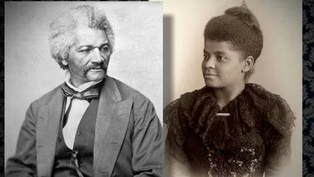
Frederick Douglass and Ida B. Wells Protest the Fair
Video has Closed Captions
Douglass and Wells object to the exclusion of African Americans from the World’s Fair. (3m 3s)
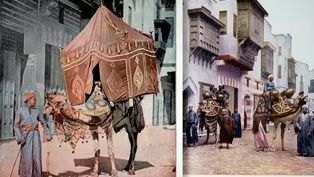
The Spectacle of the Midway Plaisance
Video has Closed Captions
The Midway Plaisance offered a different kind of energy at the World’s Fair. (7m 46s)
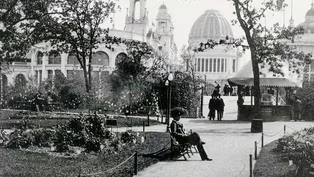
Video has Closed Captions
What was it like to visit the White City? Journey back as we imagine the World’s Fair. (5m 17s)
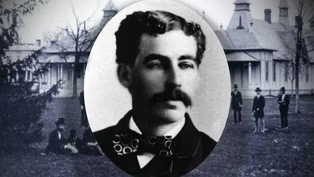
Video has Closed Captions
H.H. Holmes moves to Chicago, and a young woman later goes missing. (5m 23s)
Providing Support for PBS.org
Learn Moreabout PBS online sponsorship










Support for PBS provided by:
Chicago Stories is a local public television program presented by WTTW
Lead support for CHICAGO STORIES is provided by The Negaunee Foundation. Major support is provided by the Abra Prentice Foundation, Inc. and the TAWANI Foundation.