
Chicago Data Center Moratorium Stalled, But City Council Still Took Action
Clip: 9/28/2026 | 10m 25sVideo has Closed Captions
Alderpeople approved reporting requirements for data centers' water and energy usage.
Chicago's infrastructure and location can be attractive for the industry, but the dense population means even small data centers can have big impacts on residents.
Problems playing video? | Closed Captioning Feedback
Problems playing video? | Closed Captioning Feedback
Chicago Tonight is a local public television program presented by WTTW
WTTW video streaming support provided by members and sponsors.
Chicago Data Center Moratorium Stalled, But City Council Still Took Action
Clip: 9/28/2026 | 10m 25sVideo has Closed Captions
Chicago's infrastructure and location can be attractive for the industry, but the dense population means even small data centers can have big impacts on residents.
Problems playing video? | Closed Captioning Feedback
Where to Watch Chicago Tonight
Chicago Tonight is available to stream on pbs.org and the PBS app.

WTTW News Explains
In this Emmy Award-winning series, WTTW News tackles your questions — big and small — about life in the Chicago area. Our video animations guide you through local government, city history, public utilities and everything in between.Providing Support for PBS.org
Learn Moreabout PBS online sponsorship>> Data centers are going up around the country, but Chicago has unique factors to consider the city's infrastructure and location can be attractive for the industry.
But the dense population means even small data centers can have big impacts on residents.
Last week, City council members approved reporting requirements for data centers, water and energy usage.
But at the same meeting, other regulations, including the moratorium hit roadblocks.
Joining us, our Angela Tovar commissioner of Chicago's Department of Environment and the city's chief sustainability officer.
And Brad Keats Midwest director of state government affairs at the Data Center Coalition.
Welcome back to you both.
Thanks for joining us again.
So Brad, let's start with why Chicago is a place that data center developers might want to build.
>> Sure.
And I think one not to kind of start in a negative note, but Chicago is never going to be a hub for the kind of large-scale facilities that people are asking questions about across the country.
Right.
And Chicago has historically been a hub for the data centers that are literally servicing the economy, the modern economy that we all rely whether it's the Internet services for health care records, bank records, Government Schools, Telehealth telehealth or remote learning remote work.
The list goes on e-commerce and you know, so those are the kinds of data centers that are going to require the kind of proximity that that are needed to be next to their customers to get credit processing Crawford, you know, frequency, cetera.
So according to the city's report, there's 39 data centers currently in Chicago.
Only a handful are kind of I would suggest kind approaching the scale that folks are, you know, starting the question today.
So, you know, from our perspective, you know, there's there's been a lot of activity within the city, right over in recent months, the mayor put out an executive order back in August and we thought that was a fair ordinance.
Notwithstanding the moratorium push yet.
As you mentioned, there was the energy and water benchmarking reporting.
We did not push back against that.
We were OK with that.
But then obviously introducing a moratorium introduces a new kind of friction that I think does pose, you know, problems and potentially a signal to, you know, companies, if you're making a multi-billion dollar investment, you might not do it in a city like Chicago because of kind of the instability that you're seeing here what how would you describe the size of a data center that you'd expect to see being built in the city moving forward?
>> Yeah.
So I mean, there's going to be prime like the primary number of data centers in Chicago right now.
We're going to be what's known as edge or micro datacenters.
And, you know, Fortune 500 companies, hospitals, banks, they're going to have the smaller data centers to to process and you know, their their own compute.
Like I mentioned, you have a handful of larger data centers that are servicing businesses and residents like that.
I think the the interesting thing is here and you're starting to see some some, you know, much a maturation from what's known as the AI training data centers that we're seeing like the larger facilities saying more rural areas, what's going to happen and actually OpenAI Anthropic announced number, you know, they're they're targeting smaller data centers near more populated areas could because as we deploy technologies like this, the proximity matters.
And I think that's the opportunity for Chicago moving forward.
Commissioner Tovar, what kind of concerns have residents had about some of the existing urban data centers in Chicago?
Sure.
You know, from our perspective, I would say that this size that the data center is that that all sizes of data centers matter here in the city because we're in an urban area.
>> You know, we have data centers that are excuse communities that are existing right next to a residential communities.
Right?
We have.
>> High rises that are built next to data centers in the South loop.
And so we you know, ignore some of the concerns that we've heard from residents.
As Brad mentioned, the city did conduct in over a years long effort to better understand the impacts related to data centers.
And we found a number of issues that are concerning for including noise that's generated from the large cooling systems that data centers used to cool down their operations.
You know, we've learned a lot about concerns related to air quality.
Oftentimes data centers rely on backup diesel generators.
Those diesel generators have to test on a monthly basis.
And then in addition to that, if that there's a power failure, they rely on that system.
So that presents air-quality concerns for us and then, of course, you you know, I hear Brats point that the hyper data scan hyperscale data centers are the ones that are consuming a lot of energy.
But in a lot of water in an urban context that's still relevant.
We you know, a relatively stable grit.
We, of course, have this fresh water resource.
We want to make sure that we can maintain and protect those things for future generations ahead as well.
And then same question that we asked Brad.
But what size data center would you expect to be built in the city?
>> You know, we're seeing a wide range of sizes.
you know, we're we're seeing everything from smaller data centers says, as Brad mentioned.
>> To some, you know, larger stand-alone facility.
So it's really diverse in terms of what we're seeing, you know, Summer Co located.
So, you know, one data center company has multiple tenants and some are stand alone.
So it's really diverse in terms of what we're seeing across the city.
>> Brad, what are some of the options that data centers have to mitigate some of the concerns that commissioner just names with regards to noise and air pollution.
>> Yeah.
So I guess we'll start with the beer emissions piece for so backup generators to commissioners point they they will only be used if there is a power outage which are very in frequent in the comment territory or for maintenance and testing and typically those are going to be tested, you know, couple hours a and you can put in place rules and regulations around when when that testing occurs, you can put in place wells and barriers around all of this we see it happen all over the the Chicagoland area.
And you know something else Indy in reliable, affordable, great acts of surges that past that.
The Governor, Paterson until a few months ago, Illinois joined California now Virginia is the only state in the country to have what's known as a tear for back-up generator requirement, which removes about 90% of the pollutants that come from these backup We're working on regulation and, you know, state level there, they're on very sparsely.
So, mark, you know, from our perspective work with city leaders to put in place rules that work for the communities then on a noise really quick or sound, you know, again from You know, it's an engineering and innovation thing.
You know, you like primarily you're going to from the backup generators and the chillers.
Those can all be addressed in the are being addressed.
You know, consultation with the with the data center developer and, you know, put in place rules and regulations like the that executive order from the mayor called for several several weeks ago.
But again, don't put in place a moratorium and kinda stifles opportunity for property taxes, jobs, you know, clean energy investment.
So commissioner, you are the co-chair of the city's Data Center task for several older people introduced a one-year moratorium on data centers at last week's council meeting.
How the moratorium work towards the task force in schools.
I think that this is just important next step.
You know what we're hearing?
You know, the city was very transparent in saying, hey, the regulations that we have in place today >> are not adequate for how we should regulate the modern data center.
>> That was the top line from our report.
And so this presents an opportunity for the city to course, correct that we know that there are some important impacts that data centers present and we want the opportunity to create the right regulatory framework.
You know, you've heard brand name.
Yes, we should do that or we can do that.
And I think we agree, right?
We agree that that noise regulations that air quality regulations are too important measures.
You know, we would argue that there should also be easy to standards related to water and energy consumption as well.
There's also an opportunity to present design and innovation opportunities to encourage data centers to to to create higher efficiency standards and the better sustainable building principals.
These are all things that we can accomplish through a regulatory framework.
We just need to pause and create that framework.
Brad, how temporary moratorium changed the landscape for data center developers in Chicago.
We're looking to build Chicago.
Yeah.
And you have existing facilities, existing projects that were that are in the pipeline.
I think that presents a challenge.
>> But again, really what you're doing is saying sending a signal to the industry that this might not be the best place to put forth a multi-billion dollar investment and especially when the city is about to face 882 million dollar budget deficit.
Data centers are significant property tax generator.
So we don't believe you need a moratorium in place to spend all that time doing this.
Quite frankly, we could have reached an agreement.
of these regulations pretty quickly and and put in place those those guardrails that the city is calling for.
So that's what you're looking at.
But again, you know, 84% other renewable purchases done nationally in the 1st half of 2025.
Were done by data centers.
You know, these are significant opportunities for our union workforce in the building trades and by putting in place a moratorium.
All you're doing is sending sending those jobs the clean Energy investment.
you know, we're already seeing this jail actually estimates that Illinois has lost 200 billion dollars in data center investment to Indiana, Wisconsin and Iowa.
So Chicago is already kind of losing a lot of its workforce to other states.
All right.
And getting shorten time commissioner about 45 seconds.
Welcome.
Policymakers.
Learn from oversight.
>> Of past industries.
Sure.
I think we have the opportunity to really course, correct.
You know, we whether intentionally unintentionally because of our lack of regulations, historically.
>> Have contributed to the environmental harm of our communities.
We have an opportunity to, course, correct that by saying, hey, you know what, we can regulate more.
We could put better environmental safeguards in place.
And this is our opportunity to signal that we do care about jobs.
And just as importantly, we care about our people in our communities.
That's where we'll have to
 New
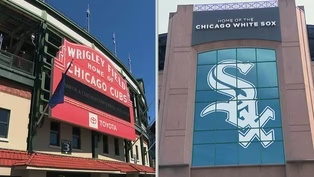
NewCubs and White Sox Both Reach the Playoffs. Here's What to Watch For
Video has Closed Captions
For the first time since 2020, baseball fans on both sides of town have something to root for. (9m 41s)
Providing Support for PBS.org
Learn Moreabout PBS online sponsorship New Episode
- News and Public Affairs

Top journalists deliver compelling original analysis of the hour's headlines.
 New Episode
- News and Public Affairs

Today's top journalists discuss Washington's current political events and public affairs.


 New Episode
 New Episode
 New Episode
 New Episode
 New Episode

 New Episode
 New Episode
Support for PBS provided by:
Chicago Tonight is a local public television program presented by WTTW
WTTW video streaming support provided by members and sponsors.