
WEDU Arts Plus
1509 | Episode
Season 15 Episode 10 | 26m 46sVideo has Closed Captions
The Sarasota Opera | Art for Oral Health | Art of Movement | Treasures of the Pacific Northwest
The history and legacy of the Sarasota Opera | A dental student uses art to highlight oral health and identity | The art of movement with Reno’s Acro Enzo | Pacific Northwest cultural treasures at the American Museum of Natural History in New York City.
Problems playing video? | Closed Captioning Feedback
Problems playing video? | Closed Captioning Feedback
WEDU Arts Plus is a local public television program presented by WEDU
Major funding for WEDU Arts Plus is provided through the generosity of Charles Rosenblum, The State of Florida and Division of Arts and Culture and the National Endowment for the Arts, and the Hillsborough County Board of County Commissioners.
WEDU Arts Plus
1509 | Episode
Season 15 Episode 10 | 26m 46sVideo has Closed Captions
The history and legacy of the Sarasota Opera | A dental student uses art to highlight oral health and identity | The art of movement with Reno’s Acro Enzo | Pacific Northwest cultural treasures at the American Museum of Natural History in New York City.
Problems playing video? | Closed Captioning Feedback
Where to Watch WEDU Arts Plus
WEDU Arts Plus is available to stream on pbs.org and the PBS app.
Providing Support for PBS.org
Learn Moreabout PBS online sponsorship- This is a production of WEDU PBS, Tampa, St.
Petersburg, Sarasota.
[Music] - Funding for WEDU Arts Plus is provided by Charles Rosenblum, Hillsborough County Board of County Commissioners, the State of Florida and Division of Arts and Culture, and the National Endowment for the Arts.
- In this edition of WEDU Arts Plus, a tribute to music performance and artistic determination.
- The crown jewel of the city was to become a grand theater, a landmark that has endured 100 years, a tribute to architecture, performing arts and the enduring spirit of community.
- A gallery show for dental students.
- This will serve like a creative platform where they can express themselves through art and also for people to get to know them.
- A movement art studio.
- We like to think about creative discovery and in ways that we can allow people to explore movement, explore themselves, and create.
- And a revitalized space highlighting the Pacific Northwest.
- The Northwest Coast Hall goes back to the late 1870s when the first pieces started to come in.
- It's all coming up next on WEDU Arts Plus.
[Music] Hello, I'm Gabe Ortiz and this is WEDU Arts Plus.
Sarasota, Florida has a rich tradition of arts and culture that goes back 100 years.
This first segment is a story about a theater's history.
Booms and busts.
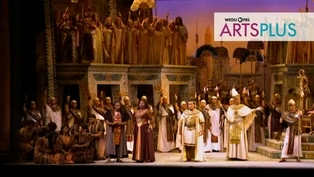
A centennial celebration of the Sarasota Opera House.
[Music] - In 1902, train service between Tampa and Sarasota began.
The crown jewel of the city was to become a grand theater, a landmark that has endured 100 years, a tribute to architecture, performing arts and the enduring spirit of community.
[Music] - The Edwards Theater is named for Arthur Britton, or A.B.
Edwards.
He was a prominent civic figure.
He was the first mayor of the consolidated City of Sarasota.
He helped create the county of Sarasota.
He served as the first head of the Chamber of Commerce.
- Sarasota was booming at the time.
The boom started, probably with the opening of the Miramar Apartments and Hotel in 1923 and 1924, and all at once, Sarasota was thriving with people and construction was going on.
- A building permit was granted in 1925.
Less than four months later, on April 10th, 1926, the Edwards Theater opened on North Pineapple Avenue in downtown Sarasota.
- When the theater opened, silent films ruled.
All the greats came here: Chaplin, Clara Bow, Rudolph Valentino, all of those films were shown here, and The Jazz Singer was the first movie that had sound, and it was a huge hit and showed for several nights and really revived the movie going audience.
[Music] - Only five months after the theater opened a catastrophic hurricane packing 150 mile per hour winds made landfall.
The theater was heavily damaged.
The real estate market collapsed and a cycle of booms and busts that would plague the city and the theater for the rest of the 20th century had begun.
[Music] - After all that growth, the Great Depression hits and people lose their livelihoods.
They lose their resource, their financial resources.
But it seems that many stay and that we don't have any kind of major de-population of the community and the arts continue.
[Music] - Growth and prosperity returned.
Sarasota was back on stage, bigger and better than ever.
[Music] - At that time, in the 1950s, The Edwards had become the Florida Theater.
Well, when The Greatest Show on Earth was filmed here, all of a sudden the focus of America was on Sarasota.
[Music] - As the postwar decade of the 50s ended and the 1960s set in unresolved social inequities like civil rights and economic trends like urban flight, took their toll on downtown Sarasota.
Once again, the pendulum was swinging from boom to bust.
The Florida Theater was a high profile symbol of the decline.
- So in 1979, the Asolo Opera Guild bought the theater for $173,000, and they began the process of turning it into an opera house.
[Music] When I entered this theater, I thought this could be a place for an opera company.
I saw, um, there weren't any... any chairs in the opera house.
The theater had a lot of construction to be done for it.
But I thought, if I have an opera house like this and I can work in an opera house like this, I could hopefully build this company and also help build the city.
So really, 1984 was a seminal year in downtown Sarasota because with this opera house opening up and becoming a destination in downtown, it sparked a revival of this downtown Sarasota.
Now, opera lovers are obsessive people.
They are people who go around from opera company to opera company, collecting titles in their little bag of operas that they've seen.
So they started to come to Sarasota.
The company started to get international attention and then add to it, Maestro's passion for Verdi and the decision to do every single work that Verdi wrote, it created a destination for people who loved opera.
[Opera music] [Applause] - Over 40 years ago, Maestro had this vision of giving kids a chance to learn about opera, to learn at a young age of what?
What an incredible art form this is.
But of course, our crowning glory is we have for decades now been doing a fully staged opera.
So these kids are getting this incredible opportunity to learn from professionals in the field about opera, about being on stage.
[Music] - All I think as our society changes, opera and opera houses have become more important than they've ever been.
Concert halls are the only places where we can all come together, where we can all share a common experience in a way that makes us what we are as people.
[Singing in Italian] - For 100 years, this grand concert hall has endured a testament to the community and performing arts in Sarasota.
[Music] - To learn more about Sarasota Opera, visit their website, sarasotaopera.org.
Janis Darko founded The Black and Art Dental Student Association as the first Black female student at the University of Utah School of Dentistry.
She wanted to promote oral health equity and provide ways for students to express their identity through art.
- This is a way for black students, especially, to elevate their voices in their community, and this will serve like a creative platform where they can express themselves through art and also for people to get to know them.
Like this would be a way for them to be known wherever they find themselves.
I wanted to express more of myself and my identity, and I wanted people to get to know who I am and my background.
And I'm originally from Ghana in West Africa, so I wanted people to see the other aspects of me as well.
And art is the way of me to express myself.
And I wasn't an artist before, but one day I went to the library and I noticed that the medical students did like an art exhibition at the library.
So I was inspired.
And so I decided, well, if medical students can do it, I think dental students can do it too.
And when it comes to dentistry, and it's not just using science, you have to be artistic as well.
You should be able to use your hands.
So I thought maybe if I start an art gallery exhibition at the dental school, I will get more participation from the faculty, students and staff.
- A lot of people may not think about this, but if you think about dentistry, there's a lot of science to it.
There's a lot of studying to it.
There's a lot of knowledge to it, but there's a lot of art to it.
As well as dentists, we use our hands all the time and we use our hands shaping teeth, making, making them look better.
And so there's definitely an artistic side to being a dentist.
Students come with a certain level of spatial orientation and hand skills, and they adapt that to dentistry.
But having a background in art really helps.
That helps the student to do that a little bit better.
- The connection between art and dentistry is huge.
Even today we were working on Class IV...Class IV composite restorations, and we had to contour and we had to imagine the way a normal tooth would look using composite.
So being able to use your hands and to visualize what you want to see your hands do is, I think a huge way that art and dentistry are interconnected.
- It's truly why I chose dentistry, because of the high emphasis of art that it is in learning about dental anatomy, learning about the tooth structure, even how our jaws align when we close our mouths.
It's all truly beautiful.
There is so much nuance within teeth, and the further in that you go and looking through your magnification loupes and you just see the beautiful intricacy that is our dentition.
And that's truly what dentistry is all about.
And combining those two and truly seeing the art behind the science.
- We've received a lot of positive responses, especially from the current students that are participating.
And every time we have this exhibit, we're seeing more and more participation with that.
And we're also seeing previous graduates still send in some of their artwork.
And you can see that they want to be a part of this community because it does express who they are, and they want to include everybody that they can.
And it's just neat to see the participation grow over time.
- What has been rewarding is knowing that there are so many undiscovered artists amongst us and the dental students, the faculty, the staff and their family members.
I'm able to see new things every time I do the exhibits.
Once the art gallery exhibition is coming up and people contact me and tell me about themselves and why they want to display their art and works.
So that has been rewarding for me.
So yeah, I enjoy getting to know people through that.
- I think the exhibit is absolutely amazing.
It really covers different areas about African culture and history, both contemporary as of right now with also previous culture.
So going back hundreds of years ago, and it's truly beautiful to see that progression of an entire culture and just truly be immersed in it and truly learn from the roots up and its prevalence in today and how they're all Africans and people of all different cultures are such an integral part of our nation and who we are as individuals.
- I'm hoping people will kind of get to know dentists more and than just like them being afraid of dentists, and they should rather appreciate the other side of dentistry, which is the artistic part.
And I'm hoping they will also be able to be challenged and to look inside themselves to see if they are also artistic and and then try new things.
I want people to be entertained, be inspired, and also try and donate so that we can keep the art gallery exhibition going.
[Music] - Find out more at dentistry.utah.edu.
Meet the team behind Acro Enso.
The first large-scale movement art studio in Reno, Nevada.
At this 9400 square foot training facility, people can learn about the art of movement through acrobatics, aerial silks, and much more.
[Music] - We like to think about creative discovery in ways that we can allow people to explore movement, explore themselves, and create and also have fun.
[Music] Acro Enso is perhaps the only place in Reno, and one of the few places in the United States where we have a very particular focus in program based around Cyr wheel and partner acrobatics, and where we incorporate a variety of other circus arts.
- The name Acro Enso came to us after a long journey of asking many friends and family about what we should call this place.
- We knew that we really wanted to focus on partner acrobatics and Cyr wheel, and so we wanted acrobatics to be a part of the name.
We also wanted something referencing a Cyr wheel, so in this case a circle.
- And so it's actually Japanese for calligraphy practice that they do circle.
And when they draw the circle it's always incomplete.
And it's supposed to symbolize that whoever draws the circle, they are perfect and imperfect in that moment.
And it's wonderful as is they're completely present.
And this moment is never going to last forever.
It's going to always be changing.
And that's kind of how I feel about acrobatics when I'm flying in the air or when I'm holding somebody up.
It's present.
It's in the moment.
There's nothing else in the world that matters.
It's perfect, it's imperfect, and it's me.
To us, Acro means meaningful play, and Enso means authentic movement in whatever form that is.
So all put together, Acro Enso is meaningful play through authentic movement.
[Music] Cyr wheel is a giant metal wheel covered in PVC.
What you do with it is you get inside of it, you spin around in it, you play with it.
[Music] - A lot of what we do in this here wheel is learning how to stand and how to root ourselves into our feet.
And so there are actually a lot of similarities between learning Cyr wheel and learning ballet in Cyr wheel.
It's all about rotation and understanding where your center is and being able to create a really nice spinning axis with our body.
And so a lot of what we do in this here wheel is we initiate rotation and then we stand into it.
And from there, it's this really cool process of, I like to talk about kind of developing a spider sense.
You can't really use your eyes because you're spinning.
You really have to develop this intuitive sense of where your center of gravity is, where it's going, and how to interact with that.
And it's a really fun process.
[Music] - Acro is where you have partnerships, either groups or two groups of three or more, and you come together and you lift each other up, you balance each other, you throw each other in the air, flip around and catch each other.
And it's a whole competitive sport on its own.
We do compete with our sports team, but we also have an adults team where we focus on performance for the kids as well.
We like to have that performance opportunity so that we can have them go to places like GSR and perform in CMS and do fun acrobatics.
Our acrobatics teams will train for about two hours per training, and in that two hours they go through a variety of conditioning drills, handstand drills, partner skills and at the end of practice, we focus primarily on choreography and linking all of those skills together.
Our son's name is Huckleberry and our daughter's name is Coco.
Family is everything to us.
We wanted to create a place that our children could come to and be able to grow inside of, and someday even take over if that's something that they're interested in.
So our kids are here all the time.
They are taken care of by the village of this community.
- When Huckleberry is wandering around, he's got all sorts of people interacting with him, playing with him, teaching him.
And the same thing with Coco and just watching how they've blossomed and how they've come up in it.
Obviously, as parents and we don't want to project onto them, but we do want to provide opportunities.
And so being, having the ability to provide those opportunities and to watch them take them up enthusiastically has just been amazing.
[Music] - When we started this place and we had only 1 or 2 people coming in and our Acro team only had five kids on it, it felt like a lot.
It felt like we had a long journey ahead of us.
- Especially with what we've had to go through.
We were just about to celebrate our first year anniversary when COVID happened.
The number of times that we thought we would have to close this place were, you know, more than we can count.
- Now, when I come into this space and I can see the floor filled with people and our team of 18 kids, everybody playing with each other and having fun with each other, it is an overwhelming feeling that just puts a big smile on my face.
[Music] - A really big feeling of wonder, almost that it could happen.
- It creates a kind of life that I don't think I would want to live without.
[Music] - To discover more head to acroenso.com.
Visit the renovated Northwest Coast Hall at the American Museum of Natural History in New York City.
The restored gallery space features an array of treasures that highlight the living cultures of the Pacific Northwest.
[Music] - My name is Peter Whiteley.
I'm the curator of North American Ethnology here at the American Museum of Natural History.
[Music] The Northwest Coast Hall goes back to the late 1870s, when the first pieces started to come in.
At that time, there was a tremendous upheaval as a result of colonial processes.
[Music] Many native people came down under this various smallpox epidemics, and the population was drastically reduced.
It's a very oppressive time for native people.
So the Canadian government passed the Potlatch Ban in 1884, which prevented people from practicing, you know, a great deal of their traditional ceremonial life.
[Music] One of the fundamental challenges of renovating the hall was, of course, the fact that the collection is an historical collection.
The major part of the collection was completed by the early 20th century.
[Music] We've had First Nations people, native people, come through for many years and they say, well, you have some wonderful material, but it makes us look as if our culture has been gone for 150 years and it's not.
We're still here.
[Music] That emphasis was certainly front and center for our co-curator and for our nine consulting curators, who definitely wanted to communicate the idea that these were living cultures and that while these were historical pieces, they informed a tradition that is still very much practiced in the present.
[Music] One of the things that we definitely wanted to bring out was this fabulous transformation mask, which is the celebration of a particular story of Sisiutl, who's a Kwakwaka'wakw culture hero.
He's displeased his father, and he's grabbed by this giant octopus who takes him down to the to the bottom of the undersea world.
Sisiutl spends four years there and being given powers, and then eventually he comes back to shore, guided by killer whales and partly transforming into a killer whale himself.
So that transformational process is represented in a variety of masks.
Starts out as a sculpture, as the face of this, this large sea creature.
And then when it gets to a certain phase where as it's being danced, the skull pins jaws open like that, revealing a sea raven inside.
And then it dances as a sea raven for a certain period of time.
And then finally, the Sea Raven's mask also opens, revealing Sisiutl kind of emphasis on transformation.
And the interrelationships of the supernatural and natural worlds is a key principle of a lot of ceremonialism all up and down the northwest coast.
[Music] The Great Canoe is the largest surviving canoe of its size that we know of anyway in the world.
It's 63 ft.
long and it's made out of a single, very large cedar tree.
And it's hand-adzed shows influences from both Hailtzaqv and Haida on there.
The painting on the prow and the stern is is definitely Haida.
The carvings there are... there are thwarts or benches on the top which are in a distinctive Hailtzaqv design.
It shows the coming together of those people who in the distant past were did not have a friendly relationship with each other.
In recent years they've renewed that reconciliation.
[Music] We're delighted to have the Moon and Mountain Goat chest as a focal element in the Haida alcove.
[Music] It comes from the Village of Skedans.
This box is a chief's box, and it corresponds with the chief Gidansda.
The box represents some of the crests of Chief Gidansda.
So it has a moon face, a mountain goat, a grizzly bear.
Most interesting element is the mountain goat, because there are no mountain goats on Haida Gwaii.
And if you see the face, the background is a Chilkat design, very similar to what you see in Chilkat blankets.
[Music] The tradition of Chilkat weaving comes from the Tsimshian and the Gitxsan on the mainland, and so this represents the gift of certain privileges from a Tsimshian chief to Chief Gidansda, which is represented in the Chilkat design.
[Music] So mountain goat wool, which is the major component of Chilkat blankets that was then traded to the Haida from the Tsimshian.
[Music] These are peoples who speak several different languages which are not related to each other.
There are a lot of differences, But that process of exchange that's represented by the moon and mountain goat chest encapsulates the whole and Northwest Coast culture as a whole.
- For more information, go to amnh.org.
And that wraps it up for this episode of WEDU Arts Plus.
To view more, visit WEDU.org/artplus or follow us on social.
I'm Gabe Ortiz.
Thanks for watching.
[Music]
 New
NewVideo has Closed Captions
Clip: S15 Ep10 | 6m 22s | Discover the arts in Sarasota. (6m 22s)
Providing Support for PBS.org
Learn Moreabout PBS online sponsorship New Episode
- Arts and Music

Innovative musicians from every genre perform live in the longest-running music series.

- Arts and Music

Join the legend for a musical journey through the people and places that shaped her career.

 New Season





 New Episode
 New Season
Support for PBS provided by:
WEDU Arts Plus is a local public television program presented by WEDU
Major funding for WEDU Arts Plus is provided through the generosity of Charles Rosenblum, The State of Florida and Division of Arts and Culture and the National Endowment for the Arts, and the Hillsborough County Board of County Commissioners.